

If your Ford has started running rough, sounding different, or throwing up an oil pressure warning out of nowhere, there's a good chance you're dealing with one of the most misunderstood problems in modern Ford engines: wet belt failure.
Unlike a traditional timing belt that sits outside the engine, a Ford wet belt runs submerged in engine oil, which sounds fine in theory, but in practice has turned into one of the costliest and most controversial design decisions in Ford's recent engine lineup. Owners of the Fiesta, Focus, Puma, EcoSport, Transit, Transit Custom, and Ranger have all reported issues, and the consequences of ignoring the warning signs can range from a few hundred pounds to a full engine rebuild.
This guide breaks down exactly what a wet belt is, why it fails, how to spot the symptoms before they become catastrophic, what replacement actually costs in the UK, and how a proper diagnostic process protects you from unnecessary engine damage.
What Is a Ford Wet Belt and Why Does It Fail?
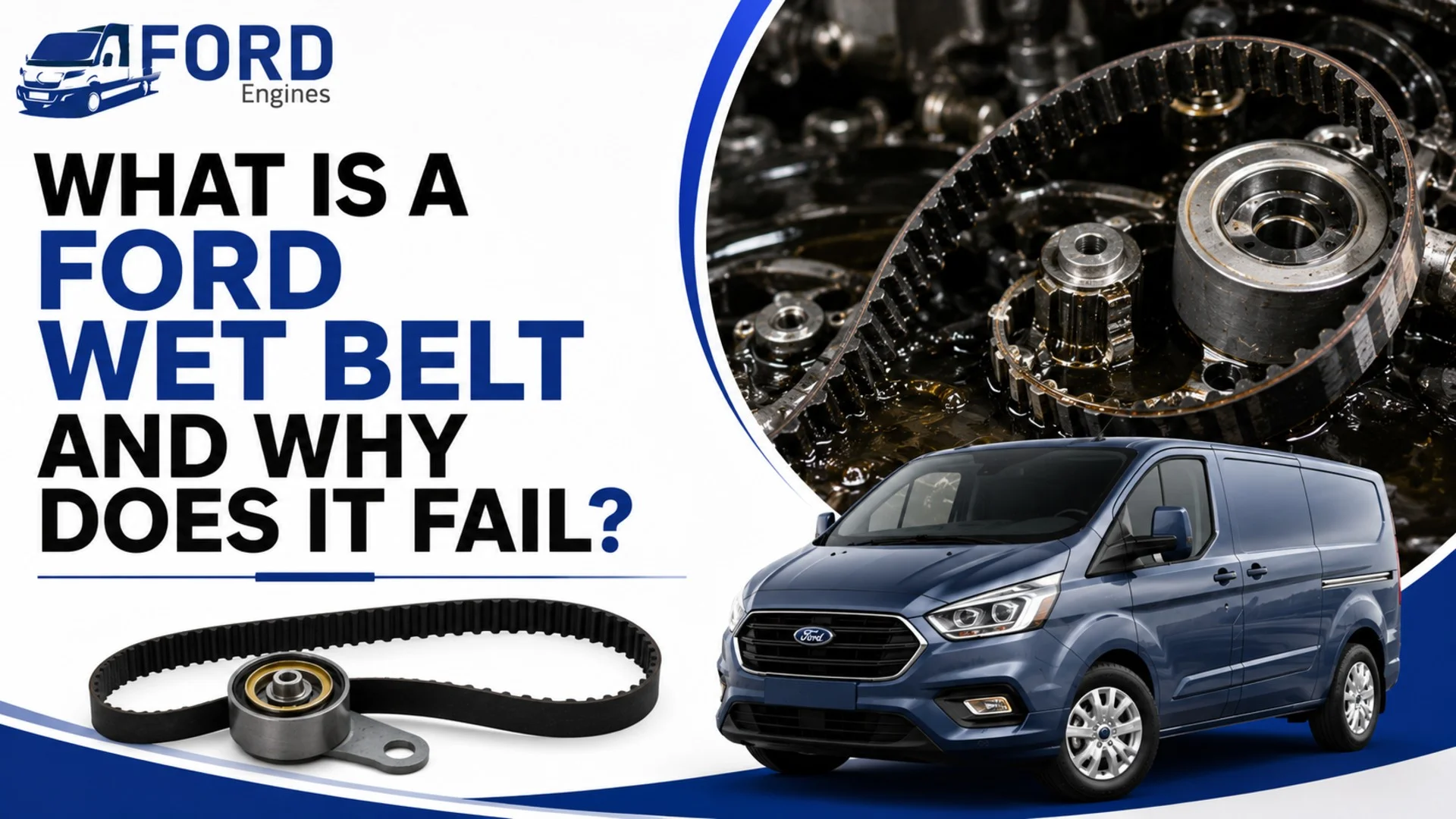
Before you can understand the failure, it helps to understand the system itself, because this isn't a standard timing belt problem. It's an oil system problem wearing a timing belt's clothing.
How Does a Ford Wet Belt (Belt-in-Oil) System Work?
A Ford wet belt, also known as a belt-in-oil (BIO) system, is a timing belt that runs inside the engine, bathed continuously in engine oil rather than sitting in a dry housing driven off the front of the engine.
Ford introduced this design on several engines, including the 1.0 EcoBoost and 2.0 EcoBlue, with the idea that running the belt in oil would reduce friction, improve fuel efficiency, and cut emissions. On paper, it made sense. In the real world, it created a new failure pathway that didn't exist with a conventional dry timing belt or timing chain.
The wet belt drives the camshaft, and in some engines, it also drives the oil pump. That second detail matters enormously, because it means a failing belt doesn't just affect valve timing, it can directly affect oil pressure and lubrication throughout the entire engine.
Because the belt lives inside the sump, in constant contact with engine oil, its condition is directly tied to oil quality, oil temperature, and how well the car has been serviced. This is the core relationship every Ford owner needs to understand:
Ford wet belt → runs in engine oil → oil quality and servicing affect belt condition → rubber deteriorates → debris enters the oil → oil pickup becomes restricted → oil pressure drops → lubrication is compromised → engine components suffer damage.
That chain reaction is why a "belt problem" so often turns into an "engine problem."
What Causes Ford Wet Belt Failure?
Wet belt failure rarely happens out of nowhere. It's almost always the end result of a slow deterioration process, accelerated by specific conditions.
Incorrect Oil, Missed Services & Extended Intervals
The single biggest factor in wet belt longevity is oil. Using the wrong oil specification, or leaving oil in the engine too long, allows the oil to break down and become more aggressive toward the belt's rubber compound.
Common contributing factors include:
- Incorrect oil specification, not all engine oils are approved for wet belt engines, and using the wrong one accelerates belt degradation
- Missed oil changes, degraded oil loses its protective properties and becomes acidic over time
- Extended service intervals, some owners stretch servicing beyond Ford's recommendations to save money, which shortens belt life dramatically
- Fuel dilution, short journeys and stop-start driving can allow unburned fuel to thin the oil, reducing its ability to protect the belt
Vogue of these issues is that they're invisible from the driver's seat. You won't notice oil degradation happening, you'll only notice the consequences once the belt has already started to break down.
Belt Wear, Heat, Age and Mileage
Even with perfect servicing, wet belts have a finite lifespan. Constant exposure to hot engine oil, combined with the mechanical stress of driving the camshaft (and sometimes the oil pump), causes the rubber to gradually crack, stretch, and delaminate.
Key wear factors include:
- Age and mileage, belts degrade over time even with low use, since heat exposure matters as much as distance covered
- Heat cycling, repeated heating and cooling causes the rubber compound to become brittle
- Belt tension changes, as the belt wears, tension can shift, increasing stress on the tensioner and belt teeth
- Material breakdown, the rubber coating can shed small particles long before a full failure occurs
This is why Ford specifies a replacement interval in the first place, the belt is a service item, not a "lasts forever" component, and treating it otherwise is where most catastrophic failures begin.
What Are the Warning Signs of Ford Wet Belt Failure?
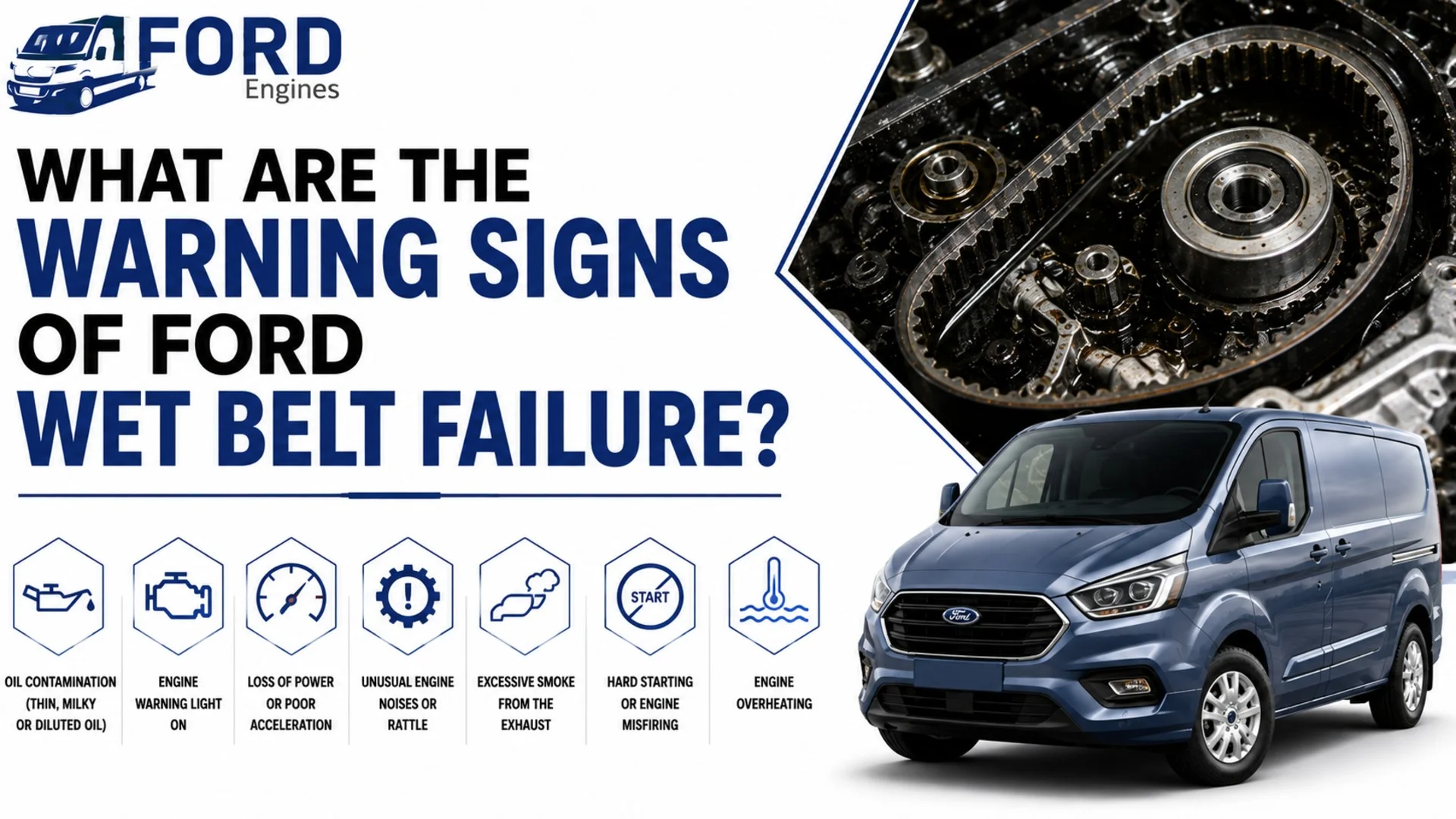
Not every symptom means your engine is already damaged, but every symptom deserves attention. The earlier you catch wet belt deterioration, the cheaper and simpler the fix.
Early Warning Signs of a Failing Wet Belt
At this stage, the belt is deteriorating but the engine hasn't suffered lasting damage yet. This is the ideal window for intervention.
- Unusual rattling noise from the front of the engine, especially on cold starts
- Contaminated or discoloured oil on the dipstick, sometimes with a slightly gritty texture
- Small rubber particles visible on the dipstick or during an oil change
- Service interval concerns, if your car is approaching or has exceeded Ford's recommended interval without a belt check
If any of these apply to your Ford, booking a wet belt inspection now is significantly cheaper than waiting for a warning light.
Advanced Wet Belt Failure Symptoms
At this stage, belt material has started entering the oil system in meaningful quantities, and oil flow may already be partially restricted.
- Oil pressure warning light appearing intermittently or persistently
- Rough running or misfires, particularly at idle
- Loss of performance or hesitation under acceleration
- Engine management warning light, sometimes with timing-related fault codes such as P0016 DPF or P0017
- Increased rubber debris in the oil, visible during inspection
A vehicle showing these symptoms should not be driven further than necessary. This is the stage where a same-week diagnostic appointment can be the difference between a belt replacement and an engine rebuild.
Signs the Engine Has Already Suffered Damage
Unfortunately, some owners only discover a wet belt problem after damage has already occurred. These are the signs that the failure has moved beyond the belt itself.
- Engine knocking or heavy mechanical noise
- Sudden loss of oil pressure
- Engine seizure or stalling that won't restart
- Timing failure, where the camshaft and crankshaft fall out of sync
- Non-starting engine following a warning light that was ignored
If your Ford has reached this point, driving it further can turn a repairable fault into a total engine loss. This is exactly why we always recommend treating early symptoms seriously rather than "waiting to see."
Ford EcoBoost Wet Belt Failure Symptoms
The 1.0 EcoBoost wet belt drives the camshaft. Owners typically report early symptoms as a light rattle on startup, followed by oil contamination if the issue isn't addressed. Because this is a smaller, high-revving engine, belt debris can circulate quickly once it enters the oil system, so EcoBoost owners are advised not to delay inspection once symptoms appear.
Ford EcoBlue Wet Belt Failure Symptoms
The 2.0 EcoBlue system is a bigger concern for many specialists, because on several applications the wet belt also drives the oil pump. That means belt failure on an EcoBlue engine doesn't just risk timing, it can cause an immediate and severe drop in oil pressure, since the pump itself may stop turning correctly. This is one of the reasons Transit, Transit Custom, and Ranger owners are seeing some of the most expensive repair bills in the wet belt category.
How Much Does Ford Wet Belt Replacement Cost, and Is It Worth Repairing?
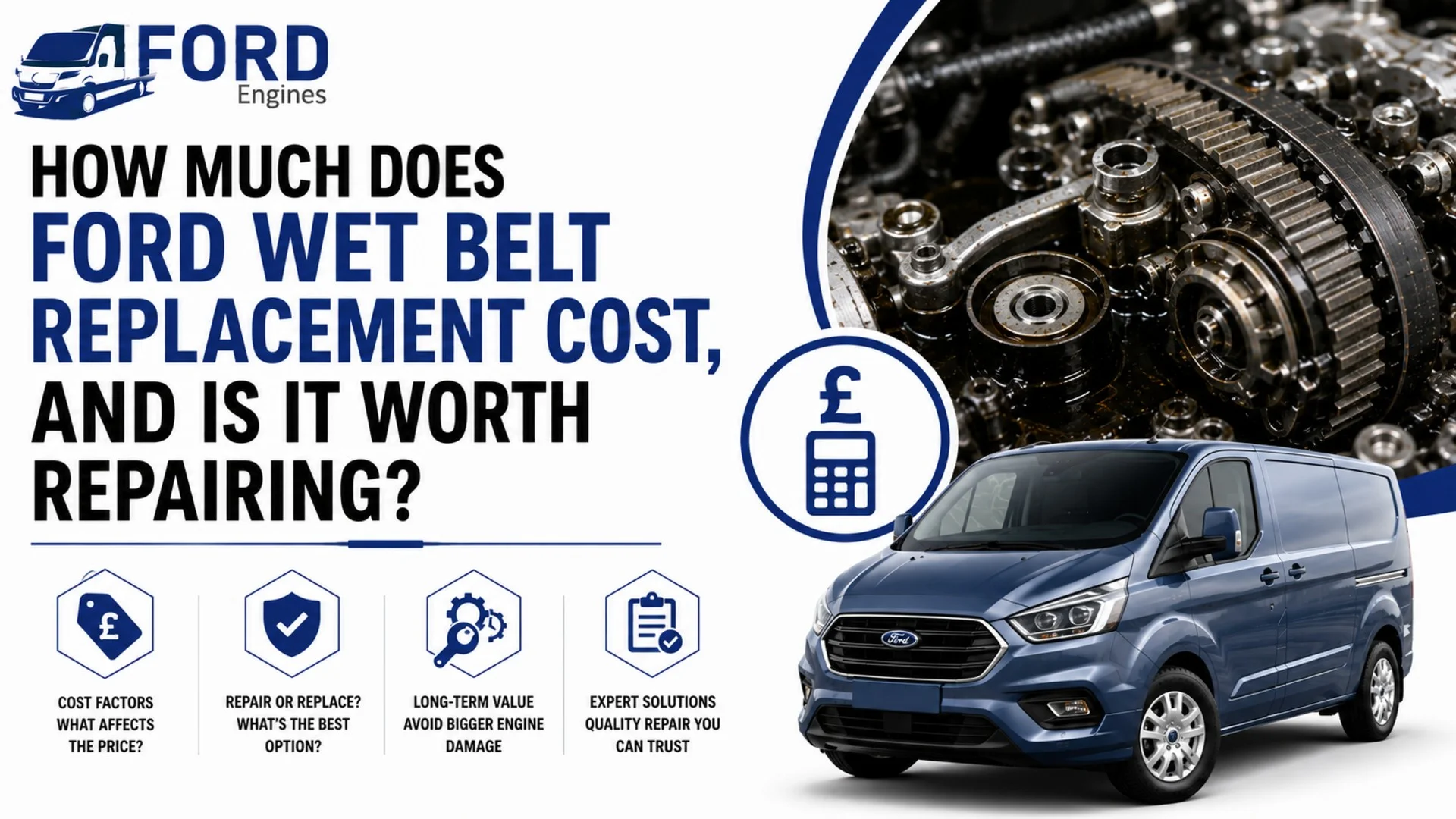
This is the question most owners are really searching for, and the honest answer depends entirely on how early the problem is caught.
Ford Wet Belt Replacement Cost in the UK
A straightforward, preventative wet belt replacement, done before failure, as part of scheduled maintenance, is a planned repair involving the belt kit, oil pump belt (where applicable), tensioner, oil, and filter, plus the labour to access and reassemble the timing system.
A wet belt replacement carried out after failure is a different story entirely, because it typically requires:
- Sump removal and cleaning to clear rubber debris
- Oil pickup and strainer inspection or replacement
- Full engine oil and filter change
- Timing correlation checks to confirm no lasting damage
- Assessment for bearing, valve, or piston damage if oil starvation occurred
Scenario | What's Typically Involved | Relative Cost |
| Preventative replacement (before failure) | Belt kit, oil pump belt, tensioner, oil & filter | Lower, planned maintenance cost |
| Post-failure replacement (belt damaged, engine intact) | Sump removal, pickup cleaning, belt replacement, full oil service | Moderate, includes cleanup labour |
| Post-failure with engine damage | Above, plus bearing, valve, or turbo repair, possible partial rebuild | High, can approach engine rebuild pricing |
| Catastrophic failure (seizure/timing failure) | Full engine rebuild or replacement | Highest, often exceeds vehicle value on older cars |
The pattern is consistent across every Ford wet belt case we assess: the cost multiplies at every stage you wait. A belt replaced on schedule is routine maintenance. A belt replaced after the oil pressure light comes on is a repair job. A belt that's already caused engine damage is a rebuild, and sometimes a write-off decision.
Wet Belt Replacement vs Full Engine Rebuild or Replacement
Owners often ask whether it's worth repairing a van or car after wet belt failure, especially on higher-mileage vehicles. The honest answer depends on three things: how far the damage has spread, the vehicle's overall condition, and what it's worth once repaired.
- If caught early (belt deteriorating but no debris-related oil pressure loss): replacement almost always makes financial sense
- If oil starvation has occurred but bearings and timing are intact: repair is usually still worthwhile, especially on newer or lower-mileage vehicles
- If the engine has seized or suffered internal damage: a rebuild or replacement engine may be more cost-effective than chasing individual component repairs
- If the vehicle is older with high mileage: it's worth getting a proper diagnostic before committing, since the repair cost needs to be weighed against the vehicle's market value
A proper diagnostic assessment, not a guess, is the only reliable way to know which category your vehicle falls into.
Which Ford Models Are Most Affected by Wet Belt Problems?
Wet belt issues aren't limited to one model or one engine size. They span Ford's petrol and diesel ranges, though the exact belt arrangement differs by engine.
Ford Transit & Transit Custom Wet Belt Problems
The 2.0 EcoBlue engine used across the Transit, Transit Custom, and Ranger has drawn particular attention because of the oil-pump-driven belt design. Commercial vehicles also tend to rack up high mileage quickly, and van servicing is sometimes deprioritised against operational demands, a combination that makes wet belt failure more common in fleet and trade vehicles than many owners expect.
Ford Fiesta, Focus & Puma Wet Belt Problems
The 1.0 EcoBoost, fitted across the Fiesta, Focus, Puma, EcoSport, B-Max, and C-Max, is the most widely used wet belt engine on the road. Its popularity means it's also what the engine specialists see most often for wet belt inspections and replacements, particularly on vehicles bought used without full service history.
How Do You Get Your Ford Wet Belt Diagnosed and Fixed?
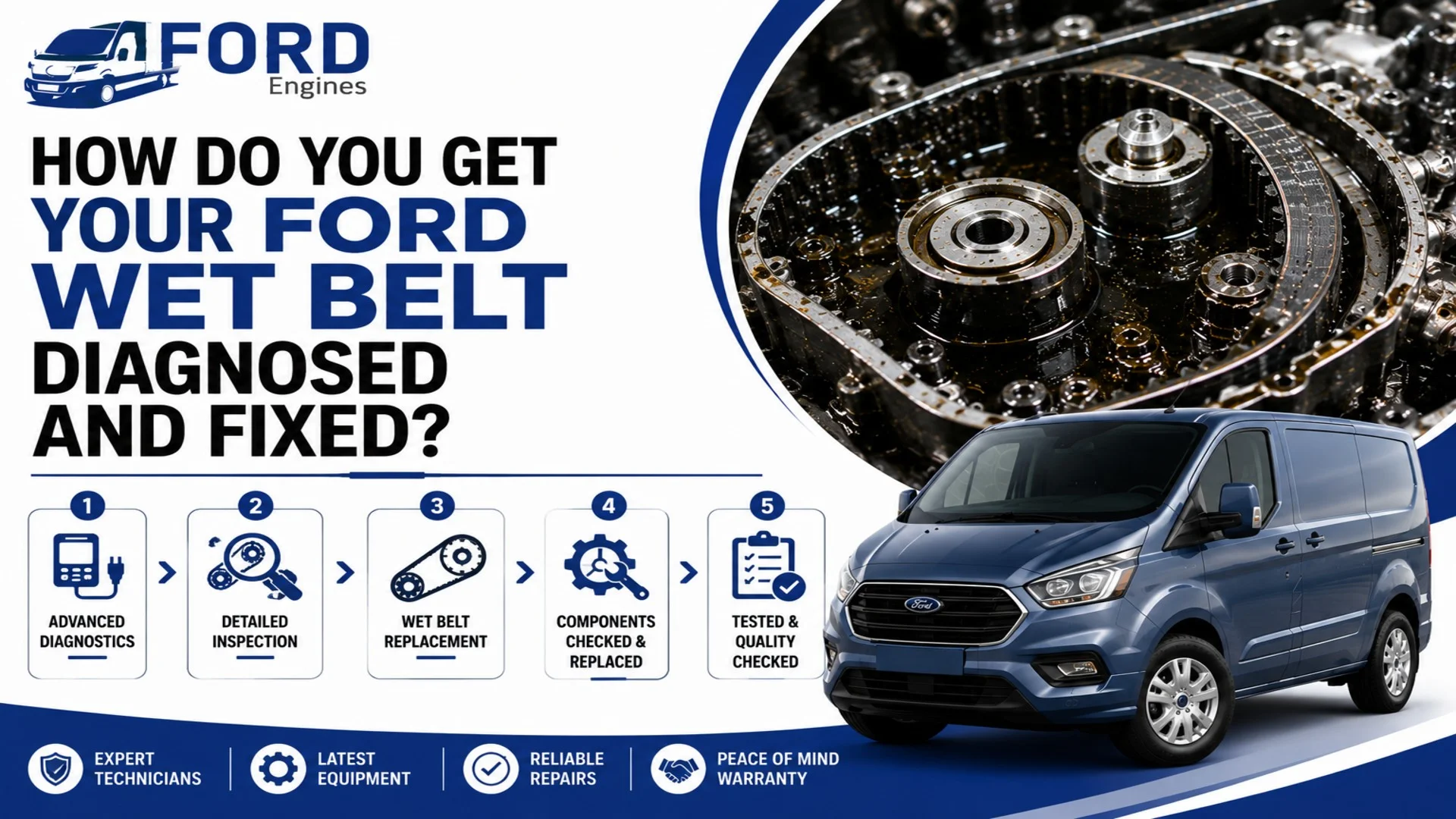
Once you suspect a wet belt issue, the process you follow matters just as much as how quickly you act. A rushed or incomplete diagnosis can miss early-stage damage that resurfaces later.
Our Ford Wet Belt Diagnostic Process
At Ford Engines, we treat wet belt diagnosis as a full investigation, not a quick look under the bonnet. Our process typically includes:
- Customer symptom review, understanding what you've noticed, when it started, and under what conditions
- Diagnostic scan, checking for timing-related fault codes and oil pressure sensor data
- Oil pressure testing, confirming whether pressure is within Ford's specified range
- Oil and filter inspection, checking for rubber particles, discolouration, or debris
- Sump and oil pickup inspection, identifying any blockage or restriction at the strainer
- Wet belt condition assessment, physically checking the belt for cracking, wear, or delamination
- Timing correlation testing, confirming the camshaft and crankshaft remain correctly synchronised
- Compression testing where necessary, to rule out internal mechanical damage
- Full damage assessment, establishing whether the repair is a belt replacement or something more extensive
This structured approach means you get a clear, honest answer about what's actually wrong, and a fixed-price quote based on evidence, not guesswork.
Book a Ford Wet Belt Inspection or Replacement
If your Ford is showing any of the symptoms covered in this guide, a rattle on startup, an oil pressure warning, or debris in the oil, the safest next step is a proper inspection before you drive it any further than necessary.
Whether you're dealing with a 1.0 EcoBoost Fiesta, a 2.0 EcoBlue Transit, or any other wet belt–equipped Ford, our team can diagnose the issue accurately and provide a fixed-price repair or replacement quote. Related services, including Ford EcoBlue engine problems, Ford EcoBoost engine problems, Ford engine rebuilds, and Ford engine replacement, are also available if diagnosis reveals damage beyond the belt itself.
Ford Wet Belt Failure FAQs
What is a Ford wet belt?
A Ford wet belt, or belt-in-oil system, is a timing belt that runs submerged in engine oil rather than in a dry, external housing. It's used on engines including the 1.0 EcoBoost and 2.0 EcoBlue.
What causes Ford wet belt failure?
The main causes are incorrect engine oil, missed or extended service intervals, oil degradation, fuel dilution, and normal wear from heat and mileage over time.
What are the symptoms of Ford wet belt failure?
Common symptoms include a rattling noise on startup, an oil pressure warning light, rough running, rubber debris in the oil, loss of performance, and in severe cases, engine knocking or seizure.
Can you drive with a failing Ford wet belt?
It's not advisable. Once symptoms like an oil pressure warning or unusual noise appear, continuing to drive risks turning a belt repair into an engine rebuild.
How much does Ford wet belt replacement cost?
Cost depends heavily on timing. A preventative replacement is a routine maintenance cost, while a post-failure repair involving sump cleaning and debris removal costs more, and cases involving engine damage can approach full rebuild pricing.
How long does a Ford wet belt last?
Lifespan varies by engine and usage, but Ford specifies a recommended replacement interval for each model. Beyond that interval, the risk of failure increases significantly, especially with poor servicing history.
Can a wet belt failure damage the engine?
Yes. Because the belt drives the camshaft, and in some engines, the oil pump, failure can lead to debris blocking the oil pickup, causing low oil pressure, oil starvation, and damage to bearings, valves, or pistons.
Is a wet belt the same as a timing chain?
No. A timing chain is a metal component designed to last the life of the engine, while a wet belt is a rubber belt with a defined service interval, despite running inside the oil system.
Final Thoughts: Don't Wait for the Warning Light
Ford wet belt failure is one of those problems that's completely manageable when caught early, and expensive when it isn't. The belt itself is a routine service item, it's ignoring it that turns a straightforward job into an engine rebuild.
If your Ford is due a service, approaching its recommended interval, or showing any of the warning signs covered above, don't wait for the oil pressure light to make the decision for you.
Get in touch with Ford Engines today to book a wet belt inspection, diagnostic assessment, or fixed-price replacement, and protect your engine before a small problem becomes a very expensive one.