

If you've just heard the words "wet belt" for the first time, probably from a mechanic, a forum thread, or a worried Google search after your Ford started making a strange noise, you're not alone. Thousands of Ford owners across the UK are asking the same question right now: does my Ford have a wet belt, and should I be worried?
The short answer is: it depends entirely on your exact model, engine, and build year. Not every Ford has one. Not every EcoBoost has one. And two Fords that look identical on the outside can have completely different timing systems under the bonnet.
This guide gives you a clear, no-nonsense way to check your own vehicle, understand what a wet belt actually is, spot the warning signs of failure early, and know what to do next, whether that's routine servicing or booking a proper inspection.
How Do I Check If My Ford Has a Wet Belt?
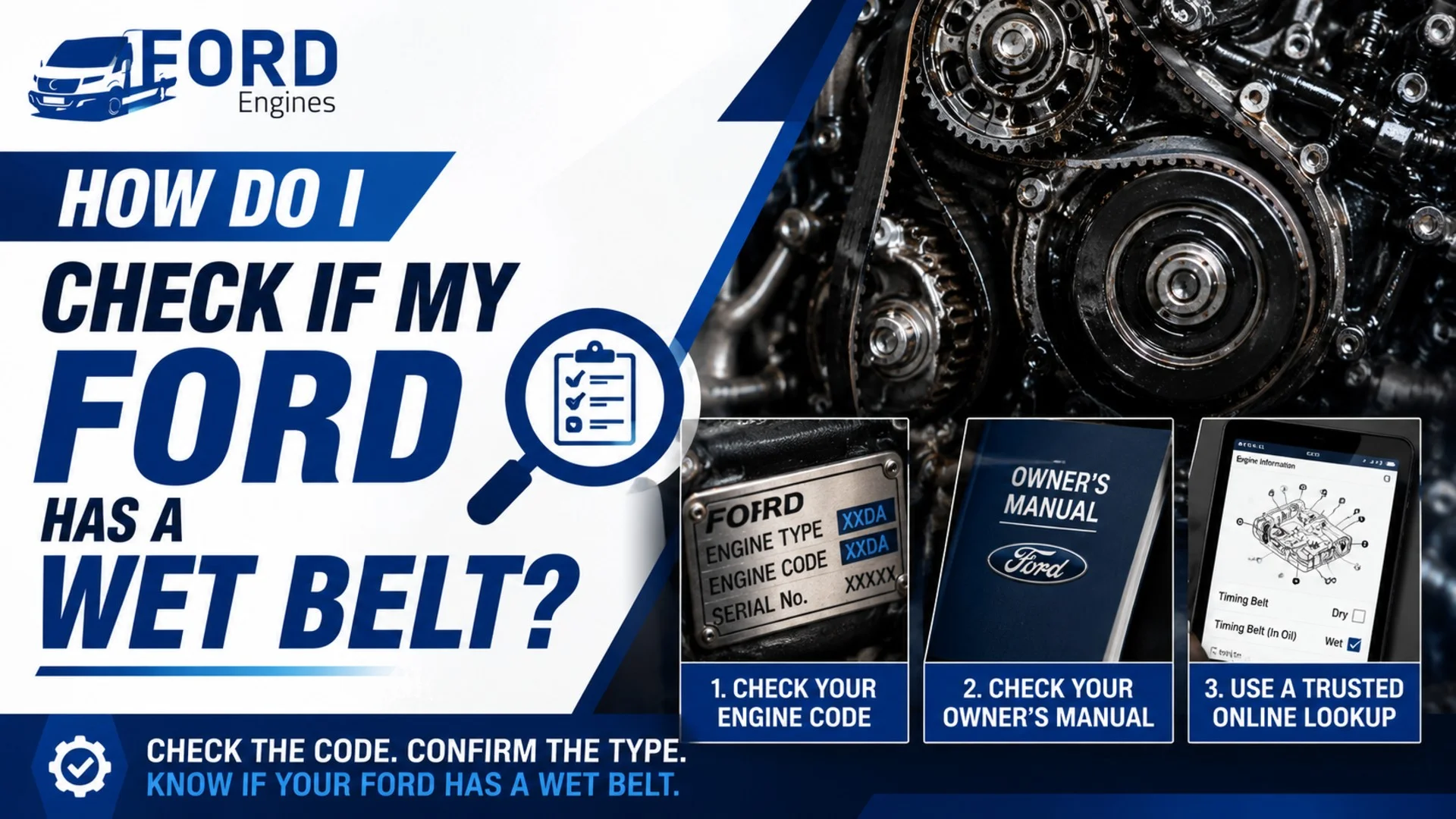
Before we get into engine codes and model years, let's answer the question you actually came here for.
A wet belt is a timing belt that runs inside the engine, submerged in engine oil, rather than sitting outside the engine like a traditional dry timing belt. Ford introduced wet belt technology on several EcoBoost and EcoBlue engines from around 2018 onwards, mainly to reduce friction and improve fuel efficiency.
The problem is that unlike a timing chain, which can last the life of the engine, or a dry belt, which is easy to inspect, a wet belt sits hidden inside the engine oil where you can't see it, and it doesn't come with a dashboard warning until something has already started to go wrong.
Here's how to actually check whether your car is affected.
Check by Ford Model
Start with the basics: what model is your Ford, and roughly when was it built? Certain models, particularly the Fiesta, Focus, Puma, Kuga, Transit, Transit Custom, and Ranger, have used wet belt engines in at least some of their production years. Others haven't used the technology at all.
Check by Engine Size and Code
Your model alone won't give you a definitive answer, the engine does. Pop the bonnet and look for the engine code, usually found on a sticker under the bonnet or stamped on the engine block itself. Ford's wet belt engines are almost entirely limited to the 1.0 EcoBoost, 1.5 EcoBoost, 1.5 EcoBlue, and 2.0 EcoBlue engine families.
Check by Registration or VIN
The most reliable way to check is by your registration number or VIN (vehicle identification number). Your V5C logbook lists your exact engine code, and that code can be cross-referenced against Ford's known wet belt engine list. This removes any guesswork that comes from relying on model names alone.
Why Model Alone Isn't Enough, Year and Spec Matter Too
This is the part most guides get wrong, and it's worth repeating clearly: the same Ford model can have a completely different timing system depending on the year and specification.
Example: Same Model, Different Timing System by Year
Take the Ford Kuga as a real-world example. A 2018 Kuga fitted with a 1.5 EcoBoost engine may use a dry timing belt, while a newer Kuga with a revised 1.5 EcoBoost setup could use a timing chain instead, not a wet belt at all. Meanwhile, a Fiesta or Focus from a similar era with the smaller 1.0 EcoBoost engine is far more likely to be running a wet belt.
The lesson here is simple: never assume based on the model badge alone. Always confirm using your engine code or VIN, and if you're unsure, a specialist can check it for you in minutes.
Which Ford Engines and Models Have a Wet Belt?
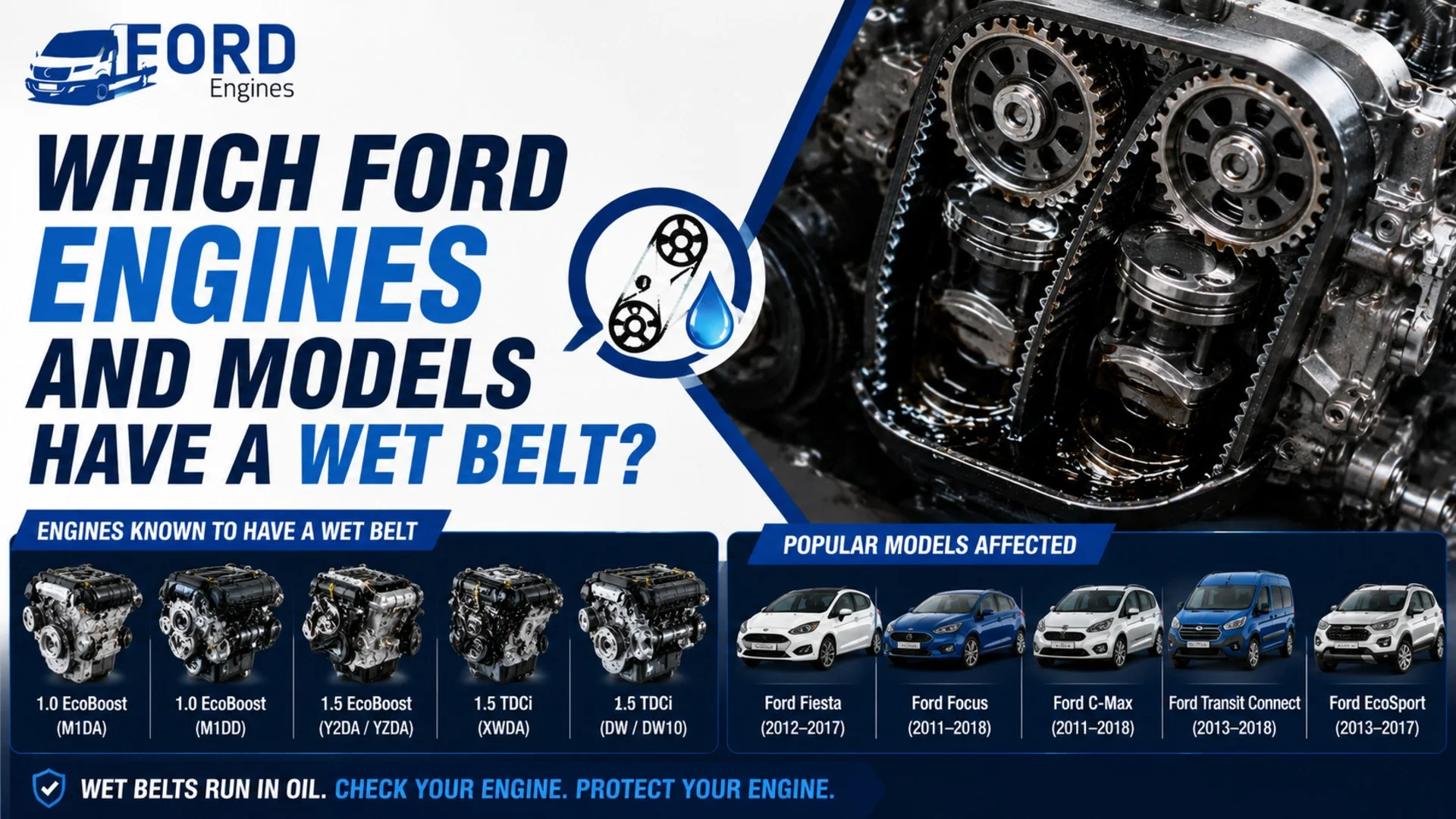
Once you know your engine code, this section gives you the full picture, which Ford engines use wet belts, which models they're fitted to, and how they differ from Ford's other timing systems.
Ford Wet Belt Models by Engine and Year
Rather than giving you a vague list of "affected models," here's a clearer breakdown by engine, since that's what actually determines your timing system.
Model | Common Engine(s) | Typical Years | Timing System | Notes |
| Fiesta | 1.0 EcoBoost | 2012–2023 | Wet belt (most variants) | Widely reported wet belt engine |
| Focus | 1.0 EcoBoost / 1.5 EcoBoost | 2015–2023 | Wet belt (varies by spec) | Check engine code carefully |
| Puma | 1.0 EcoBoost (incl. MHEV) | 2019–present | Wet belt | Some MHEV variants differ slightly |
| Kuga | 1.5 EcoBoost | 2013–present | Varies, dry belt or chain in some years | Confirm by engine code, not model alone |
| Transit / Transit Custom | 2.0 EcoBlue | 2016–present | Wet belt | Also uses a separate oil pump belt |
| Ranger | 2.0 EcoBlue | 2019–present | Wet belt | Common in commercial fleet vehicles |
| Mondeo | 1.5 EcoBoost / 2.0 EcoBlue | 2014–2022 | Varies by engine | Diesel variants more likely to have wet belt |
This table is a general guide, not a final verdict on your specific car, think of it as a starting point that narrows things down, with your engine code or VIN check confirming the details.
Does My Ford EcoBoost Have a Wet Belt?
The EcoBoost range is Ford's turbocharged petrol engine family, and it's where the majority of wet belt reports come from.
1.0 EcoBoost
The 1.0-litre EcoBoost, sometimes nicknamed the "Fox" engine, is the most widely discussed wet belt engine in Ford's petrol lineup. It's been fitted across the Fiesta, Focus, Puma, EcoSport, B-Max, C-Max, and Transit Connect. If your Ford has this engine, there's a strong chance it uses a wet belt, but always confirm with your specific engine code, since minor revisions exist.
1.5 EcoBoost
The larger 1.5 EcoBoost, found in models like the Focus, Kuga, and Mondeo, is more inconsistent. Some versions use a wet belt, others use a timing chain, and earlier examples may use a conventional dry belt. This is exactly the kind of situation where checking by engine code rather than model name really matters.
Does My Ford EcoBlue Have a Wet Belt?fB-Max
EcoBlue is Ford's modern diesel engine family, replacing the older TDCi range, and it's heavily used in vans and larger models.
1.5 EcoBlue
Found in smaller diesel Fiestas, Focuses, and Pumas, the 1.5 EcoBlue has also been associated with wet belt designs in certain configurations.
2.0 EcoBlue
The 2.0 EcoBlue is Ford's workhorse diesel engine, powering the Transit, Transit Custom, and Ranger. It's strongly associated with wet belt technology, and importantly, it also uses a separate oil pump belt, another wet, oil-submerged component that can fail independently of the main timing belt and is often overlooked during inspections.
Ford Wet Belt vs Dry Timing Belt vs Timing Chain
Understanding how these three systems differ makes it much easier to understand why wet belts get so much attention.
Timing System | Location | Lubrication | Typical Concern |
| Wet belt | Inside the engine | Runs in engine oil | Belt degradation and rubber debris contaminating the oil |
| Dry belt | Outside the engine | No oil contact | Wears with age and mileage, but easy to inspect visually |
| Timing chain | Inside the engine | Runs in engine oil | Chain stretch and tensioner wear over very high mileage |
The key difference isn't just location, it's visibility. A dry belt can be inspected by eye. A wet belt cannot, since it's hidden inside the oil, which is precisely why so many wet belt failures come as a surprise to owners who assumed everything was fine because there was no obvious warning light.
What Are the Signs of a Failing Ford Wet Belt?
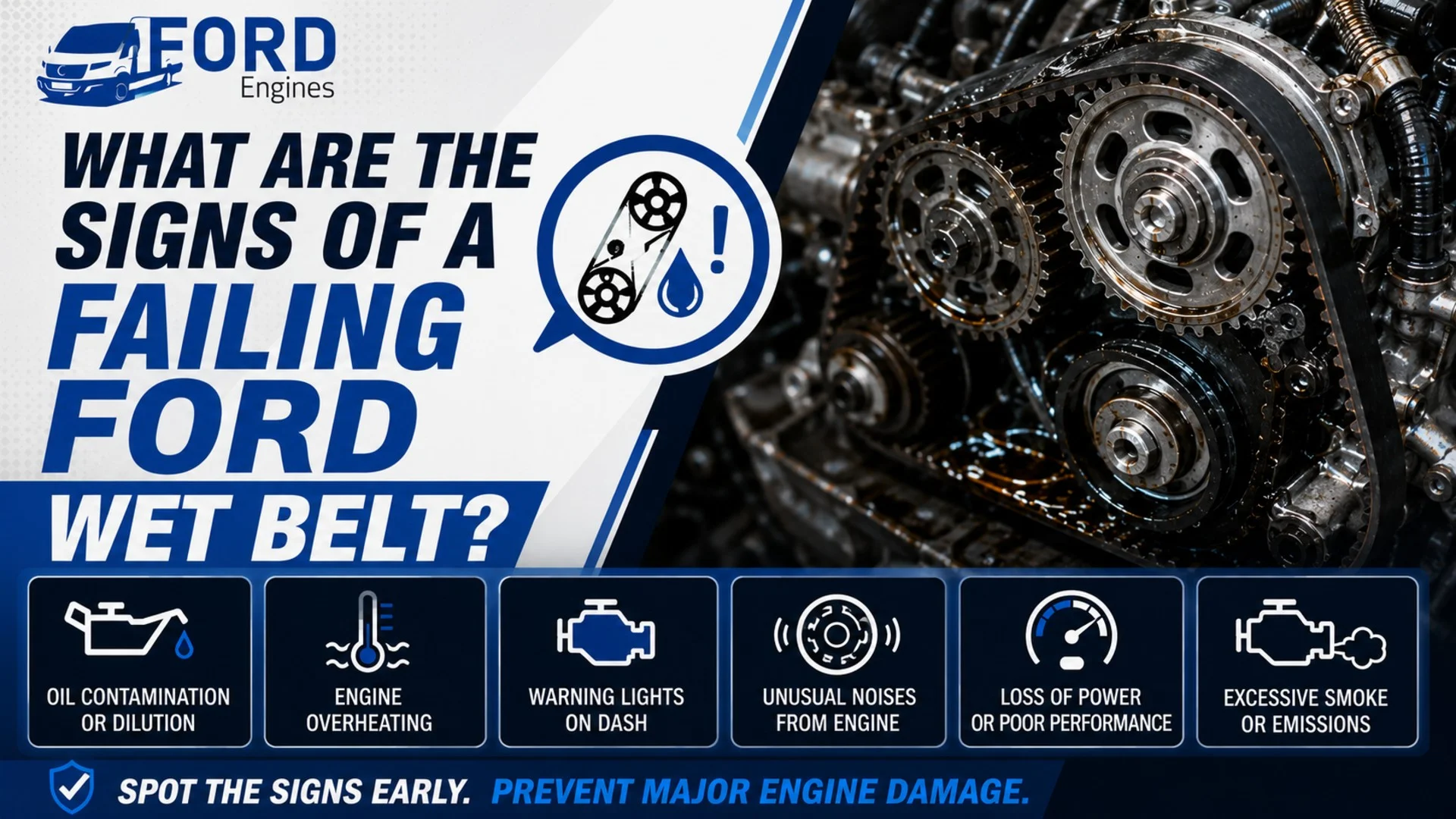
Wet belt failure rarely happens without warning, the trouble is that the warning signs are easy to dismiss as "just an old car noise" until it's too late.
- Rattling or ticking noise on startup, often the earliest sign, caused by the belt beginning to degrade and slap against internal components before oil pressure builds fully.
- Low oil pressure warning light, rubber particles shedding from the belt can block the oil pickup or partially clog the oil pump, starving the engine of lubrication.
- Rubber debris or oil contamination, visible black rubber flecks in the oil during an oil change are a strong indicator the belt is breaking down internally.
- Loss of power or rough running, as the belt wears unevenly, engine timing can shift slightly, causing misfires or a noticeable drop in performance.
- Check engine light or difficult starting, the engine management system may detect timing irregularities before you notice any physical symptoms.
If you're hearing any of these, don't wait for it to get worse. A rattle today can become a much bigger repair bill next week.
What Happens If a Ford Wet Belt Fails Completely?
This is the part that makes wet belt failure genuinely serious, rather than just an annoying repair. If the belt snaps or the debris blocks oil flow to the point of oil starvation, the engine can suffer catastrophic damage, bent valves, piston damage, or complete timing failure. In many cases, this means a full engine rebuild or replacement rather than a straightforward repair, which is why early detection matters so much.
When Should a Ford Wet Belt Be Replaced, and What's the Cost?
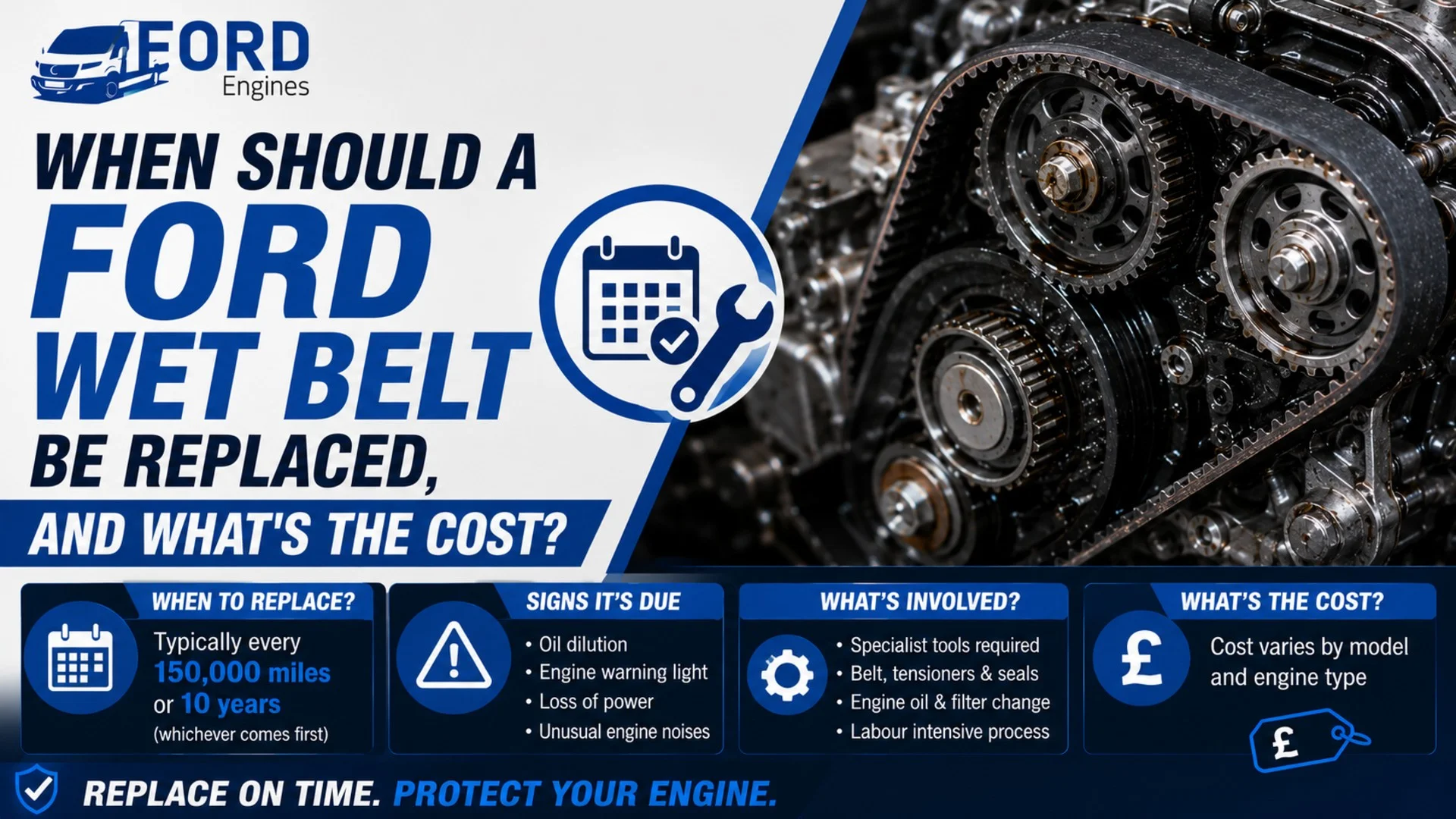
Prevention is always cheaper than repair, and this is especially true with wet belts.
Recommended Ford Wet Belt Replacement Interval
Ford's official guidance varies by engine and model, but as a general rule, most wet belt engines are recommended for replacement somewhere between 100,000 to 150,000 miles, or roughly every 10 years, whichever comes first. However, many independent Ford specialists recommend earlier replacement, particularly for vehicles used for lots of short journeys or stop-start driving, since this type of use accelerates belt wear.
Always check your specific vehicle's handbook or service history, since intervals differ between the 1.0 EcoBoost, 1.5 EcoBoost, and EcoBlue diesel ranges.
Can the Wrong Engine Oil Damage a Wet Belt?
Yes, and this is one of the most overlooked causes of premature wet belt failure. Because the belt runs directly in the engine oil, using the wrong oil specification, or leaving oil changes too long, accelerates belt degradation. Always use the exact oil grade specified by Ford for your engine, and stick closely to recommended service intervals. This single habit can meaningfully extend the life of your wet belt.
How Much Does Ford Wet Belt Replacement Cost?
Costs vary depending on your engine, labour rates, and whether any additional damage has occurred, but as a general guide:
- 1.0 EcoBoost wet belt replacement typically involves several hours of labour due to the belt's internal position within the engine, plus parts and a full oil service.
- 2.0 EcoBlue wet belt replacement tends to cost more, partly because of the additional oil pump belt that's often replaced at the same time.
- Early inspection or preventative replacement is significantly cheaper than repairing the aftermath of a snapped belt or oil starvation, which can run into engine rebuild territory.
For an accurate, no-obligation quote based on your exact model, engine, and mileage, it's always worth speaking directly to a specialist rather than relying on generic online estimates.
Why Book Your Wet Belt Check with Ford Engines UK
At Ford Engines UK, we work specifically with Ford's EcoBoost and EcoBlue engine ranges day in, day out. We know which models and engine codes are genuinely at risk, we know the early warning signs before they become expensive problems, and we use the correct Ford-specified parts and oil for every wet belt replacement we carry out.
Whether you're not sure if your car even has a wet belt, you've noticed an unusual rattle, or you're simply due for a preventative check, our team can confirm your exact engine specification and advise honestly on what, if anything, needs doing.
Get a Free Ford Wet Belt Inspection Quote
Don't wait for a warning light to tell you something's wrong. Get in touch with our team today for a free, no-obligation wet belt check and quote, tailored to your exact Ford model, engine, and mileage.
Frequently Asked Questions About Ford Wet Belts
Does my Ford have a wet belt or a timing chain?
It depends on your exact engine code rather than your model alone. Many 1.0 EcoBoost and 2.0 EcoBlue engines use a wet belt, while some 1.5 EcoBoost variants use a timing chain instead. Checking your V5C or engine code is the most reliable way to confirm.
How do I know if my Ford has a wet belt?
Check your engine code under the bonnet or on your V5C logbook, then compare it against Ford's known wet belt engine list. If you're unsure, a Ford specialist can confirm it for you quickly.
Does my Ford Fiesta have a wet belt?
Most Fiestas fitted with the 1.0 EcoBoost engine use a wet belt, though it's worth confirming your exact engine code, as minor variations exist across production years.
Does my Ford Focus have a wet belt?
It depends on the engine fitted. Focuses with the 1.0 EcoBoost are commonly wet belt engines, while some 1.5 EcoBoost and diesel variants may differ.
Does my Ford Puma have a wet belt?
Yes, most Puma models with the 1.0 EcoBoost engine, including mild-hybrid (MHEV) variants, use a wet belt design.
Does my Ford Transit have a wet belt?
Transits fitted with the 2.0 EcoBlue diesel engine typically use a wet belt, along with a separate oil pump belt that also runs submerged in oil.
How much does Ford wet belt replacement cost?
Costs vary by engine and labour rates, with 2.0 EcoBlue replacements generally costing more than 1.0 EcoBoost replacements due to additional components like the oil pump belt. Getting a quote based on your specific vehicle is the best way to know the exact cost.
Is Ford wet belt replacement covered by warranty?
This depends on your vehicle's age, mileage, and whether it's still within Ford's manufacturer warranty or covered by an extended warranty. Older vehicles outside warranty will typically need to cover replacement costs directly, which is another reason preventative servicing is worth considering.
What happens if I ignore a failing wet belt?
Ignoring early warning signs like rattling noises or low oil pressure can lead to complete belt failure, which risks serious engine damage, including bent valves or a full engine rebuild.
Final Thoughts: Don't Guess, Check
Wet belt problems have earned a lot of attention online, and rightly so, but that doesn't mean every Ford is affected, and it doesn't mean yours is doomed if it does have one. What matters most is knowing exactly what you're dealing with, staying on top of servicing, and catching early warning signs before they turn into major repairs.
If you're still unsure whether your Ford has a wet belt, or you've noticed any of the symptoms covered above, don't leave it to chance. Get in touch with Ford Engines UK today for a straightforward, specialist check of your exact model and engine, and drive with confidence, knowing exactly what's under your bonnet.