
Your Focus is losing coolant. Or the Kuga is misfiring on a cold start and the warning light has come back for the third time. Or a garage has told you the engine is finished and you want to know whether that's true before you spend thousands.
Whatever brought you here, the first step is the same: work out exactly which Ford 1.5 EcoBoost engine you have.
That matters because there isn't just one. Ford has used the "1.5 EcoBoost" name on a four-cylinder turbo petrol engine (Focus, Kuga, C-Max, Mondeo, S-Max, Galaxy) and, later, on a mechanically different three-cylinder engine (Fiesta ST, Puma ST and newer Focus applications). The timing system, service needs, common faults and replacement engine are not the same for both, and many online guides blur them together.
This guide separates them properly. You'll learn how to identify your engine code, what tends to go wrong and why, how the timing system works, and when replacement is the smarter option than repair. If you'd rather skip ahead, send us your registration or engine code for a compatibility check on.
Which Ford 1.5 EcoBoost Engine Do You Have: 3-Cylinder or 4-Cylinder?
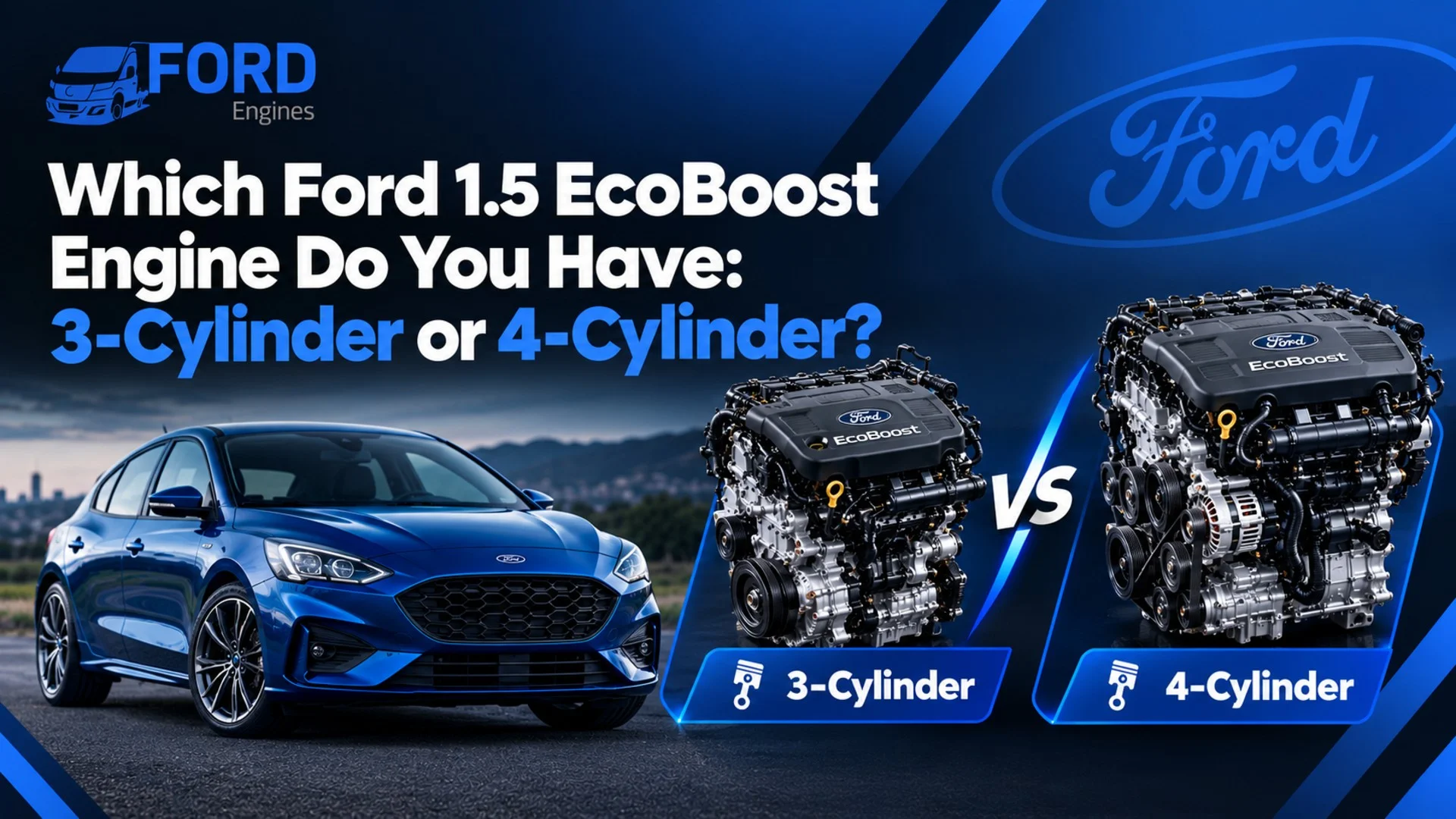
The short answer: the older Ford 1.5 EcoBoost is a 1,498cc inline four-cylinder turbocharged petrol engine with direct injection, DOHC and variable cam timing, producing 120, 150 or 182 PS in Ford's published Kuga specifications. The newer 1.5 EcoBoost is a three-cylinder unit in a different engine family. Same badge and capacity, different engine.
This is the mistake we see most often. Someone reads about a "1.5 EcoBoost cambelt" or "1.5 EcoBoost coolant problems", assumes it applies to their car, and either worries unnecessarily or misses a genuine issue.
Here's a simplified comparison:
1.5 EcoBoost 4-cylinder | 1.5 EcoBoost 3-cylinder | |
| Layout | Inline four, 1,498cc turbo petrol | Inline three, 1.5L turbo petrol |
| Typical outputs | 120, 150, 160 and 182 PS | Roughly 150 to 200 PS depending on model |
| Typical models | Focus, Kuga, C-Max, Grand C-Max, Mondeo, S-Max, Galaxy | Fiesta ST, Puma ST, later Focus applications |
| Timing system | Check by engine code (see below) | Different arrangement, check by engine code |
| Sourcing a replacement | Must match code and model year | Must match code and model year |
One more distinction is worth knowing. North American cars such as the Ford Escape and Fusion also carry a 1.5 EcoBoost, and much of the online complaint data comes from those markets. Some of it is relevant to UK owners and some isn't, so check which version any article is actually describing.
How Do I Find My Ford 1.5 EcoBoost Engine Code?
You don't need to open the bonnet with a torch. Try these in order:
- V5C logbook: some entries list the engine size and fuel type, though not always the full code.
- Engine bay label or block stamping: the code is often stamped on the block or printed on a label, but access varies by model.
- VIN check: a dealer or specialist can decode your VIN to identify the engine fitted at build.
- Send us your registration: we can match it to the right unit and confirm compatibility before you commit to anything.
Common codes you'll see in the four-cylinder range include M8DA, M8DB, M9DA, M9DB, M8MA and M9MA, with the 160 PS Mondeo appearing under the UNCA/UNCB family. Three-cylinder codes such as M1DA and M1DH appear on Fiesta ST and Focus applications. [Confirm every code, output and model pairing against your stock records before publishing.]
Why does this matter so much? Two engines that look identical on a listing can differ in ancillaries, ECU calibration and mounting points. A replacement engine that's "close enough" can mean a repeat job, a warranty dispute or a car that won't run properly. Always match the vehicle year, model, engine code and cylinder configuration.
Quick scenario: an owner finds a cheap 1.5 EcoBoost engine for their Focus, but the listing doesn't state the code. The engine turns out to be the 3-cylinder from a newer car. That's a wasted week and a bill for return transport. A code check first takes minutes.
Does the Ford 1.5 EcoBoost Have a Timing Belt or a Timing Chain?
It depends on which engine you have, which is why a single-line answer online is usually wrong.
Current UK sources describe the four-cylinder 1.5 EcoBoost applications as using a belt-driven timing system (a "dry" belt, not one running in oil). Later three-cylinder versions use a different arrangement, and the design has to be confirmed by engine code. A "wet belt" runs in engine oil, which changes how it ages and how it should be serviced.
Here's the type of matrix you should confirm for your own car:
| Engine code | Cylinders | Service note | ||
| M8DA / M8DB | 4 | Follow Ford schedule for year and use | ||
| M9DA / M9DB | 4 | Follow Ford schedule | ||
| M8MA / M9MA | 4 | Follow Ford schedule | ||
| UNCA / UNCB | 4 | Follow Ford schedule | ||
| M1DA / M1DH | 3 | Different design, confirm by code |
Why does the distinction matter beyond curiosity? Because a belt failure on an interference engine can bend valves and wreck the cylinder head. Knowing your belt type tells you what to inspect and when.
When Should the Ford 1.5 EcoBoost Cambelt Be Replaced?
There isn't one universal figure. Ford sets intervals by engine code, model year, mileage and driving conditions, and a car used for short trips, heavy traffic or towing should sit toward the cautious end.
Practical guidance:
- Check your handbook or service book first. Ford's schedule for your exact car overrides any general advice, including ours.
- Don't stretch it. A cambelt is cheap compared with the damage from a failure.
- Replace the water pump at the same time where the pump is driven by, or accessed through, the timing system. Labour overlaps, so doing both together usually costs less than doing them separately.
- Buying used? No cambelt history is a red flag. Budget for the job immediately.
What happens if the belt fails? On many turbocharged direct-injection engines, pistons and valves can collide. The result is typically bent valves and possible cylinder head or piston damage, which often turns a service item into an engine replacement conversation.
Is the Ford 1.5 EcoBoost Reliable, and What Causes Engine Failure?
The honest verdict: the 1.5 EcoBoost is a capable, efficient engine that suits most drivers well. Its low-down torque, up to 240 Nm in Ford's published Kuga specification, makes it flexible in town and comfortable on the motorway. But some owners report significant faults, particularly around cooling and coolant loss, and those reports are worth taking seriously.
Two things to keep in mind:
- Reports are not universal faults. Complaint databases show recurring reports of coolant loss, misfires, overheating and engine failure. That doesn't mean every engine suffers the same problem. Many run trouble-free for years.
- Maintenance history changes the odds. Oil quality, coolant condition and timely servicing have a real effect on how long these engines last.
Ford has also issued safety recalls in some markets relating to cylinder head cracking on certain 1.5 engines. Check your VIN against Ford's official recall lookup, and ask a specialist to confirm whether any campaign applies to your car.
How long does a 1.5 EcoBoost last? With regular servicing, many engines pass 100,000 miles comfortably. Longevity varies by variant, driving style and upkeep, so we'd rather not promise a single figure.
Reliability by model, at a glance:
- Focus: the most common application in UK cars, so most of the reports you'll find come from here.
- Kuga: heavier than the Focus, so it works the engine harder, particularly when towing.
- Mondeo, S-Max, Galaxy: larger, heavier cars asking more from a 1.5L, which makes cooling and maintenance discipline especially important.
What Are the Most Common Ford 1.5 EcoBoost Problems and Warning Signs?
Use this table to match what you're seeing to a likely cause. It's a guide to narrow things down, not a substitute for proper diagnosis.
Symptom | Possible cause | What to check | Typical outcome |
| Coolant level dropping, no visible leak | Internal coolant loss, possibly head gasket or cylinder head | Pressure test, combustion-gas test, compression or leak-down test | Repair or replacement depending on damage |
| White smoke from exhaust, rough cold start | Coolant entering the combustion chamber | As above, plus inspection of spark plugs for coolant traces | Often a serious internal fault |
| Overheating | Failing thermostat, water pump, radiator or air in the system | Cooling system pressure test, thermostat and pump inspection | Anything from a minor repair to engine damage if ignored |
| Misfire, engine management light | Worn spark plugs, faulty ignition coil, injector fault | Read fault codes, swap coils, inspect plugs | Usually a straightforward repair |
| Rising oil consumption | Worn rings, PCV or crankcase ventilation problem | Oil level checks over time, PCV inspection | Depends on cause |
| Loss of power, whistling or blue smoke | Turbo wear or oil supply issue | Boost pressure test, turbo inspection | Turbo repair or replacement |
| Rough idle, hesitation | Carbon build-up on intake valves (typical of direct injection) | Borescope inspection, intake clean | Cleaning can help if caught early |
Why does carbon build-up happen? In direct-injection engines, fuel is sprayed straight into the cylinder rather than over the intake valves, so there's no petrol washing deposits away. Over time, oil vapour from the crankcase ventilation system can bake onto the valves. It's a characteristic of the technology, not proof of a defective engine.
Warning signs you shouldn't ignore:
- A coolant warning that keeps returning after top-ups
- White exhaust smoke that doesn't clear after warm-up
- A temperature gauge climbing above normal
- Knocking or ticking noises that are new
- An engine management light flashing (a flashing light usually means active misfire and possible catalyst damage)
A typical scenario: a 2017 Focus owner tops up coolant every couple of weeks and finds no puddle under the car. The garage pressure-tests the system and confirms coolant is being lost internally. At that point the question is no longer "what's leaking?" but "is repairing the cylinder head and gasket worth more than the car?"
When repair stops making financial sense: if the diagnosis points to significant internal damage, and the repair estimate approaches or exceeds the value of the car, a tested replacement engine is often the more sensible route. If the car is otherwise sound, fitting the right engine can give you years more use at a known cost.
Should You Repair or Replace a Ford 1.5 EcoBoost Engine, and What Does It Cost in the UK?
Repair makes sense when the fault is contained: a coil, a plug set, a thermostat, a sensor, even a turbo. Replacement makes sense when the damage is internal and widespread, when repeated repairs haven't solved the problem, or when labour to strip and rebuild the existing engine approaches the cost of a replacement.
Ask yourself:
- How old is the car, and what is it worth? A well-kept 2018 Focus justifies more spend than a high-mileage example with a patchy history.
- How extensive is the damage? Cracked cylinder head or scored bores point toward replacement.
- Has it been diagnosed properly? Get the cause confirmed before deciding.
- How long will you keep the car? If it's staying in the family for years, a proper engine solution beats a series of patch-ups.
Used vs Reconditioned vs Rebuilt Ford 1.5 EcoBoost Engines
Used | Reconditioned | Rebuilt | |
| What it is | Taken from a donor vehicle | Inspected, worn parts replaced | Stripped and reassembled with new components as needed |
| Cost level | Lowest | Mid-range | Highest |
| Testing | [describe your process] | [describe your process] | [describe your process] |
| Warranty | [X months] | [X months] | [X months] |
| Best for | Budget-conscious repairs, older cars | Balance of price and confidence | Cars you intend to keep long term |
Whichever route you choose, insist on engine code confirmation, a documented testing process and a written warranty. Those three things separate a reliable supplier from a risky one.
How Much Does a Ford 1.5 EcoBoost Replacement Engine Cost in the UK?
The price of a Ford 1.5 EcoBoost replacement engine depends on several things, and any quote that ignores them is incomplete:
- Engine code and variant: a 182 PS unit and a 120 PS unit aren't priced the same, and three-cylinder units differ from four-cylinder ones.
- Condition and mileage: lower-mileage used units cost more.
- Type: used, reconditioned or rebuilt.
- Supply only vs supply and fit: fitting adds labour, and complexity varies by model.
- Extras: cambelt kit, water pump, gaskets, coolant and oil are often best replaced during the swap.
Typical price range: [insert your own price range here]. We'd rather show you real figures than guess, and give you a firm quote once we know your car.
What's included with our engines:
- ✔ Compatibility check against your registration or engine code
- ✔ [Testing before dispatch]
- ✔ [Warranty of X months]
- ✔ [Nationwide UK delivery]
- ✔ [Fitting via approved partners or in-house]
Frequently Asked Questions About the Ford 1.5 EcoBoost Engine
Is the Ford 1.5 EcoBoost a good engine?
For most drivers, yes. It delivers good torque and reasonable fuel economy for its size. Reliability varies by variant and maintenance history, and coolant-related faults are the most commonly reported concern. A full service history is the best predictor of a healthy engine.
How many miles can a 1.5 EcoBoost last?
Many pass 100,000 miles with proper servicing, and some go much further. There's no guaranteed figure, because oil changes, cooling system care and driving style all play a part.
Does the 1.5 EcoBoost have a timing belt or a timing chain?
It depends on the engine. Current UK sources describe the four-cylinder as belt-driven, while three-cylinder versions use a different arrangement. Confirm by engine code before planning any work.
Does the 1.5 EcoBoost run a wet belt?
Some Ford EcoBoost engines use belts that run in oil, while others use a dry belt. Which applies to your car depends on the code, so check before assuming.
Why is my 1.5 EcoBoost losing coolant?
Causes range from external leaks (hoses, radiator, water pump) to internal loss through a head gasket or cylinder head fault. If there's no visible leak, ask for a pressure test and combustion-gas test.
Why is my 1.5 EcoBoost overheating?
Common causes include low coolant, a stuck thermostat, a failing water pump or a blocked radiator. Stop driving as soon as it's safe, because continued overheating can cause serious damage.
Why is my 1.5 EcoBoost misfiring?
Worn spark plugs and failing ignition coils are the usual suspects, followed by injector issues. If the light flashes, reduce load and get it checked promptly.
Can I fit a used engine from a different 1.5 EcoBoost variant?
Not safely without confirming compatibility. Differences in ancillaries, ECU calibration and mounting can cause problems, so always match the engine code to your vehicle.
Is the 1.5 EcoBoost economical?
It's designed for efficiency and meets Euro 6 standards, with real-world figures depending heavily on driving style. WLTP figures are a guide, not a promise.
Final Word: Get the Right Engine Confirmed First
Whether you're troubleshooting a fault, weighing up a used purchase or facing a repair bill, the smartest move is the same: identify your exact 1.5 EcoBoost engine before you decide anything. The code determines the timing system, the service needs and which replacement will fit.
The engine itself is capable, and plenty of owners never have a problem. When something does go wrong, a proper diagnosis and an honest repair-or-replace assessment will save you far more than a quick guess.