
If your Ford Focus, Fiesta, or C-MAX has started losing power on hills, dropping into limp mode at the worst possible moment, or puffing out smoke that definitely wasn't there last year, you're not imagining things. The Ford 1.6 TDCi is a solid engine on paper, economical, torquey for its size, and cheap to run when it's healthy. But it has a well-documented reputation for a handful of specific, repeatable faults, and most owners only discover this the hard way: on the hard shoulder, or staring at a garage invoice that's bigger than expected.
This guide isn't another list of "top 5 problems" copied from a forum thread. We're going to walk through exactly how these faults develop, what causes what, how to tell them apart, and, critically, what to actually do about it. Whether you're trying to diagnose a current fault, deciding whether a used 1.6 TDCi is worth buying, or weighing up a repair against a full engine replacement, you'll find the answer here.
What Are the Most Common Ford 1.6 TDCi Engine Problems?
The Ford 1.6 TDCi shares its architecture with the PSA (Peugeot-Citroën) DV6 diesel family, badged in Ford applications as the Duratorq, with engine codes including DLD-416. That shared heritage matters, because the same weak points that affect the 1.6 HDi in Peugeots and Citroëns turn up in Fords too. Knowing this helps you recognise that these aren't random Ford quality issues; they're known characteristics of this specific engine family.
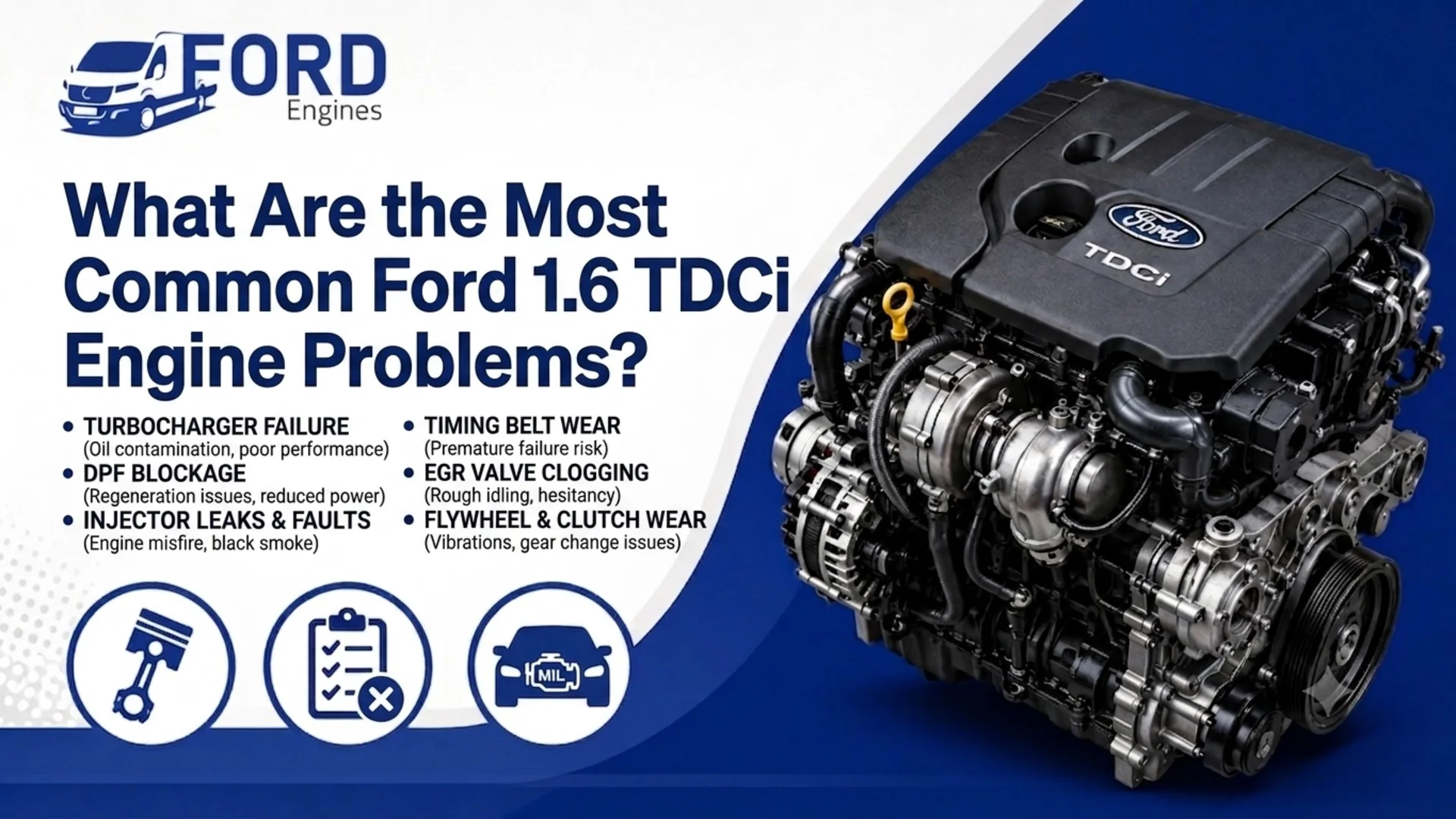
Four problem areas account for the overwhelming majority of 1.6 TDCi complaints:
- Turbocharger failure, by far the most common and most expensive fault
- Injector seal failure and carbon contamination
- DPF (diesel particulate filter) blockages
- EGR valve carbon buildup
Here's the part most guides skip: these four faults aren't isolated from each other. On the 1.6 TDCi, they're often connected, one triggers the next. Understanding that chain is the difference between fixing the problem once and paying for the same repair twice.
Turbocharger Failure, Why Does the 1.6 TDCi Turbo Keep Failing?
Turbo failure on the 1.6 TDCi is so common it's practically the engine's calling card. The turbocharger relies on a constant, clean supply of engine oil to lubricate its bearing and shaft, spinning at extremely high speed. When that oil supply is compromised, either restricted or contaminated, the turbo bearing wears prematurely and eventually seizes.
The root cause is rarely the turbo itself. It's almost always oil starvation caused by a blocked oil feed pipe, often due to a clogged banjo bolt, gauze filter, or oil pickup/strainer choked with sludge. Once oil flow to the turbo bearing drops, it's only a matter of time before the shaft develops play, the bearing wears, and you start hearing a whine or whistle under boost, followed by smoke and a drop in power.
Turbo Whistling, Whining or Siren Noise, What It Means
A turbo that whistles or emits a siren-like noise under acceleration is telling you the bearing has developed excess shaft play. This isn't a noise to ignore or "monitor", it typically gets worse quickly, and a failing turbo can send metal debris or excess oil into the intake and exhaust system, causing secondary damage.
Why a Replacement Turbo Can Fail Again (The Oil Starvation Link)
Here's the mistake we see constantly: an owner pays for a new or reconditioned turbo, only for it to fail again within months. Why? Because the underlying cause, a blocked oil feed pipe, sludge in the sump, or an oil pickup strainer clogged with carbon deposits, was never addressed. Fitting a new turbo without correcting the oil delivery problem is like replacing a burst pipe without fixing the blockage that caused the burst. Any competent repair should include inspecting and cleaning the oil feed pipe, oil pickup, and sump, plus a full oil and filter change, before the new turbo is fitted.
Injector Seal Failure & Carbon Buildup
The 1.6 TDCi uses common-rail direct injection, with each injector sealed against the cylinder head by a copper washer. Over time, particularly with high mileage or poor maintenance, these copper injector seals can fail. When they do, hot exhaust gas blows back past the seal (known as injector blow-by) instead of staying contained in the combustion chamber.
This matters more than it sounds. That escaping exhaust gas carries carbon, which contaminates the surrounding engine oil and intake system over time. It's a slow, quiet process, but it's one of the contributing factors behind the engine sludge and carbon deposits that eventually starve the turbo of clean oil.
Black Deposits Around Injectors, What's Causing Them?
If you (or your mechanic) spot black, sooty deposits around the base of the injectors when the cam cover is off, that's a strong sign of a failed copper seal allowing blow-by. It's a relatively inexpensive fix on its own, new copper washers and correct injector torque, but if left unaddressed, the resulting contamination compounds other problems, including turbo oil starvation.
DPF Blockage & Failed Regeneration
The diesel particulate filter traps soot from the exhaust and periodically burns it off through a process called regeneration, which requires sustained higher engine speeds to reach the necessary exhaust temperature. The 1.6 TDCi's DPF is particularly prone to blockage in owners who do mostly short, low-speed journeys, town driving, school runs, stop-start commutes, because the engine rarely gets hot enough for long enough to complete a regeneration cycle.
A blocked DPF typically shows up as a dashboard warning light, reduced power, or the engine dropping into limp mode. Left unresolved, exhaust back pressure builds, which can affect turbo performance and fuel economy too.
EGR Valve Carbon Buildup & Power Loss
The EGR (exhaust gas recirculation) valve reroutes a portion of exhaust gas back into the intake to reduce combustion temperatures and emissions. Because it's constantly exposed to sooty exhaust gas, carbon buildup around the valve is almost inevitable over time, and on the 1.6 TDCi, it's a well-known cause of rough idling, hesitation, and a stuck-open or stuck-closed valve.
A stuck EGR valve commonly triggers fault codes, reduced power, and, again, a trip into limp mode. It's frequently misdiagnosed as a turbo or injector fault because the symptoms overlap so closely, which is exactly why a proper diagnostic process matters more than guesswork.
How to Diagnose a Ford 1.6 TDCi Engine Fault (Symptom → Cause → Test)
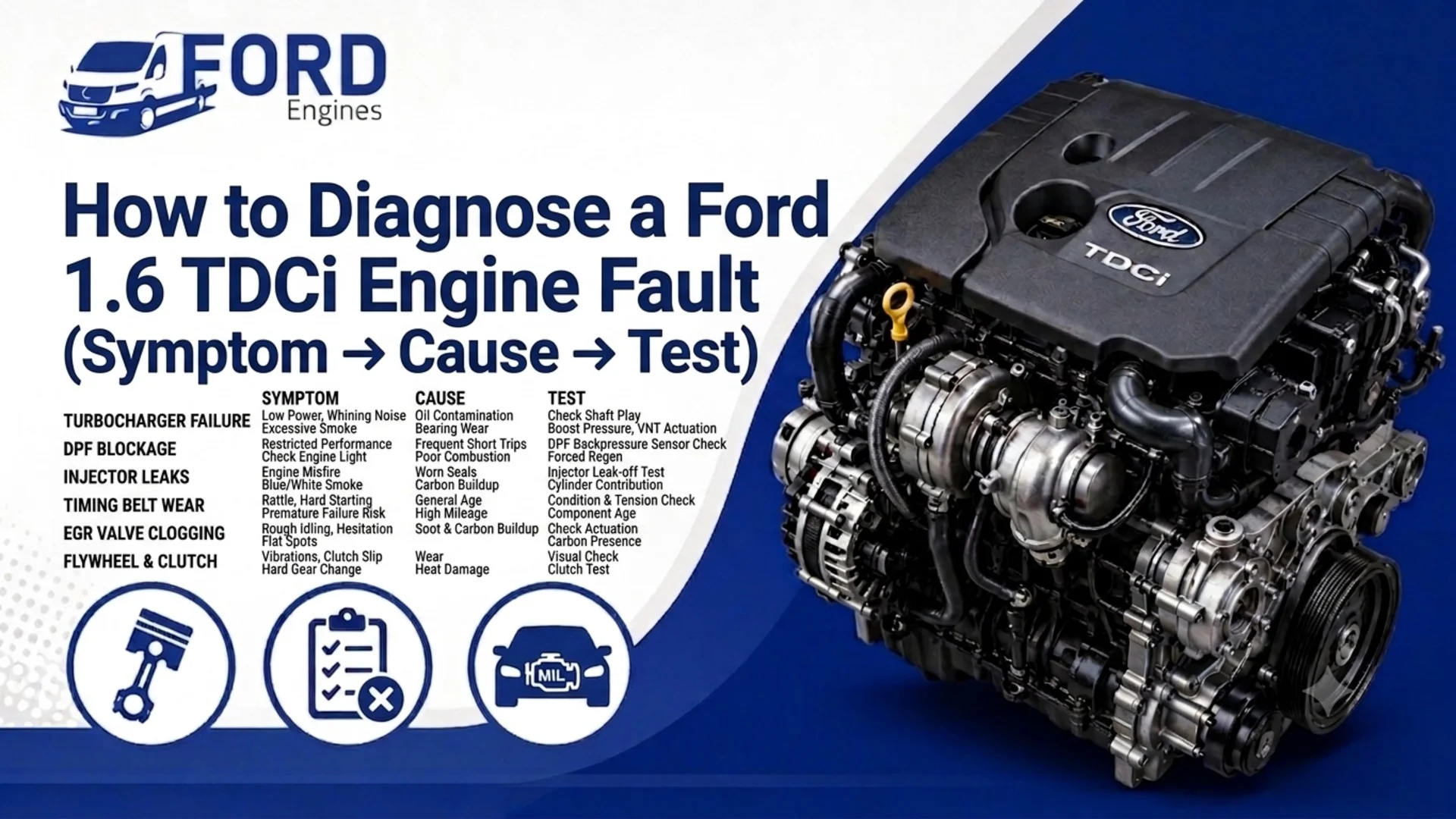
Here's the problem with most "1.6 TDCi problems" articles: they list faults in isolation, as if turbo failure, injector issues, DPF blockages and EGR faults each announce themselves with a unique, obvious symptom. In reality, they overlap heavily. Loss of power could be any of the four. Limp mode could be any of the four. This is exactly the gap that leaves owners throwing money at the wrong part first.
Below is a practical symptom-to-cause breakdown, based on how these faults actually present.
Loss of Power & Limp Mode, What's Actually Happening
Limp mode (also called limp-home mode) is the engine management system deliberately restricting power to protect the engine after detecting a fault, usually related to boost pressure, airflow, or fuel delivery. It's a symptom, not a diagnosis. Common triggers on the 1.6 TDCi include a failing turbo actuator, a boost leak in the intercooler hose, a blocked DPF, or a stuck EGR valve. The only reliable way to identify which one is a diagnostic scan for fault codes, followed by targeted testing.
Black, White or Blue Smoke, What Each Colour Tells You
- Black smoke under acceleration usually points to excess fuel or insufficient air, check boost pressure, the EGR valve, and injector condition
- Blue smoke suggests the engine is burning oil, often linked to worn seals or, in advanced cases, oil getting past a failing turbo's seals
- White smoke on startup can be normal condensation in cold weather, but persistent white smoke may indicate a coolant leak into the combustion chamber
Starting Problems (Hot vs Cold Start), Likely Causes
Difficult cold starts often trace back to glow plug issues or low compression, while difficult hot starts are more commonly linked to fuel pressure irregularities or injector wear. Stalling shortly after starting can also point to fuel delivery inconsistencies from the high-pressure pump or fuel rail.
Engine Knocking, Rattling or Vibration, Diagnostic Checklist
A knocking or rattling noise, particularly at idle, deserves prompt attention rather than a "let's see if it goes away" approach. Causes range from worn injectors (a sharper, more mechanical knock) to timing belt tensioner wear, to more serious internal wear if oil starvation has already caused damage elsewhere in the engine.
Fault Codes Worth Knowing (Including P0299 Underboost)
A diagnostic scan is always the sensible first step before spending money on parts. P0299 (turbocharger/supercharger underboost condition) is a commonly seen code on the 1.6 TDCi and points toward reduced boost pressure, which could stem from a boost leak, a failing turbo, or a stuck EGR valve. Rather than guessing, a scan narrows the search considerably and should always be followed by physical inspection rather than a code-only assumption, since fault codes point to a system, not always the exact component.
Symptom-to-Cause Quick Reference Table
Symptom | Likely Cause | First Diagnostic Check |
| Turbo whine or whistle | Turbo bearing wear from oil starvation | Inspect shaft play, check oil feed pipe condition |
| Loss of power | Boost leak, turbo fault, EGR fault, or blocked DPF | Diagnostic scan plus boost pressure test |
| Black smoke under acceleration | Excess fuel or restricted air supply | Check boost pressure, EGR valve, injector condition |
| Black deposits around injectors | Failed copper injector seal | Visual inspection of injector seat |
| Limp mode | Boost, air, or fuel delivery fault | Full diagnostic scan for stored codes |
| Repeated turbo failure | Ongoing oil starvation | Inspect oil feed pipe, pickup strainer, and check for sludge |
Is the Ford 1.6 TDCi Reliable? Lifespan, Variants & Buying Checklist
The honest answer: it depends heavily on maintenance history and which variant you're looking at. A well-maintained 1.6 TDCi with a clean service history and regular oil changes can comfortably clear 150,000 miles. A neglected one with skipped oil changes and unknown turbo history can fail well before 80,000.
DV6 / DLD-416 Engine Variants Explained (8v vs 16v, 90hp vs 110hp, DPF vs Non-DPF)
Not all 1.6 TDCi engines are identical, and treating them as one uniform unit is where a lot of buying guides fall short. Ford used this engine across the Focus, Fiesta, C-MAX, and Fusion, with variations including:
- Early 16-valve DV6 variants, generally found in earlier production years
- Later 8-valve DV6C/DV6D variants, which Ford and PSA introduced partly to address reliability concerns in earlier versions
- 90hp and 110hp outputs, affecting turbo specification and stress on the engine
- DPF-equipped versions (mandatory on most models from the Euro 5 emissions standard onward) versus earlier non-DPF versions
The practical takeaway: a later 8-valve, DPF-equipped 1.6 TDCi with full service history is generally a safer bet than an early, high-mileage 16-valve unit with patchy records.
How Many Miles Will a 1.6 TDCi Engine Last?
With consistent maintenance, particularly regular oil changes using the correct specification oil, and prompt attention to any turbo noise or warning light, a 1.6 TDCi can realistically reach 150,000-200,000 miles. The engines that fail early are almost always let down by deferred maintenance, not inherent design flaws.
Buying a Used Ford Focus, Fiesta or C-MAX with a 1.6 TDCi? What to Check First
Before buying, it's worth treating the 1.6 TDCi with the same scrutiny you'd apply to any engine with known weak points. Check:
- Full service history, especially oil change frequency and intervals
- Turbo replacement history, has it already failed once, and was the underlying oil feed issue addressed?
- Injector seal condition, if accessible or documented in service records
- DPF status, any warning lights or recent regeneration issues
- Timing belt replacement history against the manufacturer's interval
- A cold start test, listen for excessive smoke or hesitation
- Turbo noise during a test drive, particularly under load
- A diagnostic scan before purchase, ideally with a tool that can read manufacturer-specific codes
Service History Red Flags to Watch For Before You Buy
Be cautious of vehicles with irregular oil change intervals, "engine oil topped up" entries without an explanation, any mention of turbo replacement without accompanying oil system work, or gaps in service history around 60,000-90,000 miles, a period when many of these faults first surface.
Repair, Rebuild or Replace? Your Ford 1.6 TDCi Options, Costs & Next Steps
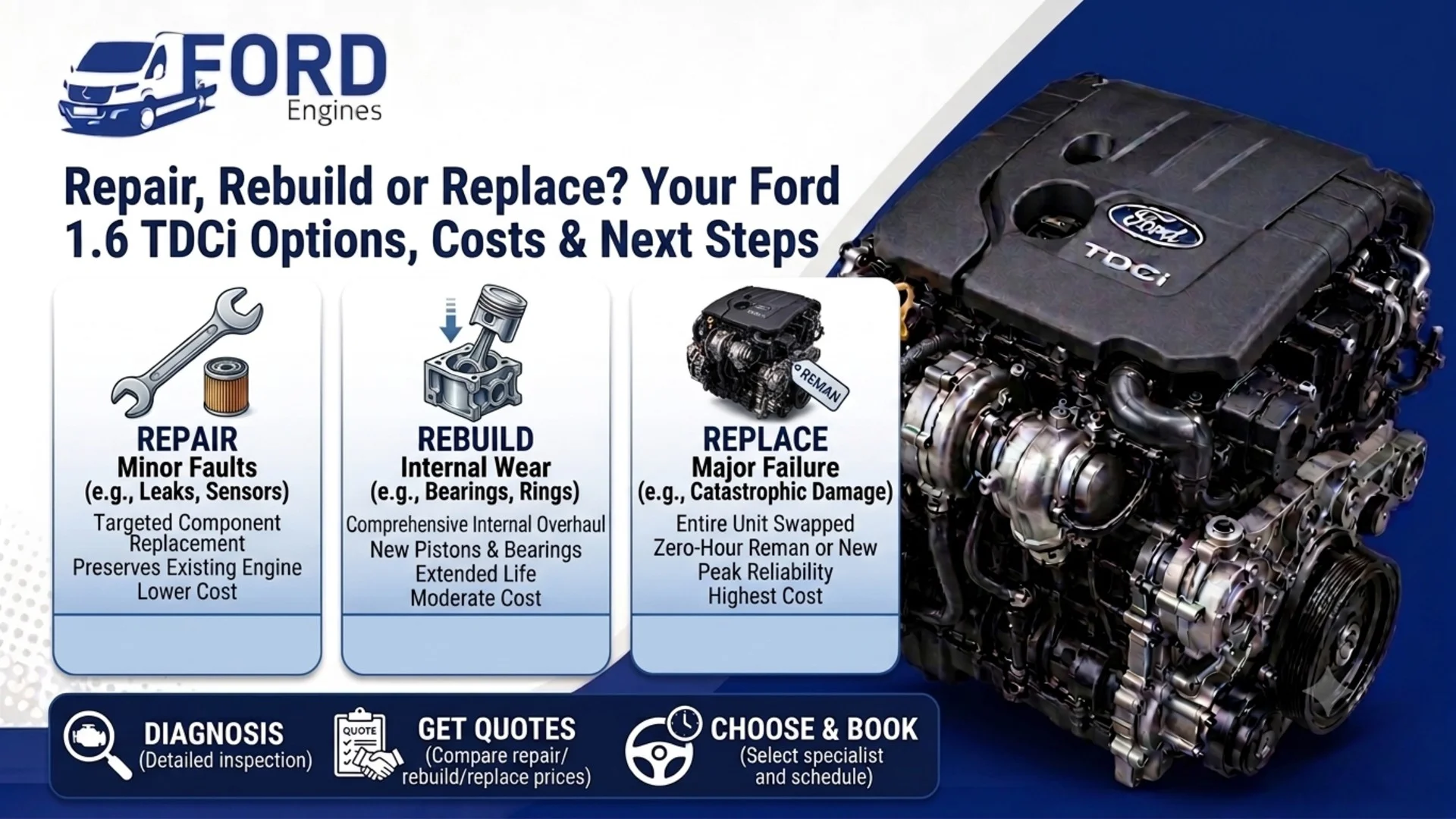
Once you've confirmed the fault, the real decision is what to do about it. This is where owners often either overspend on unnecessary work or underspend on a fix that doesn't last. Here's how to think about it properly.
When Is a Turbo Repair Enough?
If the fault is caught early, a whine with no significant power loss, no metal debris in the oil, and no history of oil starvation, a turbo repair or like-for-like replacement, combined with clearing the oil feed pipe and changing the oil and filter, is often sufficient. This is the most cost-effective outcome, provided the root cause is genuinely addressed rather than just the symptom.
When Do You Need a Full Engine Rebuild?
If oil starvation has been ongoing for some time, or the engine has been driven with a failing turbo (allowing debris or excess oil into the system), damage can extend beyond the turbo itself, to bearings, the timing components, or internal wear from prolonged low oil pressure. In these cases, a full rebuild addresses the underlying wear rather than just replacing one part and hoping the rest holds.
Reconditioned vs Replacement Engine, Which Is More Cost-Effective?
When damage is extensive, a full engine replacement often becomes more economical than an expensive rebuild, particularly on higher-mileage vehicles where the labour cost of a rebuild starts to approach the cost of a reconditioned unit. A reconditioned 1.6 TDCi engine, rebuilt to factory tolerances with new wear components, offers a middle ground: significantly cheaper than a brand-new engine, with more assurance than a used engine of unknown history.
Option | Best For | Typical Scenario |
| Turbo repair/replacement | Early-stage fault, no oil starvation history | Whine or whistle, power still largely normal |
| Engine rebuild | Localised internal wear from past oil starvation | Turbo already replaced once, some engine noise present |
| Reconditioned engine | Extensive wear or repeated turbo failures | High mileage, multiple faults, cost of rebuild approaches replacement |
| New replacement engine | Severe damage, or owner wants maximum reliability going forward | Catastrophic failure, engine seized or heavily contaminated |
Frequently Asked Questions
How much does a 1.6 TDCi turbo replacement cost?
Costs vary depending on whether you choose a new, reconditioned, or aftermarket turbo, and whether the underlying oil feed issue also needs addressing. Getting a specific quote based on your vehicle and fault is the most reliable way to budget accurately, since guessing a fixed figure without inspection tends to be misleading either way.
Can injector seals really cause turbo failure?
Not directly, but indirectly, yes. Failed injector seals allow exhaust gas blow-by, which contributes to oil contamination and carbon buildup over time, one of several factors that can eventually restrict oil flow to the turbo bearing.
Should I repair or replace my Ford 1.6 TDCi engine?
It depends on the extent of the damage and how long the underlying fault (usually oil starvation) has been present. A proper diagnostic assessment, including inspection of the oil feed pipe and internal engine condition, is the only reliable way to know which option makes financial sense.
Is the Ford 1.6 TDCi the same as the 1.6 HDi?
They're closely related, both come from the shared PSA-developed DV6 diesel platform, which is why Peugeot, Citroën, and Ford models often show the same characteristic faults.
Does the 1.6 TDCi have a DPF?
Most models produced from the point Euro 5 emissions standards applied are DPF-equipped. Earlier models may not have one, which is one of the variant differences worth checking before buying or diagnosing a fault.
Get a Free, No-Obligation Engine Quote
If you're dealing with any of the symptoms covered here, a whining turbo, repeated limp mode, smoke, or a fault code that isn't going away, the smartest next step is getting a proper assessment before committing to a repair. Whether that means a turbo replacement, a rebuild, or a full reconditioned engine, having accurate pricing based on your specific vehicle and fault beats guessing.
Get in touch for a free, no-obligation quote, and we'll help you work out the right fix, not just the most expensive one.