
If your Ford has started losing power on hills, blowing smoke at the lights, or dropping into limp mode on the motorway, you're not imagining things, and you're definitely not alone. The Ford 1.6 TDCi is one of the most common diesel engines on UK roads, fitted across the Focus, Fiesta, C-MAX, Mondeo and several other models. It's also an engine with a well-documented set of weak points that tend to surface once the mileage climbs past the 80,000–100,000 mark.
This guide walks through everything you actually need to know: what the engine is, which version you've got, why it fails, how to spot trouble early, and, if you've reached the point of no return, how to choose the right replacement engine without overpaying or buying the wrong part.
What Is the Ford 1.6 TDCi Engine? (Specs, Codes & Applications)
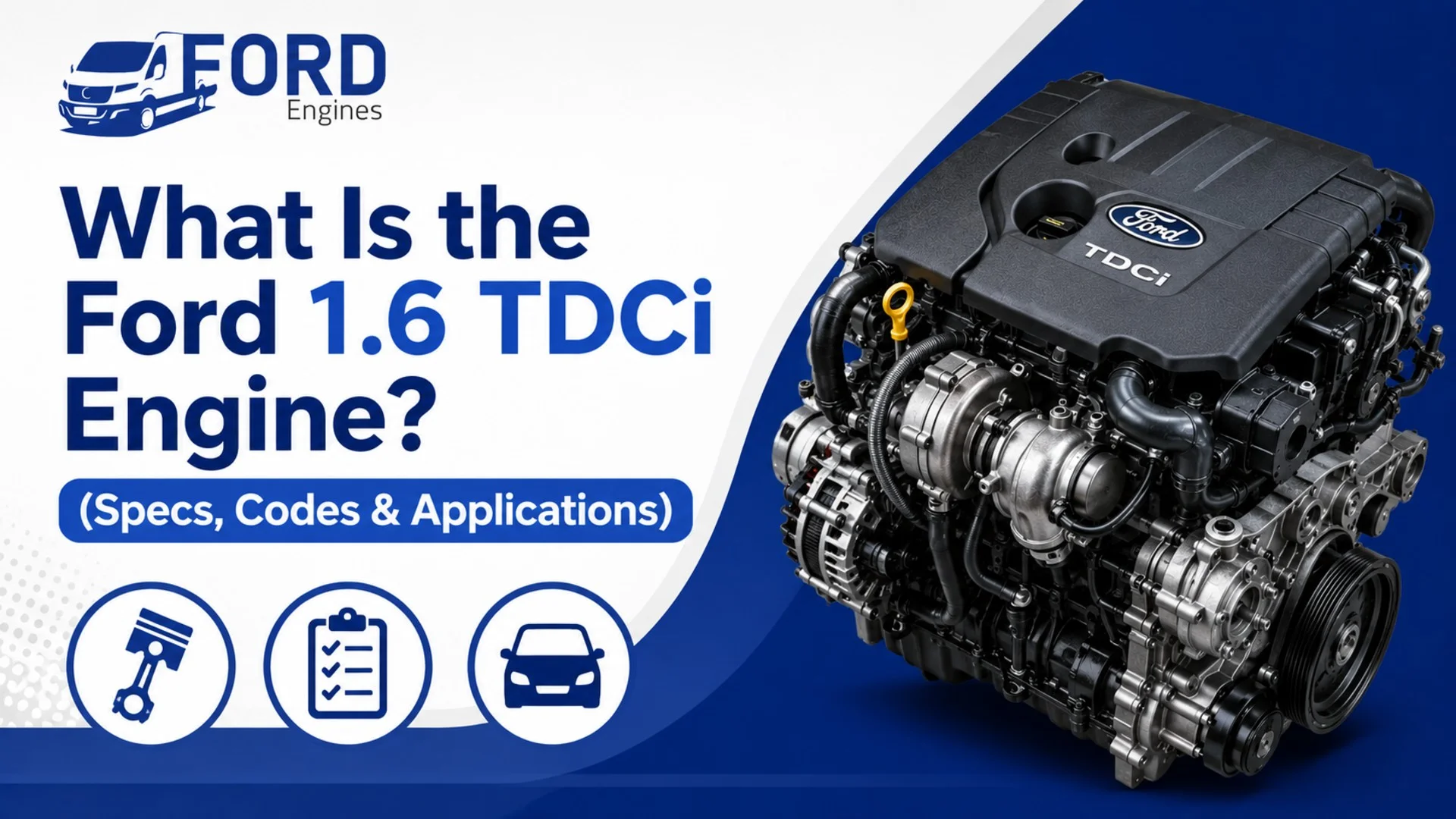
The 1.6 TDCi is a 1,560cc, four-cylinder, common rail turbo diesel engine that Ford has used since the mid-2000s. It wasn't built by Ford alone, it's part of the joint Ford/PSA DV6 engine family, developed alongside Peugeot and Citroën. That's why you'll see the same core engine wearing different badges depending on which car it's sitting in.
Under the bonnet, it's a fairly conventional inline-four turbo diesel setup: an aluminium cylinder head and block, common rail direct injection, and a variable geometry turbocharger paired with an intercooler. Depending on the generation, it uses either a Garrett GT1544V or a Mitsubishi TD025 turbo, and either a timing belt or, on some layouts, a camshaft chain, so it's worth checking which your specific car has before assuming a service schedule.
Ford 1.6 TDCi Engine Specifications (Power, Torque & Capacity)
Across its production life, the engine was tuned to several different outputs. Here's how they break down:
Power Output | Torque | Typical Configuration |
| 75 hp | ~185 Nm | Early 8-valve |
| 90 hp | 215–230 Nm | 16-valve |
| 95 hp | 215 Nm | Later 8-valve |
| 109/110 hp | 240 Nm | 16-valve |
| 115 hp | 270 Nm | Later 8-valve |
The lower-powered versions were mostly aimed at the Fiesta and smaller Focus trims, while the 109–115 hp variants found their way into the Mondeo and higher-spec C-MAX and Focus models, where a bit more torque was needed to shift the extra weight.
1.6 TDCi 75/90/95 hp vs 109/110/115 hp, What's the Difference?
The gap isn't just a tuning tweak. Later, higher-output versions typically run different turbo geometry, revised fuelling, and in many cases a completely different cylinder head design. That matters enormously if you're sourcing a replacement engine, a 90 hp unit won't bolt in and perform like a 115 hp one, even though both are marketed under the same "1.6 TDCi" name.
Is the 1.6 TDCi the Same as the 1.6 HDi? (Ford/PSA DV6 Explained)
Yes, essentially, with caveats. The Ford 1.6 TDCi and the Peugeot/Citroën 1.6 HDi share the same DV6 architecture. You'll find close relatives of this engine in the Peugeot 207/307/308, Citroën C4, Volvo S40/V50/C30, and even some Mazda 3 models. The core mechanicals, block, injection system, turbo family, are shared, but calibration, ancillaries, and ECU mapping differ by manufacturer. This is exactly why "it's the same engine as my mate's Peugeot" isn't always true when it comes to parts interchangeability.
1.6 TDCi Engine Codes Explained (G8DA, HHDA, T1DA & More)
This is the part most guides skip, and it's the single most useful thing you can check before buying parts or a replacement engine. The engine code is stamped on the block and tells you far more than the "1.6 TDCi" badge ever will.
Engine Code | Generation | Valves | Power | Common Applications |
| G8DA / G8DB | Early DV6 | 16V | 90/109 hp | Focus |
| HHDA / HHDB | DV6 | 16V | 90/109 hp | Focus |
| HHJA / HHJB | DV6 | 16V | 90 hp | Fiesta |
| T1DA / T1DB | Later DV6 | 8V | 95/115 hp | Focus |
| T1BA / T1BB | Later DV6 | 8V | 115 hp | Mondeo |
| TZJA / UBJA | Later DV6 | 8V | 95 hp | Fiesta |
A word of caution here: these codes are a starting point, not a guarantee. Exact interchangeability still depends on the vehicle's exact spec, ancillaries, ECU, emissions equipment, and production year. Always match by engine code first, then double-check against your V5C and a parts specialist before ordering.
8-Valve vs 16-Valve DV6 Engines, Which One Do You Have?
Early DV6 engines used a 16-valve cylinder head (DOHC), while later revisions moved to an 8-valve SOHC design. This wasn't a downgrade, Ford simplified the valvetrain in later versions partly to improve reliability and reduce complexity around the timing components. If you're not sure which you have, the engine code table above is the quickest way to check, since the badge on the car won't tell you.
Which Ford Models Use the 1.6 TDCi Engine?
Focus, Fiesta, C-MAX, Mondeo & Transit Connect Applications
The 1.6 TDCi found its way into a wide spread of the Ford range:
- Ford Focus (Mk2 and Mk3) the most common application by volume
- Ford Fiesta (Mk6 and Mk7) typically the lower-output 75/90/95 hp versions
- Ford C-MAX / Focus C-MAX shared much of its drivetrain with the Focus
- Ford Mondeo usually fitted with the higher-output 109–115 hp variants
- Ford B-MAX and Transit Connect smaller-volume applications, worth checking codes carefully
If you're trying to identify your own car's exact setup, cross-referencing the model, year, and engine code together is far more reliable than going off power figures alone.
Is the Ford 1.6 TDCi Reliable? (Common Problems Explained)
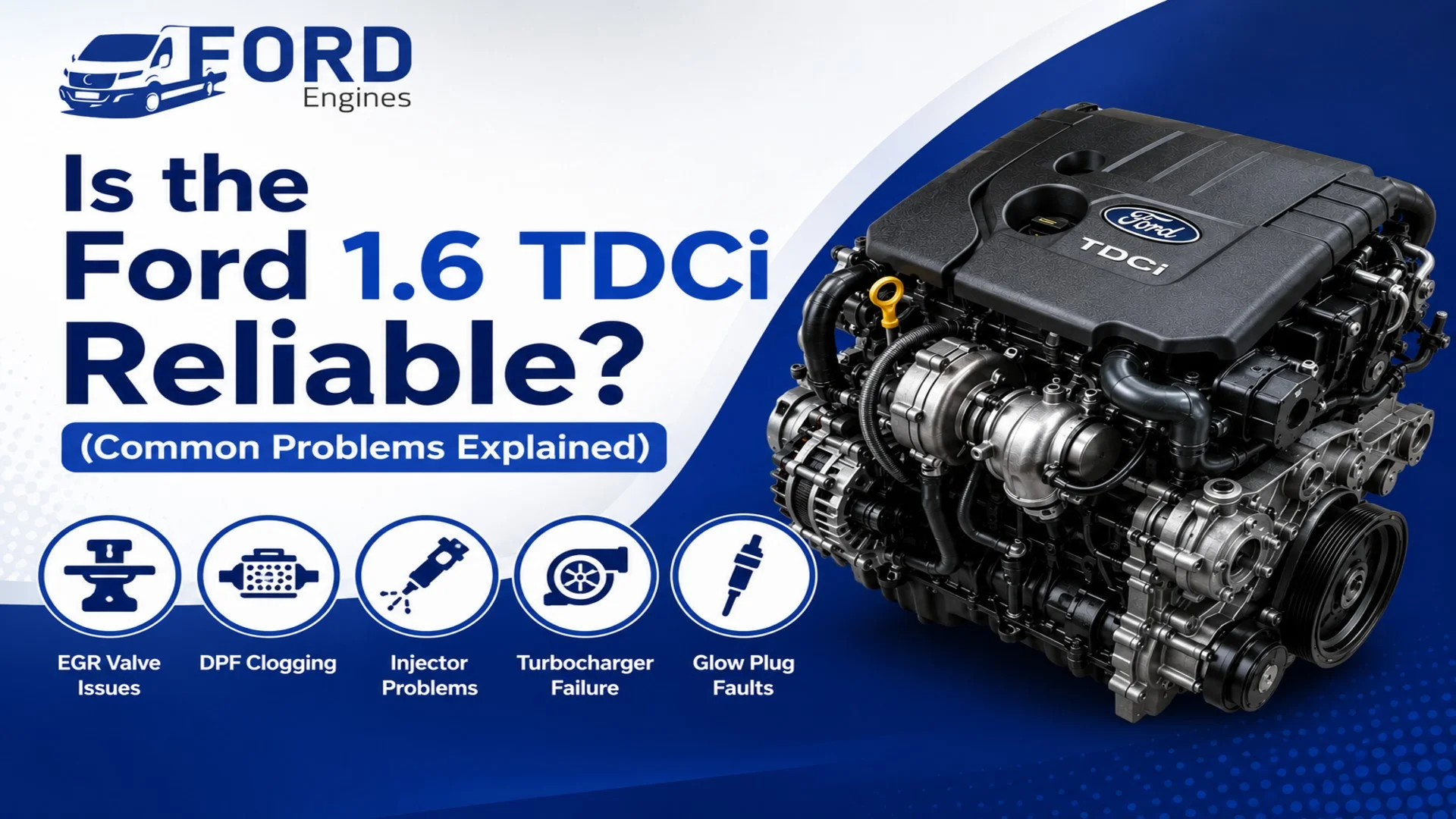
Here's the honest answer: the 1.6 TDCi is reasonably reliable if it's been maintained properly, and genuinely troublesome if it hasn't. This engine is unusually sensitive to oil quality and service intervals compared to some of its rivals, skip a couple of oil changes and you're gambling with a very expensive repair bill.
How Long Does a 1.6 TDCi Engine Last?
With consistent maintenance, regular oil changes, timely timing belt replacementcamshaft chain , and not ignoring early warning signs, many 1.6 TDCi engines will comfortably reach 150,000–180,000 miles. Neglect the oil changes or run on extended service intervals, though, and it's common to see turbo or injector failures well before 100,000 miles. The engine itself isn't fragile; it's the maintenance-dependent components around it that tend to let it down.
Why Does the 1.6 TDCi Turbo Fail? (Oil Starvation & Sludge Explained)
Turbo failure is the single most talked-about issue with this engine, and it rarely happens out of nowhere. It's usually the end result of a chain reaction:
Oil degradation leads to sludge and carbon build-up in the oil galleries, which restricts the oil feed to the turbo. Once the turbo isn't getting properly lubricated, its bearings start to wear prematurely, and eventually the turbo fails outright, sometimes sending debris or oil into the rest of the engine and causing secondary damage.
This is exactly why oil change intervals matter so much more on this engine than people expect. A cheap oil and a stretched service schedule is often the real root cause behind what looks like "random" turbo failure.
Symptoms of a Failing Turbo (Whining, Smoke, Loss of Power)
Watch out for:
- A rising whining or whistling noise under acceleration
- Noticeable loss of power or sluggish acceleration
- Blue or grey smoke from the exhaust (often a sign of oil getting into the intake)
- The engine warning light appearing alongside reduced performance
Catching these symptoms early can be the difference between a turbo repair and a full engine rebuild.
Common 1.6 TDCi Injector & Fuel System Problems
Injector issues are the second most frequent complaint owners raise. The 1.6 TDCi's common rail system relies on precise, high-pressure fuel delivery, and injectors can wear, stick, or leak internally over time, especially with poor fuel quality or infrequent filter changes.
Why Do Injectors Fail, and What Is Injector Coding?
Injectors fail for a mix of reasons: age-related wear, contamination from a neglected fuel filter, or simply reaching the end of their service life. When an injector is replaced, it needs to be "coded" to the ECU, this calibration step tells the engine management system the exact flow characteristics of the new injector. Skip this step, and you can end up with rough running, poor fuel economy, or a fault light even with a brand-new part fitted.
1.6 TDCi DPF & EGR Problems (Blockages, Limp Mode & Carbon Buildup)
Like most modern diesels, the 1.6 TDCi uses a Diesel Particulate Filter (DPF) and an EGR valve to manage emissions. Both are prone to clogging, particularly in cars used mostly for short journeys where the DPF never gets hot enough to regenerate properly.
A blocked DPF or a carbon-clogged EGR valve commonly triggers limp mode, a safety feature that limits engine power to protect it from further damage. If your car has suddenly lost power and feels like it's stuck in a low gear, this is one of the first things worth checking.
Symptom-to-Cause Diagnostic Guide
Loss of Power, Rough Idle, Hard Starting & Excessive Smoke, What Do They Mean?
Rather than guessing, it helps to work backwards from the symptom:
Symptom | Likely Area to Investigate |
| Loss of power | Turbo, EGR, DPF, or a boost leak |
| Rough idle | Injectors, EGR, or fuel pressure |
| Hard starting | Glow plugs, fuel pressure, injectors |
| Black smoke | Airflow issues, EGR, turbo, or injectors |
| Limp mode | Boost control, DPF, EGR, or sensor faults |
| Turbo whine | Turbo bearing wear, boost leak, or oil starvation |
This isn't a substitute for a proper diagnostic scan, but it gives you a solid starting point before you book the car in, and it can save you from paying for guesswork.
1.6 TDCi Maintenance, Timing Belt, Oil & Service Schedule
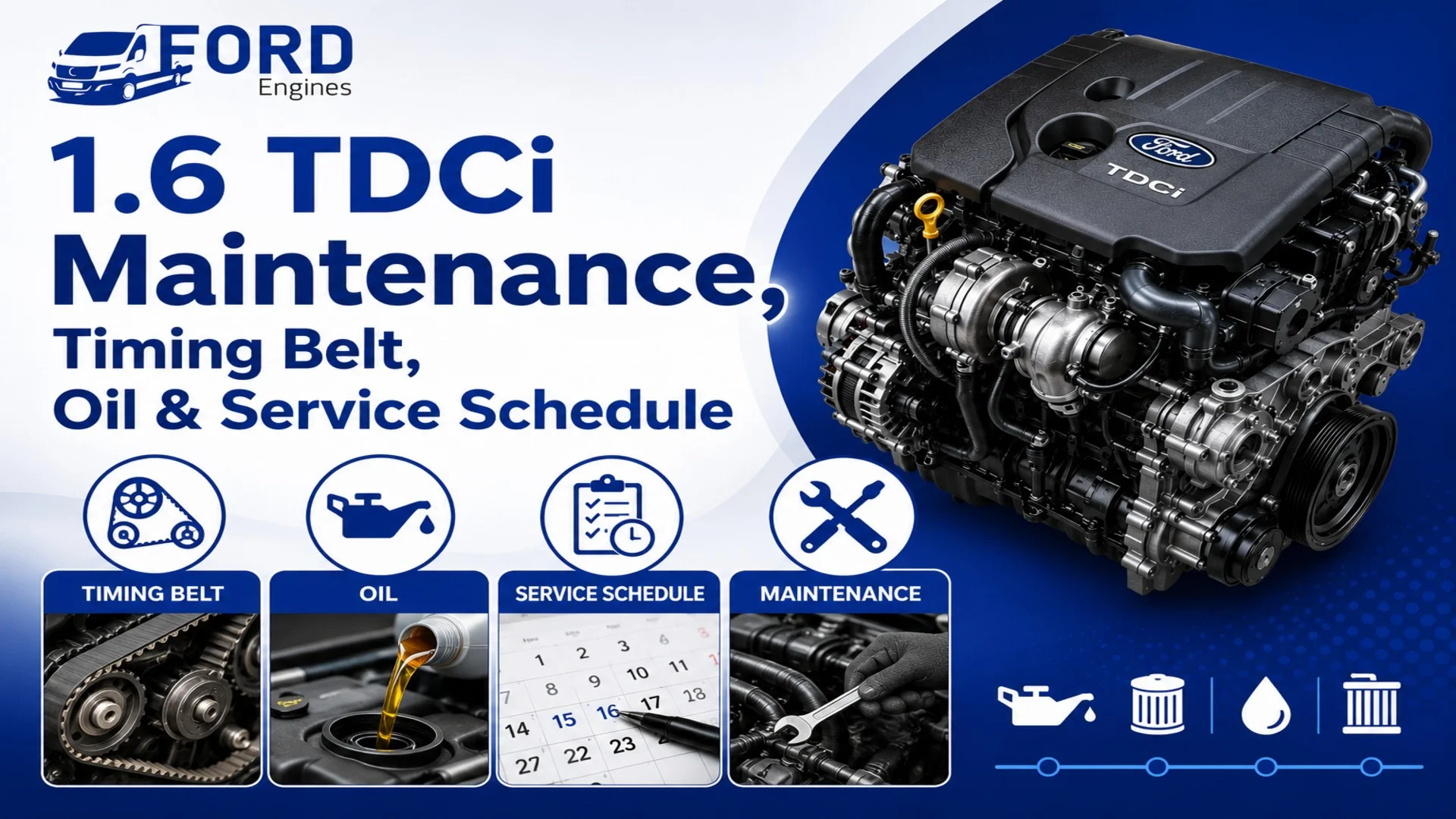
Most of the problems above are preventable, or at least delayable, with the right maintenance approach. This engine rewards owners who stick to the schedule and punishes those who don't.
When Should the 1.6 TDCi Timing Belt Be Changed?
Manufacturer guidance typically recommends timing belt replacement somewhere between 100,000–125,000 miles or every 10 years, whichever comes first, but always check the specific figure for your model year, since this varies. This is a non-negotiable job: the 1.6 TDCi is an interference engine, meaning a snapped timing belt will cause the pistons to hit the valves, resulting in catastrophic and expensive internal damage.
What Oil Does the 1.6 TDCi Take? (Type, Capacity & Change Intervals)
Given how sensitive this engine is to oil quality, using the correct specification matters more here than on many other diesels. Stick to the manufacturer-recommended low-SAPS fully synthetic oil (typically 5W-30), and don't stretch service intervals beyond 10,000–12,000 miles, even if the service indicator suggests otherwise. Cheaper oils or extended intervals are directly linked to the sludge-related turbo failures discussed earlier.
How to Prevent Turbo & Injector Failure Through Regular Maintenance
A few habits go a long way with this engine:
- Change the oil and filter on time, using the correct specification
- Replace the fuel filter at the recommended interval to protect the injectors
- Avoid short, low-speed journeys where possible, so the DPF gets a chance to regenerate
- Address warning lights immediately rather than waiting for symptoms to worsen
- Have the EGR valve checked periodically if the car does a lot of urban driving
None of this guarantees a fault-free engine, but it significantly shifts the odds in your favour.
Buying a Replacement or Reconditioned 1.6 TDCi Engine
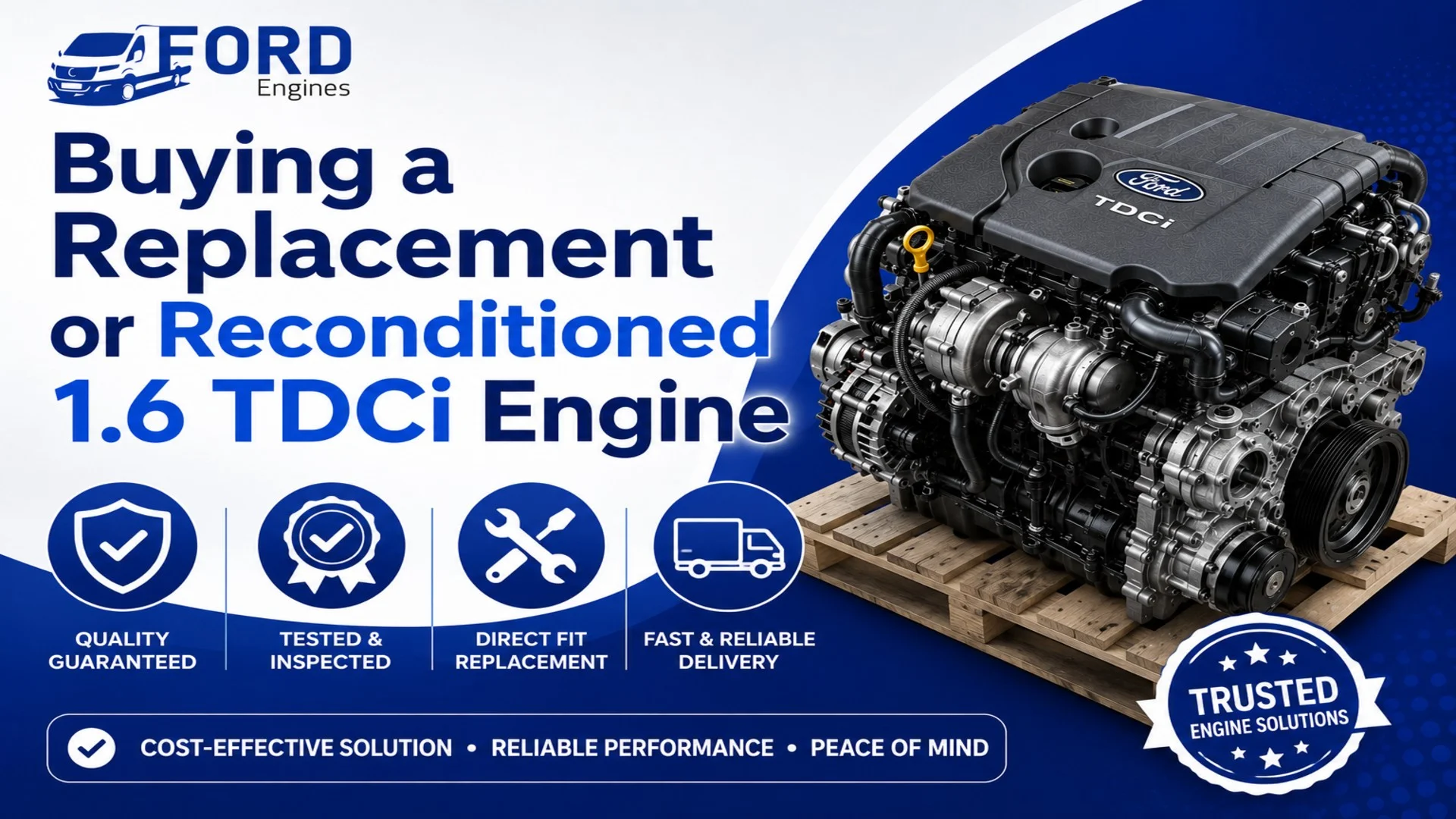
Sometimes maintenance comes too late, or the damage is already done, a snapped belt, a seized turbo that's sent metal through the engine, or simply an engine that's worn out after 200,000 miles. At that point, the question shifts from "how do I fix this" to "what's the smartest way to replace it."
Used vs Reconditioned vs Bare 1.6 TDCi Engines, Which Should You Choose?
These terms get used loosely, but they mean very different things:
- Used engine taken from a donor vehicle, typically with unknown internal wear, sold as-is with minimal guarantees
- Reconditioned engine stripped, inspected, and rebuilt with new or refurbished components where needed, tested before sale
- Bare engine (long block) just the core engine assembly, without ancillaries like the turbo, injectors, or manifolds
For most owners looking for long-term reliability, a properly reconditioned engine offers the best balance of cost and peace of mind, you're not inheriting someone else's neglected maintenance history.
What's Included? (Turbo, Injectors, Ancillaries & ECU Compatibility)
Before you buy, get clarity on exactly what's included in the price:
- Is the turbo included, and is it new or refurbished?
- Are the injectors supplied, and have they been tested or recoded?
- Which ancillaries come with the engine, manifolds, sensors, pumps?
- Is the engine confirmed compatible with your existing ECU, or does it need reprogramming?
Skipping these questions is one of the most common ways people end up paying twice, once for the engine, and again for the parts they assumed were included.
How to Match the Correct Engine by Code and Vehicle Compatibility
Go back to your engine code before ordering anything. Two engines both marketed as "1.6 TDCi" can differ in valve configuration, power output, and ancillary compatibility. A reputable supplier should ask for your engine code, registration, or VIN before confirming a match, if they're happy to sell you an engine based on the model name alone, that's worth being cautious about.
How Much Does a 1.6 TDCi Replacement Engine Cost in the UK?
Pricing varies depending on whether you're buying used, reconditioned, or a bare long block, and whether the turbo and injectors are included. As a general rule, reconditioned engines with a warranty and confirmed testing sit at a higher price point than used engines of unknown history, but they typically work out cheaper over the life of the car once you factor in the reduced risk of early failure. It's worth getting a like-for-like quote based on your exact engine code rather than comparing headline prices alone.
Why Choose Fordengines.co.uk for Your 1.6 TDCi Engine Supply & Fit
At Fordengines.co.uk, every 1.6 TDCi engine is matched by engine code before it leaves our supply chain, not just by model name, so you're not left guessing whether it'll actually fit and run correctly. We work across the full range of applications, from Focus and Fiesta to Mondeo and C-MAX, with clear guidance on exactly what's included with each engine before you commit.
Warranty, Testing & UK-Wide Delivery, Get a Free Quote Today
Every engine we supply is tested and backed by a warranty, giving you confidence that you're not just buying a part, you're buying reliability. With UK-wide delivery and supply-and-fit options available, getting your car back on the road doesn't need to be complicated. Get in touch for a free, no-obligation quote based on your exact engine code and vehicle details.
Frequently Asked Questions
Is the 1.6 TDCi engine reliable?
It's reasonably reliable when properly maintained, but sensitive to neglected oil changes and extended service intervals, which are directly linked to turbo and injector failures.
What are the most common 1.6 TDCi problems?
Turbo failure from oil starvation, injector wear, DPF and EGR blockages, and timing belt-related damage are the most frequently reported issues.
How long does a 1.6 TDCi engine last?
With consistent maintenance, 150,000–180,000 miles is realistic. Poor maintenance can bring on major faults well before 100,000 miles.
Is the 1.6 TDCi the same as the 1.6 HDi?
They share the same underlying PSA/Ford DV6 architecture, but calibration, ancillaries, and ECU mapping differ between manufacturers.
What oil does a 1.6 TDCi take?
A low-SAPS fully synthetic oil, typically 5W-30, changed at or before the recommended interval, usually no more than 10,000–12,000 miles.
When should the 1.6 TDCi timing belt be changed?
Typically between 100,000–125,000 miles or every 10 years, though this should always be confirmed against your specific model year, since it's an interference engine.
What cars have a 1.6 TDCi engine?
The Ford Focus, Fiesta, C-MAX, Mondeo, B-MAX, and Transit Connect all used versions of this engine, alongside related DV6 applications in Peugeot, Citroën, Volvo, and Mazda models.
Why is my 1.6 TDCi losing power?
Loss of power is commonly linked to turbo issues, a blocked DPF or EGR valve, or a boost leak; a diagnostic scan is the fastest way to narrow it down.
Final Thoughts
The Ford 1.6 TDCi isn't a bad engine, but it's one that punishes shortcuts. Stick to the maintenance schedule, use the right oil, and address warning signs early, and there's no reason it shouldn't see you well past 150,000 miles. Ignore those basics, and you're likely to meet the turbo, injector, or DPF problems that give this engine its reputation.
If you've reached the point where repair isn't cost-effective anymore, don't rush into buying "a 1.6 TDCi engine" based on the badge alone. Get your exact engine code confirmed, understand exactly what's included in any quote, and work with a supplier who checks compatibility properly before you hand over any money.
Need help finding the right engine for your car? Get in touch with Fordengines.co.uk today for a free quote, tell us your engine code and vehicle details, and we'll match you with the correct reconditioned engine, backed by a warranty and UK-wide delivery.