
The light flicks mid-journey. The engine feels flat, the van hesitates on the slip road, and a message about the exhaust filter appears on the dash. If that sounds familiar, you are dealing with one of the most common faults on modern diesel Fords, and a blocked Ford DPF is rarely something that fixes itself by ignoring it.
This guide explains what the diesel particulate filter does, why it blocks, how regeneration works, and how to decide between cleaning, repair and replacement. It covers the Transit, Transit Custom, Ranger, Focus, Fiesta, Mondeo, Kuga and other diesel Fords, from older TDCi and Duratorq engines to the 2.0 EcoBlue.
Ford Engines is a UK Ford diesel specialist. We start with diagnosis, so the work we recommend is based on what is actually wrong with your vehicle. If you already know you need help, you can book a Ford DPF diagnostic check or request a cleaning or repair quote at any point.
What Does the Ford DPF Warning Light Mean and Why Does the Filter Block?
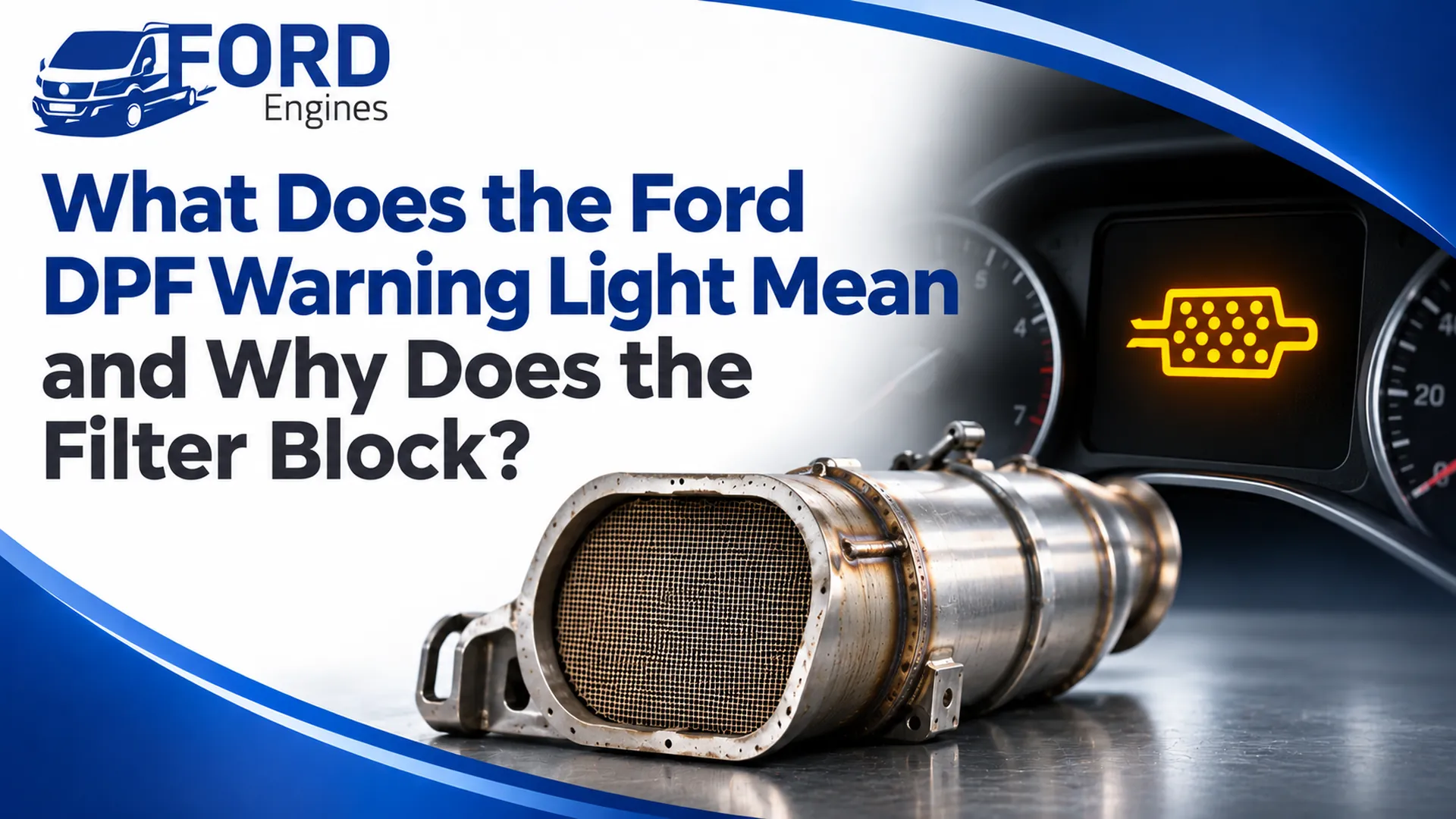
The diesel particulate filter sits in the exhaust system and traps soot, the fine carbon particles every diesel engine produces during combustion. Without it, those particles would leave the tailpipe as particulate matter. It is a core part of the Ford diesel emissions system, and Euro 5 and Euro 6 vehicles depend on it to stay compliant.
The filter cannot hold soot forever. The engine control module watches the soot load using a differential pressure sensor, which compares exhaust pressure before and after the filter, along with readings from the exhaust temperature sensors. When the soot load climbs too high, the ECU starts a cleaning cycle called regeneration, which burns the soot off as ash. If that cycle cannot finish, soot keeps building and the dashboard warns you.
You may see a DPF symbol, an engine management light, or an exhaust filter overloaded message. All three mean the same thing at heart: the filter is filling faster than it can clear.
Why Does My Ford DPF Keep Blocking?
A DPF almost never blocks without a reason. The filter is usually the victim, and the cause sits somewhere else in how the vehicle is driven or how the engine is running. These are the usual suspects:
- Frequent short journeys. Regeneration needs sustained exhaust heat. A ten-minute run to the shops never gets the exhaust hot enough to finish a cycle.
- Stop-start and urban driving. Heavy traffic, prolonged idling and cold engine operation keep exhaust temperatures low.
- Interrupted regeneration. Switching off mid-cycle leaves the job half done, and repeated interruptions stack up.
- A faulty EGR valve. A valve stuck open or clogged with carbon disturbs combustion and produces excess soot.
- Faulty fuel injectors. Poor spray patterns cause incomplete combustion and more soot than the filter can handle.
- Turbocharger oil leakage. Oil passing through a worn turbo seal ends up in the exhaust and contaminates the filter.
- The wrong engine oil. Diesel engines with a DPF need a low-ash oil. The wrong grade leaves excess ash that cannot be burned away.
- Sensor and pipe faults. A failing pressure sensor, a faulty temperature sensor or blocked pressure pipes can feed the ECU false readings.
Because so many causes overlap, the symptoms can look similar. This table shows how they usually connect.
Likely cause | What you may notice | Why it matters |
| Short journeys and stop-start use | Warning light returning every few weeks | Regeneration never completes |
| Faulty EGR valve | Excess soot, rough running, repeat blockages | Cleaning alone will not stop it returning |
| Faulty injectors | Smoke, higher fuel use, frequent regeneration | Raises soot production at the source |
| Turbo oil leakage | Oil loss, blue or grey smoke | Contaminates the filter and can damage it |
| Pressure sensor fault | Warning light with no real blockage | Replacing the filter would waste money |
| Wrong oil or excess ash | Filter blocks sooner after each clean | Ash cannot be regenerated away |
One important legal point belongs here. Removing a DPF, or deleting it through software, is not a legitimate repair for a road vehicle in the UK. A vehicle missing its filter can fail the MOT, and the DVSA treats tampering with a fitted emissions system seriously. We do not offer removal. We diagnose, clean, repair or replace so your Ford stays compliant.
Can I Drive My Ford With the DPF Light On or the Exhaust Filter Overloaded Warning?
It depends on what the light is doing.
A steady DPF light usually means the soot level is rising and the system wants a chance to regenerate. A longer run at a steady speed, often twenty minutes or more on a dual carriageway or motorway, can help the cycle complete. Keep the fuel level reasonable, as low fuel can stop regeneration from starting.
A flashing light, an exhaust filter overloaded message, noticeable power loss or limp mode is a different situation. Here the filter may be too full for a normal cycle to work safely. Pushing on can raise exhaust back pressure, strain the turbocharger and make the eventual repair bigger. It can also dilute the engine oil with fuel during repeated failed regenerations.
If your Ford is showing any of those signs, get a diagnostic check before the problem grows. A blocked filter that is caught early is far more likely to be cleaned successfully. If the turbo is also a concern, our guide to Ford turbo repair and replacement explains how exhaust restriction and boost problems connect. Book a Ford DPF diagnostic check and we will tell you what is really happening.
How Does Ford DPF Regeneration Work, and Why Does It Fail?
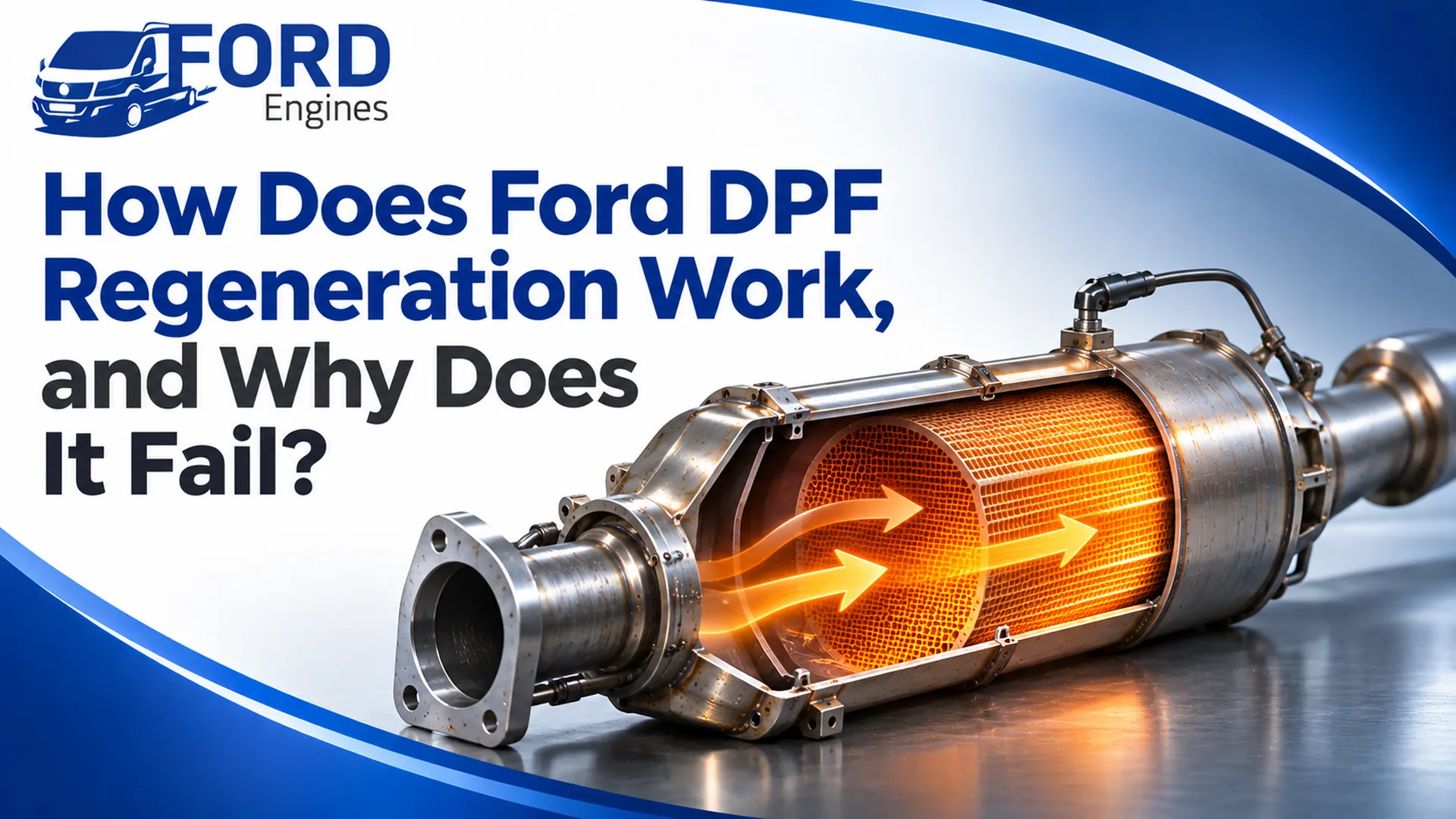
Regeneration is the filter's way of cleaning itself. The ECU raises the exhaust temperature, which oxidises the trapped soot and turns it into a much smaller amount of ash. Done properly, you barely notice it. Done badly, or not at all, it is the root of most DPF trouble.
There are three types, and they are often confused.
Type | How it happens | Who controls it |
| Passive regeneration | Soot burns off naturally during steady, hot motorway-style driving | Happens on its own with no extra fuel |
| Active regeneration | The ECU uses post-injection of extra fuel to raise exhaust gas temperature | The engine management system |
| Forced regeneration | A technician starts a cycle using diagnostic equipment, often with the vehicle stationary | A specialist with the right tools |
Passive regeneration needs sustained heat, so it works well for drivers who cover long steady distances. Active regeneration takes over when passive burning is not enough. Forced regeneration, sometimes called static regeneration, is the specialist option when the car cannot complete a cycle by itself, though it only works if the filter is not already beyond saving.
How Long Does Ford DPF Regeneration Take, and How Can I Tell It Is Happening?
A typical active regeneration lasts somewhere between ten and twenty minutes, though it varies with the engine, the soot load and the driving conditions. How often it happens depends on how you drive. A van doing long motorway runs may regenerate rarely. A town car on short trips may try far more often.
The signs of an active cycle are subtle once you know them:
- The idle speed rises slightly
- The cooling fan keeps running after you switch off
- Fuel consumption climbs for a while
- You may notice a hot, slightly acrid smell from the exhaust
- Stop-start may be disabled temporarily
Knowing this helps in practice. If you spot these signs, let the cycle finish rather than switching off. Many blocked filters begin with a driver who unknowingly interrupted regeneration again and again.
For the best chance of a full cycle, keep a decent amount of fuel in the tank, drive at a steady speed once the engine is warm and avoid cutting the journey short when the fan is still running. These habits help, but they cannot rescue a filter that is already overloaded or a system with a hidden fault.
Why Is My Ford DPF Not Regenerating, and Can a Faulty Sensor Be the Cause?
Yes, a faulty sensor is one of the more common reasons. Regeneration can fail or be interrupted for several reasons:
- Low exhaust temperature from short journeys or cold running
- Low fuel level, which can prevent the cycle from starting
- A faulty differential pressure sensor that sends wrong readings to the ECU
- A failed exhaust temperature sensor that stops the ECU from controlling the cycle
- Blocked or split differential pressure pipes, which distort the pressure reading
- An EGR or injector fault that produces more soot than regeneration can clear
- A filter already past its limit, where the ECU refuses to start a cycle for safety
The key question is whether the filter is genuinely blocked or whether the system is simply misreading it. A scan tool shows live data, including the soot load measurement, differential pressure readings and exhaust temperature. A high pressure reading with matching soot load points to a real blockage. A high pressure reading with a clean filter points to a sensor or pipe fault. The two need completely different repairs.
Here is a scenario we see often. A Transit driver has the DPF light on for the third time in two months. A garage suggests a new filter. A proper diagnostic reveals that the pressure pipe has split and the sensor is sending exaggerated readings. The filter itself was fine. Fixing the pipe and sensor solves the problem for a fraction of the cost of a new filter. This is why the diagnostic comes first.
Should You Clean, Repair or Replace Your Ford DPF?
Once the cause is understood, the choice becomes clearer. Not every blocked filter needs replacing, and not every filter can be cleaned. The right option depends on the condition of the filter, the root cause and your vehicle.
Can a Ford DPF Be Cleaned Instead of Replaced, and How Much Does It Cost?
In many cases, yes. A filter loaded with soot but with an intact internal structure can often be cleaned back to good working order. Here is how the main options compare.
Option | What it involves | Best suited to | Limits |
| Forced regeneration | A technician triggers a controlled burn cycle with diagnostic equipment | Filters with moderate soot load | Cannot remove ash, and not suitable for badly blocked filters |
| On-car cleaning | Cleaning fluid or treatment applied without removing the filter | Early or light blockage | Limited effect on heavy soot or ash |
| Off-car cleaning | The filter is removed and professionally cleaned, then tested | Heavily blocked filters, ash build-up | Needs removal and refitting, so it takes longer |
| Replacement | A new or suitable replacement filter is fitted | Cracked, melted or damaged filters | Highest cost, and does not fix the original cause |
Cost varies, and the honest answer is that no single figure fits every Ford. What shapes the total:
- The model and engine. A Transit 2.0 EcoBlue, a Ranger 3.2 TDCi and a Focus 1.6 TDCi all differ in filter design and access.
- The condition of the filter. Light soot is simpler than heavy ash loading.
- The method chosen. Forced regeneration, on-car cleaning, off-car cleaning and replacement sit at very different points.
- Labour time. Some filters are easy to reach, others need a lot of strip-down.
- Related repairs. A faulty sensor, damaged pressure pipe, EGR valve or injector may need attention at the same time.
The most reliable way to learn what your Ford needs is a diagnostic assessment, followed by a clear quotation. You can request a Ford DPF cleaning quote with your registration and symptoms and get a response based on your actual vehicle.
Cleaning is not always possible. A filter may be beyond professional cleaning if it has:
- Substrate damage, such as cracks or melting caused by an uncontrolled burn
- Heavy ash loading, where ash has built up beyond what cleaning can remove
- Internal damage from oil or coolant contamination
- Repeated cleaning failures, which suggest the filter has lost its capacity
In those cases, replacement is the sensible route. A specialist will say so clearly rather than cleaning a filter that will block again within weeks.
Why Does My Ford DPF Block Again After Cleaning?
This is one of the most frustrating situations, and it nearly always comes down to one thing: cleaning treats the filter, not the reason it filled up.
If an EGR valve is sticking, the engine keeps producing excess soot. If an injector is faulty, combustion stays incomplete. If the turbocharger is leaking oil, contamination returns. If the pressure sensor is failing, the warning light may come back even with a clean filter. Without finding and fixing that underlying fault, a freshly cleaned DPF fills up again.
A thorough specialist deals with this by:
- Reading fault codes and live data before cleaning
- Checking the EGR valve, injectors, turbocharger and pressure pipes
- Confirming the engine oil is the correct low-ash specification
- Cleaning or replacing the filter as appropriate
- Verifying the repair afterwards, with pressure readings back in range and a completed regeneration
That last step is the one many garages skip. Without it, you only find out the repair worked when the light returns.
How Do I Choose a Ford DPF Specialist and Get a Quote?
Not every garage handles diesel emissions properly. When comparing options, look for these signs:
- A diagnostic-first approach, not an immediate recommendation for a new filter
- A clear explanation of what was found and why
- Honest advice about whether cleaning is realistic for your filter
- Transparent terms on any warranty or guarantee, explained before work starts
- Real Ford diesel experience across the Transit, Transit Custom, Ranger, Focus, Fiesta, Mondeo and Kuga
To receive an accurate quote, send us:
- Your vehicle registration
- The engine size and fuel type
- Any warning messages or lights on the dash
- The symptoms you have noticed, and how long they have been present
Request your Ford DPF cleaning or repair quote today and we will respond with a recommendation based on your vehicle, not a generic answer.
How Can You Prevent Future Ford DPF Problems?
The best DPF repair is the one you never need. Most filter trouble comes down to how the vehicle is used and maintained, which means much of it is preventable.
What Driving Habits and Servicing Keep a Ford DPF Healthy?
Small changes make a real difference to Ford DPF maintenance:
- Take a longer run regularly. Twenty to thirty minutes at a steady speed lets the exhaust get hot enough for regeneration to finish.
- Do not interrupt a cycle. If the fan is running after you stop or the idle is high, give it time.
- Use the correct engine oil. Choose the low-ash grade specified for your Ford, and change it on schedule.
- Service on time. Fresh oil and clean filters protect the whole emissions system.
- Act on warning lights early. A light caught early is simpler and cheaper to deal with than one ignored for weeks.
- Fix related faults promptly. A rough-running injector, sticking EGR valve or leaking turbo will damage the filter over time.
- Keep the fuel level sensible. Running very low can prevent regeneration from starting.
How long a cleaned or new DPF lasts depends heavily on driving style, engine condition and oil quality. A well-maintained filter on a healthy engine can last for a very long time, while a filter on an engine with unresolved faults may block repeatedly. There is no fixed lifespan, which is why prevention matters so much.
If you are unsure about your Ford's condition, a diagnostic or health check can catch problems early. It is a small step that often prevents a larger repair later.
Frequently Asked Questions About Ford DPF Problems
What does the Ford DPF warning light mean?
It means the diesel particulate filter is accumulating soot faster than it is clearing it. A steady light is an early warning. A flashing light, loss of power or limp mode means you should get the vehicle checked promptly.
How do I clear the DPF light on my Ford?
Often the light clears once a regeneration cycle completes, which usually needs a longer steady drive. If it stays on or keeps returning, there is likely a blockage or fault that needs diagnostic equipment. Simply resetting the light without fixing the cause only delays the problem.
How long does Ford DPF regeneration take?
A typical active regeneration takes around ten to twenty minutes, though this varies with soot load, engine and driving conditions.
Why does my Ford DPF keep blocking?
The most common causes are short journeys, interrupted regeneration, a faulty EGR valve, faulty injectors, turbo oil leakage, incorrect oil and sensor faults. The filter is usually the symptom, not the root cause.
Can I drive with a blocked DPF?
A short, careful drive may be possible with a steady light, but a flashing light, power loss or limp mode is a sign to stop and seek help. Driving on can raise back pressure and damage other components, including the turbocharger.
Can a Ford DPF be cleaned rather than replaced?
Often, yes. If the internal structure is intact, professional cleaning can restore the filter. Cracked, melted or heavily ash-loaded filters usually need replacing.
What is the difference between DPF cleaning and forced regeneration?
Forced regeneration uses diagnostic equipment to trigger a burn cycle, which clears soot but not ash. Professional cleaning, especially off the car, can remove soot and ash from a more heavily blocked filter.
Is it illegal to remove a DPF in the UK?
Removing a DPF from a vehicle that was fitted with one is not permitted for normal road use. It can lead to an MOT failure and legal consequences, so the correct approach is to clean, repair or replace the filter.
Can a faulty EGR valve or injector cause DPF problems?
Yes. Both can raise soot production, which overloads the filter and causes repeat blockages even after cleaning.
Can a blocked DPF damage the turbocharger or engine?
It can. Excess exhaust back pressure strains the turbo and, with repeated failed regenerations, fuel can dilute the engine oil and accelerate wear.
Why does my Ford Transit go into limp mode?
Limp mode protects the engine when readings go out of range. A blocked DPF is one common trigger, but boost faults, EGR problems and sensor failures can cause it too, so diagnosis matters.
Does the DPF light stay on after cleaning?
It can, if a sensor fault, pipe fault or underlying engine problem remains. The light may also need clearing and the system re-tested to confirm the repair worked.
Get the Cause Fixed, Not Just the Warning Light
A DPF warning is your Ford's way of telling you something needs attention, and the cheapest moment to act is early. Whether the answer is a longer drive, a sensor repair, a professional clean or a replacement filter, the right fix starts with knowing why the filter filled up in the first place.
Ford Engines diagnoses the cause, explains the findings in plain terms and recommends the option that suits your vehicle. Contact us to book a Ford DPF diagnostic check, or send your registration and symptoms to request a cleaning or repair quote.