
If your Ford Ranger has started smoking on startup, lost power on a hill, or dropped into limp mode on the motorway, you're probably here for one reason: you need straight answers about the 2.2 TDCi engine, not marketing fluff. Maybe you're staring down a hefty repair quote and wondering if it's even worth it. Maybe you're eyeing a used Ranger and want to know what you're actually buying into.
Either way, you're in the right place. The Ford Ranger 2.2 TDCi is one of the most widely used diesel engines in the pickup world, powering thousands of Rangers built between 2011 and 2019. It's a genuinely capable workhorse, but like any high-mileage diesel that's been worked hard, it has a known list of failure points that every owner should understand before they get caught out.
This guide walks through the specifications, the reliability picture, the problems that actually show up in workshops, and, when repair isn't the answer anymore, what your replacement engine options look like, including realistic costs.
Ford Ranger 2.2 TDCi Engine Specifications & Which Models Use It
Before diagnosing any problem or shopping for a replacement, it helps to know exactly what you're dealing with. The 2.2 TDCi isn't a single fixed unit, it comes in multiple power outputs and configurations depending on the model year and market.
Engine Codes, Displacement & Power Output (130 PS vs 160 PS)
The Ford Ranger 2.2 TDCi is a 2,198cc four-cylinder common-rail diesel engine, part of Ford's Duratorq engine family (also referred to as the 2.2 Duratorq TDCi). It uses direct injection, a turbocharger with an intercooler, and, depending on spec, either a variable geometry or fixed geometry turbo setup.
Ford offered this engine in two main power outputs:
- 130 PS / 131 PS variant, typically paired with 330 Nm of torque, aimed at lighter-duty use and better fuel economy
- 150–160 PS variant, delivering up to 385 Nm of torque, built for stronger towing and payload performance
Compression sits around 15.7:1, with fuel delivery pressures reaching approximately 1,800 bar through the common-rail system, figures that explain both the engine's efficiency and why injector wear becomes such a critical maintenance point over time.
A quick note on engine codes: because the 2.2 TDCi spans multiple Ranger generations and markets, engine codes vary by production year, power output, and transmission type. If you're sourcing a replacement engine, always confirm the exact engine code stamped on your block rather than assuming compatibility based on displacement alone, this single step prevents the vast majority of fitment headaches.
Which Ford Ranger Models and Years Use the 2.2 TDCi (2011–2019)?
The 2.2 TDCi engine was fitted across the Ford Ranger T6 platform, known in various markets as the PX, PX1, PX2, and PX3 generations. Broadly, you'll find it in:
- Ford Ranger models built from 2011 through 2019
- Both 4x2 and 4x4 drivetrain configurations
- Manual and automatic transmission variants
- Double cab, super cab, and single cab body styles
If you're checking whether your specific Ranger uses this engine, your V5 logbook or a VIN check will confirm the engine code, a step worth doing before ordering any parts or a replacement unit.
Torque, Fuel System & Timing Chain Explained
The 2.2 TDCi uses a timing chain rather than a belt in most UK-market applications, along with a chain tensioner and guides that are known service items on higher-mileage engines. That said, timing arrangements can vary slightly by market and production year, so it's worth confirming your exact configuration with your engine code rather than assuming a blanket answer applies to every Ranger 2.2 TDCi worldwide.
The fuel system itself is a high-pressure common-rail setup, feeding diesel to the injectors at pressures precise enough to deliver strong economy, but also sensitive enough that fuel quality and filter maintenance directly affect long-term reliability.
Is the Ford Ranger 2.2 TDCi Reliable? Common Problems Explained
This is the question most people searching for this engine actually want answered: can you trust it?
The honest answer is that the 2.2 TDCi is a fundamentally solid engine, Ford built it on well-proven diesel technology, and plenty of examples rack up well over 150,000 miles without major issues. But it's not immune to problems, and certain failure points show up often enough in workshops that they're worth knowing before they catch you out.
How Long Does a Ford Ranger 2.2 TDCi Engine Last?
With regular servicing, a Ford Ranger 2.2 TDCi engine can reasonably be expected to last 150,000 to 200,000+ miles. Owners running commercial fleets, where oil changes and filter replacements happen on schedule, routinely report engines still performing well past the 200k mark.
Where lifespan drops significantly is with:
- Skipped or extended service intervals
- Short journeys that never let the engine (and DPF) reach full operating temperature
- Heavy towing without corresponding maintenance attention
- Ignored early warning signs, smoke, rough idle, or minor power loss left unaddressed until they become expensive failures
In short: a well-maintained 2.2 TDCi is a genuinely long-lasting engine. A neglected one will show its age far sooner.
Most Common Ford Ranger 2.2 TDCi Engine Problems
If you're troubleshooting symptoms right now, these are the issues that come up most consistently across workshops and owner forums.
Turbocharger Failure Symptoms
Turbo problems on the 2.2 TDCi typically show up as:
- A whistling or whining noise under acceleration
- Noticeable loss of power, especially at higher revs
- Blue or grey smoke from the exhaust (a sign of oil getting past worn turbo seals)
- Boost pressure fault codes on a diagnostic scan
Turbo failures are often linked to oil starvation, either from delayed oil changes or a failing oil feed line, so turbo issues and oil maintenance history tend to go hand in hand.
Injector Failure Symptoms
Because the fuel system runs at such high pressure, injector wear is one of the most frequently reported 2.2 TDCi issues. Watch for:
- Rough idle or a noticeable engine vibration at standstill
- Hard starting, particularly in colder weather
- Misfires under load or hesitation during acceleration
- Increased fuel consumption with no obvious explanation
- Excessive black smoke, often paired with a rattly, uneven idle
Injector balance tests during a diagnostic scan can usually pinpoint which cylinder is underperforming before a full injector failure leaves you stranded.
EGR Valve & DPF Problems
The EGR (exhaust gas recirculation) valve and DPF (diesel particulate filter) work together to manage emissions, and both are known trouble spots on diesels driven mostly on short trips.
- A sticking or clogged EGR valve often triggers rough idling, reduced power, and an illuminated engine warning light
- A blocked DPF typically causes a noticeable drop in performance, higher fuel use, and repeated failed regeneration attempts
- Ignoring either issue for too long tends to cascade into turbo and injector problems, since the whole system is interconnected
Loss of Power, Limp Mode & Smoke Issues
These symptoms are less a single fault and more a "check engine now" signal that something upstream, turbo, injectors, EGR, or a sensor, needs attention:
- Limp mode is the ECU's protective response to a detected fault, deliberately restricting power to prevent further damage
- Sudden loss of power under load often points to boost pressure issues or a fuel delivery problem
- Persistent smoke, whatever the colour, is never something to just "keep an eye on"; each colour points to a different underlying cause (black = fuel/air, white = fuel/coolant, blue = oil)
What Causes These Problems? (Mileage, Maintenance & Usage Patterns)
Most 2.2 TDCi failures trace back to one of three root causes:
- Deferred maintenance, extended oil change intervals accelerate turbo and injector wear dramatically
- Driving patterns, short urban journeys prevent the DPF from regenerating properly, creating a domino effect through the EGR and turbo
- High mileage without proportional care, an engine doing 200,000 miles on schedule ages very differently from one doing 150,000 miles on a stretched service history
Understanding which of these applies to your Ranger tells you a lot about whether you're looking at a manageable repair or a more serious conversation about replacement.
Ford Ranger 2.2 TDCi Engine Replacement: Used vs Reconditioned vs Rebuilt
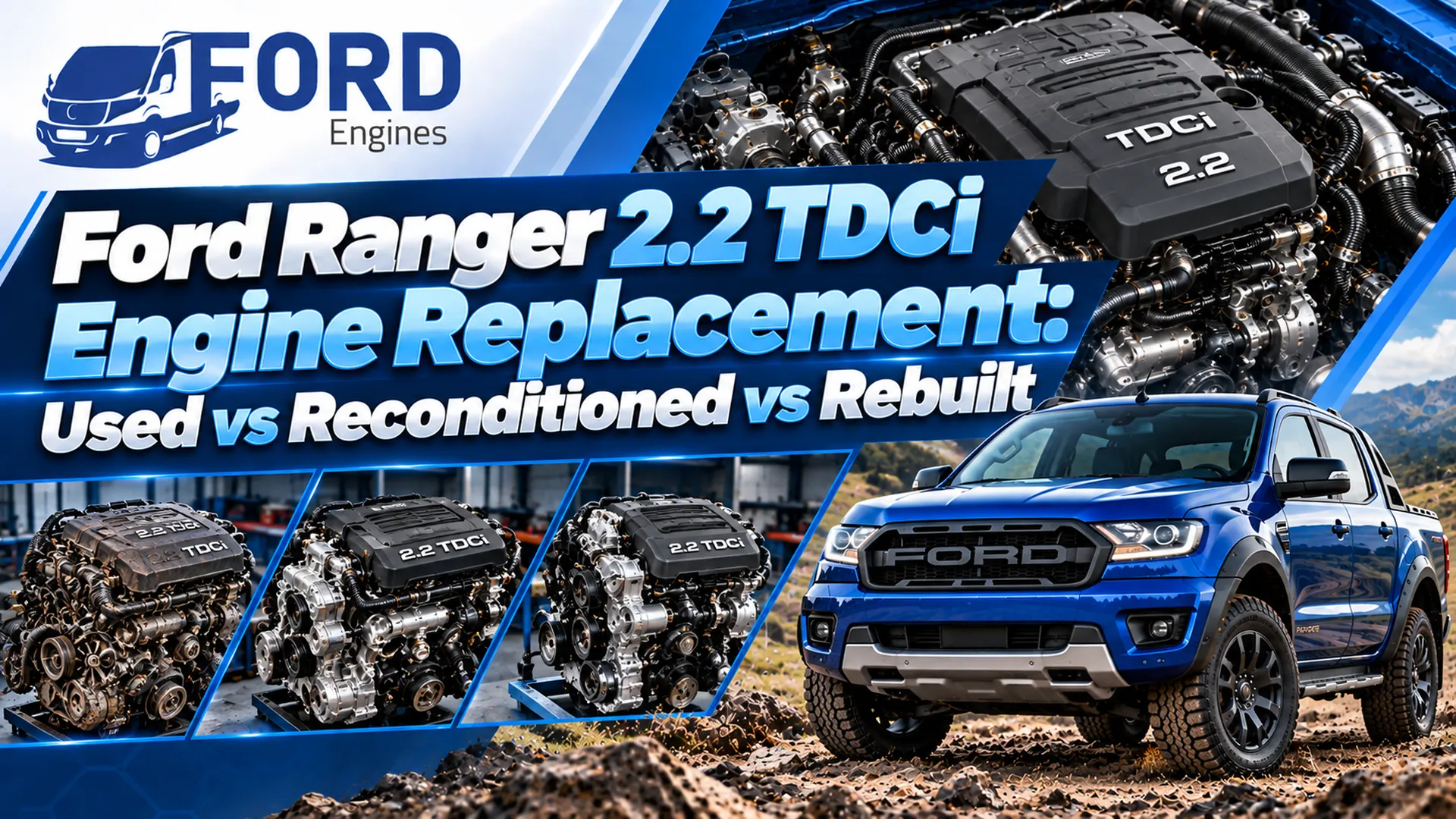
At some point, repeated component repairs stop making financial sense, and that's when replacement enters the conversation. Here's how to think about it clearly.
When Does a 2.2 TDCi Engine Need Replacing?
Replacement generally becomes the sensible option when:
- You're facing internal engine damage (e.g., a failed timing chain that's caused valve or piston damage)
- The cost of repairing multiple failing components (turbo, injectors, EGR) approaches or exceeds the cost of a replacement engine
- The engine has suffered catastrophic failure, a snapped timing chain, a seized turbo that's sent debris through the intake, or severe overheating damage
- You want long-term reliability rather than a patchwork of repeated repairs on an ageing unit
Used vs Reconditioned vs Rebuilt Engines Compared
This is one of the most common points of confusion for Ranger owners, and getting it right matters, both for your budget and your peace of mind.
Factor | Used Engine | Reconditioned Engine | Rebuilt Engine |
| Initial cost | Lowest | Mid-range | Highest |
| Condition | Variable, depends on donor vehicle mileage and history | Inspected, with key wear components replaced | Fully stripped and rebuilt to spec |
| Mileage | Whatever the donor engine had | Often reset or significantly reduced wear | Effectively "as new" on wear components |
| Warranty | Usually limited or short-term | Typically stronger, often 6–12 months | Usually the strongest available |
| Best suited for | Budget-conscious replacement, older vehicles | Owners planning to keep the vehicle long-term | Major failures or those wanting maximum assurance |
A real-world scenario: if your Ranger is a 2014 model with 140,000 miles and you're planning to keep it another 3–4 years, a reconditioned engine usually offers the best balance of cost and reliability. If it's a newer, lower-mileage vehicle that's suffered an isolated catastrophic failure, a rebuilt engine protects your investment for the long haul. If you're running an older commercial vehicle purely for utility and cost is the priority, a used engine with a verified low-mileage history can be a perfectly sound choice.
How Much Does a Ford Ranger 2.2 TDCi Engine Replacement Cost?
Costs vary depending on engine condition, warranty length, and whether you're paying for supply-only or supply-and-fit. As a general guide, your total replacement cost should factor in:
- Engine unit price (used, reconditioned, or rebuilt)
- Labour for removal and installation
- Fluids, oil, coolant, and any required top-ups
- Gaskets, seals, and belts/chains replaced during fitting
- Turbo inspection or replacement, if not already covered
- Injector testing, to confirm the existing injectors are fit to pair with the "new" engine
- Diagnostics, both pre- and post-fit
- Warranty terms and what they actually cover
- Delivery, if sourcing the engine separately from the fitting garage
Getting a detailed, itemised quote, rather than a single lump figure, lets you compare suppliers properly and avoid surprise add-ons partway through the job.
What to Check Before Buying a Replacement Engine (Code & Compatibility)
Before committing to any replacement engine, confirm:
- The exact engine code matches your vehicle (not just "2.2 TDCi" generically)
- Transmission compatibility, manual and automatic variants aren't always interchangeable without additional parts
- Emissions equipment compatibility, particularly around EGR and DPF systems, which can differ between production years
- The supplier's warranty terms in writing, including what's covered and for how long
- Whether the price includes supply only or supply and fit
Buying Guide & Frequently Asked Questions
Pre-Purchase Checklist for a Used Ford Ranger 2.2 TDCi
If you're looking at buying a used Ranger with this engine rather than replacing one, a short but thorough inspection can save you from inheriting someone else's problem.
- Check the service history for consistent, on-schedule oil and filter changes
- Start the engine cold and watch for smoke, rough idle, or hesitation
- Listen for turbo whistle or unusual rattling during a test drive under load
- Run a diagnostic scan to check for stored fault codes, even if the warning light isn't currently on
- Ask about DPF regeneration history, frequent forced regenerations suggest short-journey use
- Inspect for oil leaks around the turbo, sump, and timing chain cover
- Verify the mileage against MOT history for consistency
A Ranger with thin paperwork and a suspiciously low price is rarely a bargain once you factor in what might be hiding underneath.
Frequently Asked Questions
Is the Ford Ranger 2.2 TDCi a good engine?
Yes, generally. It's a well-engineered diesel capable of high mileage when properly maintained, though it does have known wear points around the turbo, injectors, and EGR/DPF system that owners should stay ahead of.
How many miles can a 2.2 TDCi engine do?
With regular servicing, 150,000 to 200,000+ miles is realistic. Poorly maintained examples can develop serious issues well before that.
Does the Ford Ranger 2.2 TDCi have a timing chain or belt?
Most UK-market 2.2 TDCi engines use a timing chain rather than a belt, though it's worth confirming your specific engine code and market, as configurations have varied.
Why does my Ranger 2.2 TDCi keep going into limp mode?
Limp mode is triggered by the ECU detecting a fault, commonly related to boost pressure, EGR/DPF issues, or a sensor fault. A diagnostic scan will identify the specific trigger.
Is a reconditioned engine better than a used engine?
It depends on your priorities. A reconditioned engine generally offers stronger reliability and warranty coverage for a higher price, while a used engine can be a cost-effective option if verified with good mileage and history.
How much does a Ford Ranger 2.2 TDCi engine replacement cost?
Costs depend on the engine type (used, reconditioned, or rebuilt) and whether fitting is included. Always request an itemised quote covering the engine, labour, and associated parts rather than a single flat figure.
What causes a Ford Ranger 2.2 TDCi to lose power?
Power loss is most often linked to turbo problems, a failing EGR valve, a blocked DPF, or injector wear, all of which a proper diagnostic scan can narrow down quickly.
Final Thoughts
The Ford Ranger 2.2 TDCi has earned its reputation as a dependable diesel workhorse, but that reputation depends heavily on how well it's been looked after. Turbo whistles, injector rattle, EGR faults, and DPF struggles aren't random bad luck; they're predictable outcomes of mileage, maintenance gaps, and driving patterns. Catching them early is almost always cheaper than waiting for them to escalate.
If your Ranger's engine has reached the point where repair no longer makes financial sense, or you're planning ahead for a replacement, getting the right engine, matched by code, backed by a genuine warranty, and properly fitted, is what separates a smooth transition from another round of headaches down the line.
Not sure whether your Ranger needs a repair or a full replacement? Get in touch with our team at Ford Engines for straightforward advice on your specific engine code, an honest assessment of your options, and a clear, itemised quote, whether that's a used, reconditioned, or fully rebuilt 2.2 TDCi engine, supplied and fitted with confidence.