
Your Ranger drops into limp mode halfway up a hill with a trailer on the back. Or the oil light flickers after a service. Or there's a faint rattle at idle that wasn't there last month.
Whatever brought you here, you need to know three things. How serious is it? Can you keep driving? And is this a repair or a replacement job?
This guide covers the Ford Ranger 3.2 engine problems owners and workshops see most often, how to tell a bolt-on component fault from genuine engine damage, and what your options are when the engine is beyond saving. It applies to the 3.2-litre five-cylinder TDCi (Duratorq, also known as the Puma or P5AT) only. The 2.2 TDCi, 2.0 EcoBlue and 2.0 Bi-Turbo have different fault profiles, so we keep them out of this page.
We supply Ford engines across the UK, so we'll tell you plainly when a repair is worth it and when it isn't.
What Are the Most Common Ford Ranger 3.2 TDCi Engine Problems, and How Serious Is Each One?
The 3.2 TDCi is a 3,198cc inline-five turbo-diesel with common-rail injection, fitted to the T6/PX Ranger (PX1, PX2 and PX3) in Wildtrak, XLT and Limited trims, in manual and automatic form. The same engine family also appears in the Ford Everest and Mazda BT-50, so you will see those names in parts catalogues.
It produces strong torque and handles towing well. It also has a handful of known weak points. Most of them are manageable if you catch them early, and a few are not.
Is the Ford Ranger 3.2 TDCi Reliable, and Which Faults Come Up Most?
Short answer: yes, it can be a capable and long-lasting engine, but its lifespan depends heavily on servicing, oil quality and how the truck is used. A Ranger that tows regularly and gets serviced on time is a different proposition from one that has spent years on short journeys with stretched oil changes.
The table below is the one we wish more articles included. It ranks each common fault by severity, so you know whether to keep driving or stop.
Problem | Typical symptoms | Severity | Can you keep driving? | First diagnostic step |
| Oil pump / low oil pressure | Oil warning light, ticking, knocking | Critical | No. Stop and get it checked | Oil pressure test |
| Timing chain wear | Rattle at start-up or idle | Critical if rattling persists | Avoid | Chain and tensioner inspection |
| Turbo / boost fault | Whistle, loss of boost, smoke | High | Limited | Boost pressure test |
| EGR cooler failure | Coolant loss, white smoke | High | Avoid if coolant is dropping | Cooling-system pressure test |
| DPF blockage | Warning light, reduced power | Medium to high | Depends on the warning | Diagnostic scan |
| Injector faults | Rough idle, smoke, hard starting | Medium to high | Limited | Injector test |
One distinction matters more than any other. A component fault is not engine failure. A failed turbo, a clogged EGR valve or a leaking intercooler hose is a repair. Low oil pressure that has already damaged the bearings is a different story, and that is where rebuilds and replacement engine come in.
Why Is My Ford Ranger 3.2 Losing Power, Smoking, Overheating or Showing an Oil Warning Light?
Symptoms are how most owners find out something is wrong. Here's how to read them, starting with the most common complaint.
What Should I Check First When My Ford Ranger 3.2 Loses Power or Goes Into Limp Mode?
Loss of power has several possible causes, and guessing is expensive. A sensible workshop works through them in order, from cheapest and easiest to the more involved checks:
- Read the fault codes. An OBD scan tells you which system is complaining. Be aware that some owners report power loss and an rpm ceiling with no obvious code, so a clean scan does not mean a clean bill of health.
- Check boost pressure and inspect the intercooler hoses. A split or loose hose leaks boost, and the truck feels flat, especially under load or uphill. This is a very common cause, and a cheap one to fix.
- Check the turbo actuator. The variable geometry turbo relies on its actuator to control boost. A sticking or failing actuator can cause low boost or overboost.
- Inspect the EGR system. A valve stuck open from carbon build-up hurts power and idle quality.
- Check the DPF. A blocked filter raises exhaust back pressure and can trigger limp mode. This is common on trucks that rarely complete a regeneration.
- Check fuel rail pressure and the injectors. Weak fuel delivery or worn injectors cause hesitation, misfires and smoke.
Treat limp mode as a message, not a fault in itself. Each of these systems can trigger it.
Matching smoke and other symptoms to the likely cause:
- Black smoke usually points to too much fuel or too little air. Think injectors, boost leaks, a restricted intake or an EGR fault.
- White smoke on a warm engine, combined with coolant loss, should make you suspect the EGR cooler. Treat it seriously, because coolant entering the combustion chamber can cause hydrolock or head gasket damage.
- Blue smoke means burning oil, which can come from a worn turbo or worn engine internals.
- Rough idle and hard starting often trace back to injectors, glow plugs, sensors (MAF, MAP, crankshaft or camshaft position) or the EGR valve.
- Overheating and coolant loss need immediate attention, whether the cause is the EGR cooler, a leaking hose, a failed thermostat or a cooling fan fault.
A short scenario shows how this plays out. A Ranger owner notices the truck feels flat on a motorway incline and the temperature gauge sits a touch high. Topping up coolant every few weeks seems like a minor chore. By the time white smoke appears at start-up, the EGR cooler has been leaking for months. A cooler replacement would have been a fraction of the cost of the head gasket repair that follows. Small signs matter.
Here is what the main fault systems look like on this engine:
Turbocharger and boost problems. Warning signs include a whistle or whine, a rattle from the turbo, loss of boost and sluggish acceleration. Before condemning the turbo, rule out boost leaks, charge pipes, intercooler hoses and the actuator. Replace the turbo only once those checks are clear.
Injector problems. Common-rail injectors are sensitive to fuel contamination, and worn injectors, damaged seals or injector cup issues can cause rough idle, misfires, hard starting and smoke. After injector replacement, the new units usually need coding, and the high-pressure fuel pump should be assessed if contamination is suspected.
EGR valve and EGR cooler problems. Carbon builds up in the EGR valve and intake manifold over time. The cooler is a bigger concern, because an internal leak sends coolant into the engine. Coolant loss with no visible leak is the classic clue.
DPF problems and regeneration issues. The diesel particulate filter burns off soot during regeneration, which needs sustained speed and heat. Short journeys interrupt the process, soot accumulates and reduced power follows. Forced regeneration or professional DPF cleaning resolves many cases when caught early.
What Causes Low Oil Pressure, Knocking or Rattling on a Ford Ranger 3.2, and Can It Destroy the Engine?
Yes, it can, and this is the section to take seriously.
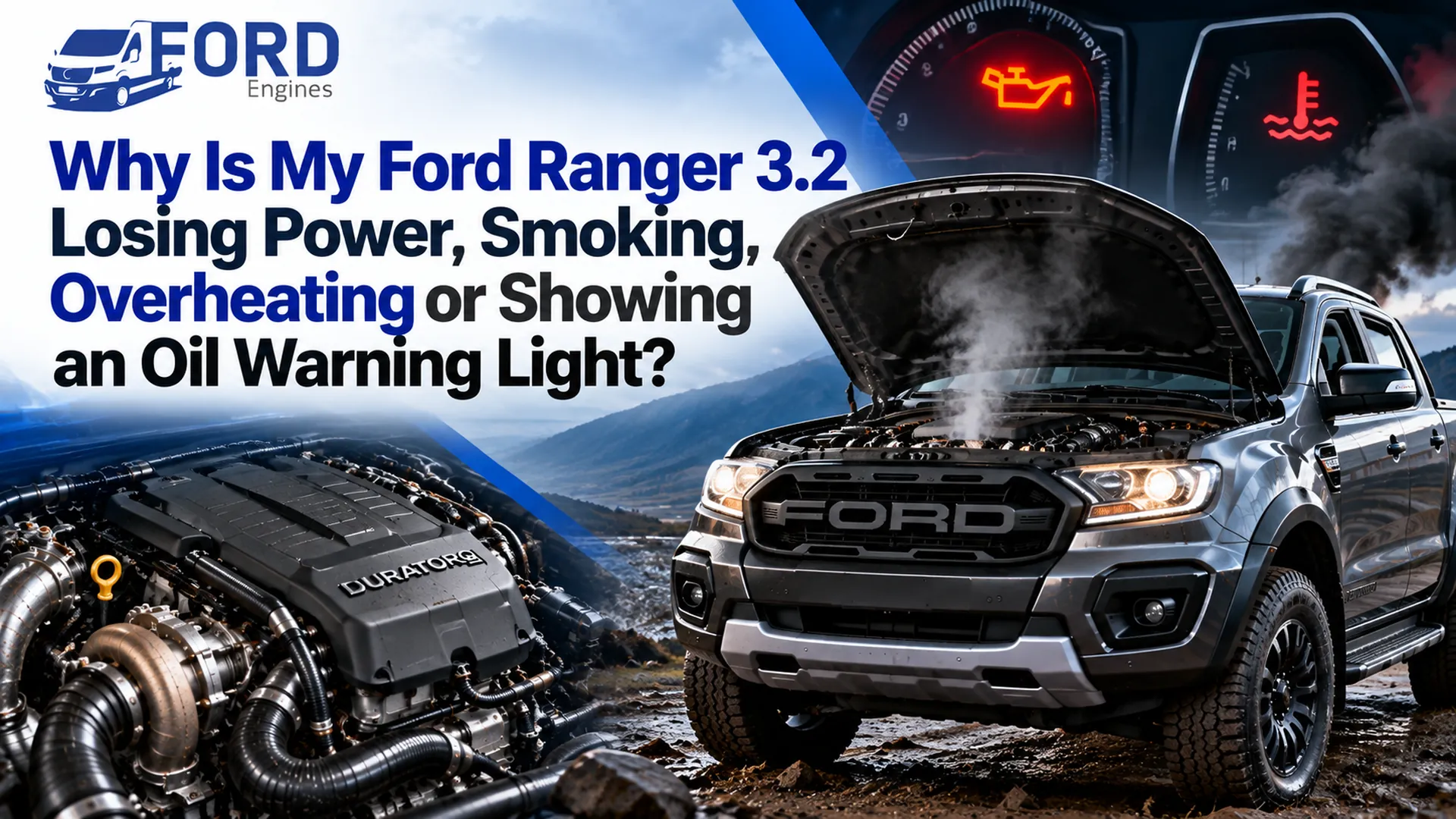
The 3.2 TDCi is widely discussed for oil pump and low oil pressure problems. When the pump cannot maintain pressure, bearings, the crankshaft and camshaft lubrication all suffer. The warning signs are an oil pressure warning light, ticking, knocking or a rattle that gets worse as the engine warms up.
Common causes include:
- A worn or failing oil pump or its drive, which reduces pressure
- Oil contamination or the wrong oil specification, which affects lubrication
- Oil starvation after a service, where the pump fails to prime properly
- Timing chain wear, which causes a rattle and, if ignored, timing failure and internal damage
Oil pump priming deserves a mention. The 3.2 uses a variable displacement oil pump, and some owners report an oil warning light after an oil change. Always follow Ford's official procedure for servicing and priming, and ask your workshop how they handle it. Confirm wording with your technician before publishing.
If the oil light comes on or the engine starts knocking, stop driving. Driving even a short distance with no oil pressure can turn a repairable fault into a bearing failure and a seized engine. At that point you are looking at a rebuild or a replacement engine.
Is It Worth Repairing a Ford Ranger 3.2 Engine, and How Much Does Repair or Replacement Cost in the UK?
Once you know what's wrong, the question becomes whether to fix it or replace it. Here's how we think about it.
When Does a Ford Ranger 3.2 Fault Mean Engine Replacement Instead of Repair?
Start with the type of damage.
Repair first when the fault is a bolt-on component:
- Turbocharger or actuator
- Intercooler hoses or charge pipes
- EGR valve or EGR cooler
- DPF cleaning or regeneration
- Injectors, sensors and glow plugs
These parts sit around the engine, not inside it, so replacing them does not touch the core internals. If the rest of the engine is healthy, repair is usually the sensible route.
Consider a rebuild or replacement when the damage is internal:
- Bearing damage or a knocking bottom end
- Metal particles in the oil
- Low compression on a compression test
- Confirmed head gasket or cylinder head damage
- Timing chain failure with internal damage
- Hydrolock from coolant or fuel entering the cylinders
A useful rule: if the repair quote approaches the cost of a tested reconditioned engine, replacement usually wins. That is especially true on a high-mileage truck, where fixing one failure often reveals another.
If you are weighing a rebuild against a replacement, ask what is actually worn. A rebuild makes sense when the block and crankshaft are sound. A replacement makes sense when the damage is widespread or the labour cost of a strip-down is high.
How Much Does Ford Ranger 3.2 Engine Repair or Replacement Cost in the UK?
Prices vary too much by vehicle, condition and workshop for any single figure to be honest. What we can do is show you what drives the cost, so you can judge a quote.
Job | What affects the price |
| Diagnosis | Depth of testing (scan, oil pressure, boost, compression) |
| EGR valve or cooler repair | Part cost, labour access, coolant and flush |
| DPF cleaning | Cleaning versus replacement, regeneration needs |
| Injector replacement | Number of injectors, coding, fuel system flush |
| Turbo replacement | New versus remanufactured, related hoses and oil feed |
| Oil pump repair | Labour-intensive, as the job is deep in the engine |
| Timing chain work | Parts, labour and what else is found worn |
| Head gasket repair | Machining, head condition, coolant system checks |
| Engine rebuild | Extent of wear, parts needed, labour |
| Used engine | Mileage, condition and engine code |
| Reconditioned engine | Testing, parts replaced and warranty |
| Supply and fit | Distance, fitting time and related parts |
Be cautious of any quote that looks cheap but says little. Ask what is included, what the warranty covers and which related parts are being replaced.
Which Replacement Engine Should I Buy for My Ford Ranger 3.2, and Who Can Supply and Fit It in the UK?
If the engine cannot be saved, you have three realistic routes.
Should I Choose a Used, Reconditioned or Rebuilt Ford Ranger 3.2 Engine?
Used | Reconditioned | Rebuilt | |
| What it is | Taken from a donor vehicle and tested | Cleaned, inspected, worn parts replaced | Stripped and rebuilt with new internals |
| Price tier | Lowest | Mid-range | Highest |
| Condition | Depends on donor history | Known, tested condition | Closest to like-new |
| Warranty | Insert your terms | Insert your terms | Insert your terms |
| Best for | Tight budget, older truck | Most owners wanting value | Towing, heavy use, long-term ownership |
How to decide:
- Older Ranger on a tight budget? A tested used engine with a known history and warranty can be a sensible choice.
- Keeping the truck for years? A reconditioned engine usually offers the best balance of cost and confidence.
- Towing heavy loads or covering big mileage? A rebuilt unit is worth the extra.
Before you pay for any engine, check:
- Engine code and compatibility. Confirm by registration or VIN, because the Ranger, Everest and BT-50 share engine families but not every fitting.
- Mileage and condition. Ask for it in writing.
- Service and oil history. Oil pump, timing chain and EGR history all matter on a 3.2.
- Warranty terms. Know what is covered and for how long.
- Related parts. Replace the oil pump check, timing chain components, EGR cooler, thermostat and fuel filter while the engine is out if they are due. It is far cheaper than doing them twice.
If you are buying a used Ranger 3.2 rather than an engine, apply the same logic. Ask for service history, check for previous limp mode or no-start episodes, and have a specialist inspect the oil system, turbo, injectors and EGR before you commit. A pre-purchase inspection costs far less than a failed engine at 100,000, 150,000 or 200,000 miles.
How to prevent a repeat failure:
- Use the correct oil specification and change it on time
- Replace fuel and air filters at the proper intervals
- Give the DPF regular long runs so it can regenerate
- Keep the coolant fresh and watch the level
- Have the timing chain and oil pressure checked at high mileage
- Fix small boost leaks and sensor faults before they grow
Can fordengines.co.uk Supply and Fit a 3.2 TDCi Engine for My Ranger, and How Do I Get a Quote?
- Send us your registration. We use it to identify your exact variant.
- We confirm the engine and compatibility and check what is available.
- You receive a clear quote covering the engine, delivery and fitting options.
What you can expect from us: warranty length, testing process, delivery coverage and customer reviews or ratings.
A Ranger back at work beats one sitting on the drive. Request a quote online, and we'll give you an honest recommendation and an engine that matches your truck.
Frequently Asked Questions
What are the common problems with the Ford Ranger 3.2?
The most common are oil pump and low oil pressure issues, turbo and intercooler hose boost faults, EGR valve and cooler problems, DPF blockage, injector wear and timing chain wear. Severity ranges from a routine repair to full engine failure.
Is the Ford Ranger 3.2 TDCi reliable?
It can be, with correct servicing, the right oil and a healthy DPF and EGR system. Most serious failures trace back to neglected maintenance or ignored warning signs.
How long does a Ford Ranger 3.2 engine last?
Many reach well over 100,000 miles, and some go much further. Lifespan depends on oil quality, service intervals, towing use and how early faults are fixed.
What mileage is too high for a Ford Ranger 3.2?
There is no hard cutoff. A well-documented truck at 150,000 miles can be a better buy than a neglected one at 80,000. Service history matters more than the number on the clock.
Does the Ford Ranger 3.2 have a timing chain or a wet belt?
It uses a timing chain confirm for your stock. Listen for rattling at start-up, and have it inspected at higher mileage.
What causes a Ford Ranger 3.2 to go into limp mode?
Common causes include boost leaks, turbo actuator faults, EGR problems, a blocked DPF, sensor faults and fuel system issues. A diagnostic scan is the first step.
Can a blocked DPF cause loss of power?
Yes. A blocked DPF raises exhaust back pressure, reduces power and can trigger limp mode.
What are the symptoms of a bad oil pump?
An oil pressure warning light, ticking or knocking, and in serious cases a rattle that worsens as the engine warms. Stop driving and get it tested.
What causes EGR cooler failure, and can it damage the engine?
Heat cycling, age and coolant-system issues are common causes. A leaking cooler can send coolant into the engine, which risks overheating, hydrolock and head gasket damage.
Is it worth rebuilding a Ford Ranger 3.2 engine?
Often, when the block and crankshaft are sound. If the damage is widespread, a reconditioned or replacement engine may cost less overall.
How much does a Ford Ranger 3.2 engine replacement cost?
It depends on the engine code, condition type, mileage and whether you need supply only or supply and fit. Insert your price ranges or invite a quote.
What should I check before buying a used Ford Ranger 3.2?
Service history, oil pump and timing chain records, EGR and DPF history, any previous reduced-power or no-start events, and a specialist inspection.
Is the Ford Ranger 3.2 good for towing?
Yes, its torque suits towing, though heavy use puts more strain on the oil system, turbo and DPF, so servicing needs to keep pace.
How often should a Ford Ranger 3.2 be serviced?
Follow Ford's schedule for your model year verify interval, and shorten it for towing, short journeys or heavy use.
Final Thoughts: Act Early, and Don't Drive on Warning Lights
Most Ford Ranger 3.2 engine problems give you warning. Boost leaks, EGR faults and DPF issues are repairable when caught early. Oil pressure problems and rattles are the ones that cannot wait.
If your Ranger is losing power, smoking or showing a warning light, get it diagnosed before the problem spreads. If the engine has already failed, we will help you choose between a used, reconditioned or rebuilt replacement, and we will tell you honestly if a repair makes more sense.