

Your Ranger's just lost a bit of shove on the motorway slip road. Or maybe there's a faint knocking under the bonnet that wasn't there last month. Perhaps the oil light flickered on for a second and you're now Googling at 11pm wondering if you should be worried.
You should, a little. Not panicking-in-a-layby worried, but worried enough to read on.
Ford Rangers are tough, capable pickups, and across the 2.2 TDCi, 3.2 TDCi, and 2.0 EcoBlue engines, most owners get years of solid, dependable service out of them. But every one of these engines has known weak points, and the vast majority of Ranger engine failures we see could have been caught, and fixed cheaply, if the early symptoms had been recognised sooner. This guide breaks down exactly what those common Ford Ranger engine problems look like, engine by engine and component by component, so you know precisely what you're dealing with and what to do next.
What Are the Most Common Ford Ranger Engine Problems?
Before diving into specific faults, it helps to understand the shape of the problem. Ford Ranger engine issues generally cluster around a handful of systems: the timing/lubrication system (wet belt and oil pump), the emissions system (EGR and DPF), the fuel system (injectors), and the turbocharger. Almost every symptom you'll notice as a driver, noise, smoke, power loss, warning lights, traces back to one of these.
Here's a quick reference before we go deeper into each one.
Problem | Affected Engines | Typical Symptoms | Severity |
| Wet belt failure | 2.0 EcoBlue | Low oil pressure, rattling, engine damage | Critical |
| Oil pump failure | 2.2 TDCi, 3.2 TDCi, 2.0 EcoBlue | Low oil pressure warning, ticking noise | Critical |
| EGR valve/cooler issues | 2.2 TDCi, 3.2 TDCi, 2.0 EcoBlue | Limp mode, poor performance, warning light | High |
| DPF blockage | All diesel models | Power loss, warning light, poor economy | High |
| Injector faults | All diesel models | Rough idle, misfire, black smoke | High |
| Turbocharger issues | All diesel models | Whining noise, blue smoke, loss of boost | High |
| Overheating/coolant loss | Various | Rising temp gauge, coolant leak | High |
Notice how many of these point back to the same root causes, oil starvation and heat. That's not a coincidence. A diesel engine under load generates enormous stress on its lubrication and cooling systems, and the Ranger's various engine generations each have their own specific vulnerability in that chain.
Ford Ranger Engine Problems by Engine Type, 2.0 EcoBlue vs 2.2 TDCi vs 3.2 TDCi
The Ranger has been sold with three distinct diesel engine families in the UK, and lumping them together does owners a disservice, because their common faults are genuinely different.
- 2.2 TDCi (earlier PX/PX2 models): A four-cylinder Duratorq diesel that's generally well-regarded for durability, but still suffers from EGR, DPF, and turbo issues typical of any high-mileage common-rail diesel.
- 3.2 TDCi (Wildtrak and higher trims): A five-cylinder engine with strong low-end torque, but it's the model most associated with oil pump failure and EGR cooler problems, particularly on vehicles that have missed servicing intervals.
- 2.0 EcoBlue (PX3 and later models): Ford's more modern, efficient diesel, but it's also the engine fitted with a wet belt (belt-in-oil) timing system, which is the single biggest engine reliability concern across the current Ranger range.
Which Ford Ranger Engine Has the Most Problems?
If we're being straightforward about it, the 2.0 EcoBlue attracts the most concern among specialists and owners alike, not because it's a badly engineered engine, but because the wet belt design is genuinely unforgiving of poor maintenance and short-journey driving. The 3.2 TDCi's oil pump issue runs a close second in terms of potential severity. The 2.2 TDCi tends to be the most forgiving of the three, though it's not without its own EGR and DPF headaches.
How Serious Are Ford Ranger Engine Problems?
Not every fault carries the same risk, and treating a dirty MAF sensor with the same urgency as a failing wet belt helps nobody. It's worth thinking about Ranger engine problems in four tiers:
- Minor, things like a slightly dirty MAF sensor or a minor oil seep that affect performance marginally but won't cause sudden failure
- Moderate, EGR carbon buildup or early-stage DPF blockage, which reduce performance and economy and need attention but rarely cause catastrophic damage if caught in reasonable time
- Serious, turbo whining, injector misfires, or persistent warning lights, which indicate active component wear and risk escalating if ignored
- Catastrophic, wet belt degradation and oil pump failure, both of which can starve the engine of lubrication and lead to a full rebuild or replacement if not caught early
That last tier is the one worth losing a little sleep over, and it's where we'll spend the most time below.
Ford Ranger Engine Problems by Component
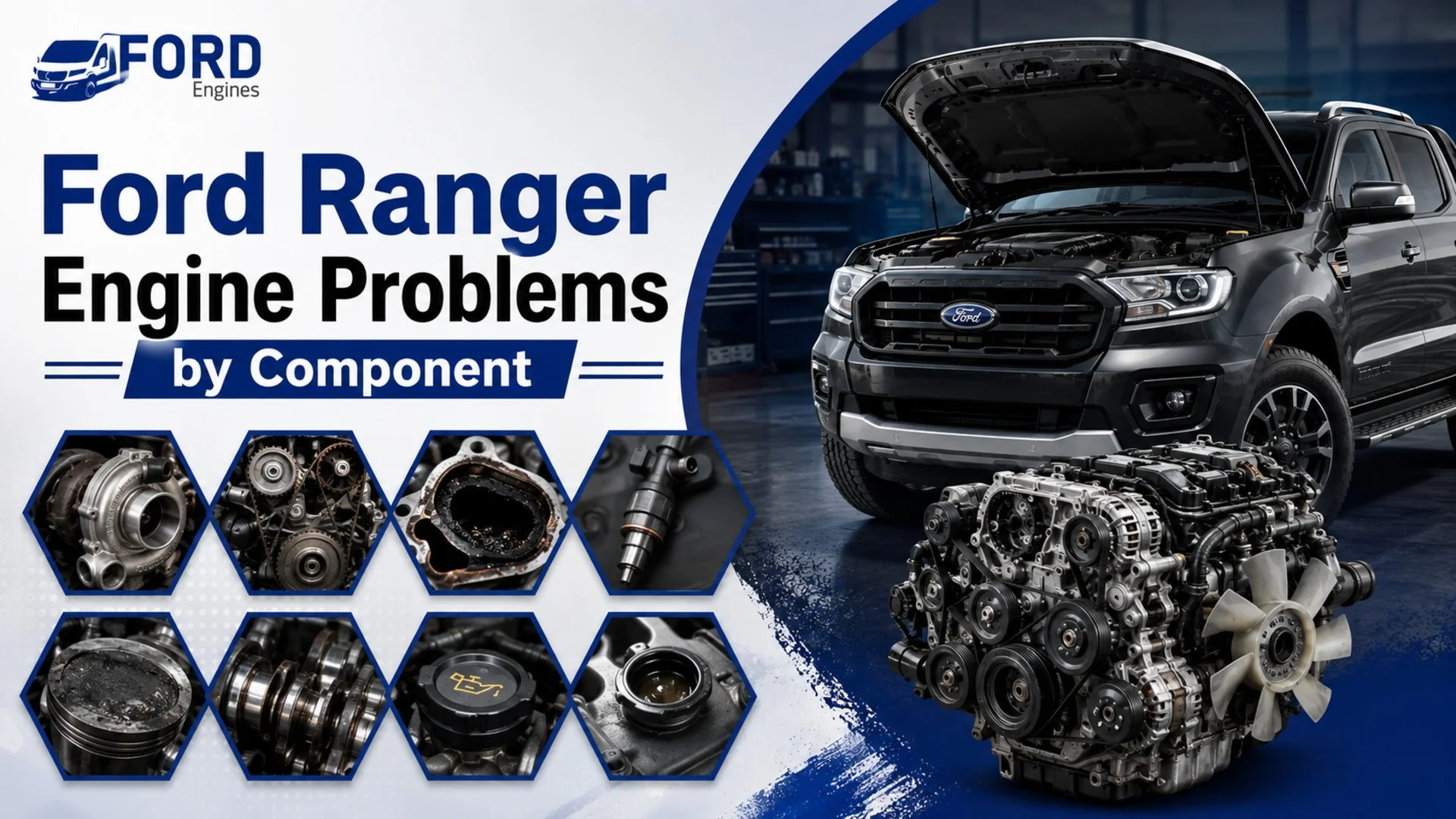
Understanding symptoms is useful. Understanding why they happen is what actually helps you make a good decision about repairs. Here's the breakdown by system.
Ford Ranger Wet Belt Problems (2.0 EcoBlue)
The wet belt, sometimes called an oil-pump belt or belt-in-oil system, runs submerged in engine oil rather than out in the open like a conventional timing belt. It's a design Ford adopted to cut friction and improve efficiency on the EcoBlue engine, and it works fine when it's in good condition. The trouble starts as the rubber compound ages inside that oil bath and begins shedding material.
What Causes Ford Ranger Wet Belt Failure?
The belt material degrades over time, particularly on vehicles that do a lot of short journeys where the oil never gets fully up to temperature, or where service intervals have been stretched beyond what the belt can tolerate. As it breaks down, fibres and debris enter the oil circuit and can block the oil pickup strainer in the sump, starving the oil pump of supply and dropping oil pressure across the whole engine.
How Do I Know If My Ford Ranger Wet Belt Is Failing?
Watch for a rattling or ticking noise on cold start, a flickering low oil pressure warning light, reduced power, or, if you're having an oil change done, visible rubber debris or unusually contaminated oil in the sump. Any one of these on a 2.0 EcoBlue Ranger warrants an inspection sooner rather than later. We've written a full breakdown of this in our Ford wet belt symptoms guide, which covers the warning signs in far more depth if you want to check your car against a complete list.
Ford Ranger Oil Pump Problems
Oil pump failure is one of the more serious faults across the 3.2 TDCi and, to a lesser extent, the 2.2 TDCi and 2.0 EcoBlue. Once oil pressure drops, every moving part inside the engine, bearings, camshaft, crankshaft, is running with reduced or no lubrication, and that kind of wear compounds fast.
What Causes Low Oil Pressure on a Ford Ranger?
A handful of things can cause it: worn oil pump gears, a blocked pickup strainer (sometimes from wet belt debris on EcoBlue models, sometimes from general sludge buildup on older engines), the wrong oil viscosity being used, or simply an engine that's overdue an oil change and running on oil that's broken down past its useful life. A low oil pressure warning light should never be driven through, pull over, check the level, and get it inspected.
Ford Ranger Turbocharger Problems
The turbo is doing serious work on any Ranger diesel, and it relies entirely on clean oil supply and correct boost pressure to stay healthy.
What Does a Failing Ford Ranger Turbo Sound Like?
A failing turbo often produces a distinct whining or whistling noise that rises and falls with engine revs, sometimes accompanied by blue smoke from the exhaust, a sign that oil is getting into the combustion chamber past worn turbo seals. You might also notice a loss of boost, where acceleration feels flat compared to how the truck normally pulls. Left unaddressed, a failing turbo can shed metal fragments into the intake system, causing far more expensive damage downstream.
Ford Ranger Injector Problems
Common-rail diesel injectors on the Ranger are precision components, and even small calibration drift affects how the engine runs.
Typical signs of injector wear include a rough idle that you can feel through the seat, hard starting (especially in cold weather), black smoke under acceleration, an audible "injector knock" that's sharper than normal diesel clatter, and a noticeable drop in fuel economy as the injectors fail to deliver fuel efficiently. A specialist can run injector balance tests via diagnostics to confirm which cylinder, if any, is underperforming before recommending replacement.
Ford Ranger EGR and DPF Problems
These two systems are closely linked and worth discussing together, since a fault in one often accelerates problems in the other.
The EGR valve recirculates a portion of exhaust gas back into the intake to reduce emissions, and over time carbon buildup can cause it to stick open or closed. A stuck EGR valve typically triggers limp mode, a rough idle, or a check engine light. The EGR cooler, particularly on 3.2 TDCi models, can also develop internal leaks that let coolant mix with exhaust gas, a fault that's more expensive to fix and easy to miss until coolant levels start dropping unexpectedly.
The DPF (diesel particulate filter) traps soot from the exhaust and needs periodic high-temperature regeneration to burn that soot off. Rangers used mainly for short trips or low-speed driving often can't complete a full regeneration cycle, leading to a blocked filter, a DPF warning light, and a noticeable loss of power.
What Causes a Ford Ranger to Go Into Limp Mode?
Limp mode is the engine control unit's protective response to a fault it considers risky to ignore, commonly a failed EGR sensor, a boost pressure fault from the turbo, a blocked DPF, or a serious oil pressure issue. It deliberately restricts power and revs to reduce the chance of further damage while you get the vehicle checked. Don't ignore it and don't try to "drive it off", get a diagnostic scan done.
How to Recognise Ford Ranger Engine Failure Symptoms
Sometimes you won't know which specific component is at fault, you'll just know something feels wrong. Here's how to translate what you're experiencing into what it likely means.
Ford Ranger Losing Power Under Acceleration
A Ranger that feels noticeably weaker than it used to, particularly when overtaking or climbing a gradient, points toward a handful of usual suspects: a failing turbo unable to build boost, a blocked DPF restricting exhaust flow, a stuck EGR valve confusing the engine management system, or injector wear affecting fuel delivery. The pattern of the power loss is a useful clue, gradual loss over weeks suggests a filter or carbon buildup issue, while sudden loss often points to a sensor fault or boost leak.
Ford Ranger Engine Knocking, Ticking or Rattling Noise
Noise diagnosis is genuinely one of the more useful skills an owner can develop, because different faults sound different:
- A ticking noise on cold start that fades as the engine warms often relates to oil pressure delay or, on EcoBlue models, early wet belt wear
- A rattling noise that persists, especially under load, can indicate more advanced belt or timing component wear
- A knocking noise, particularly if it's deep and rhythmic, is more concerning and can point toward bearing wear from prolonged low oil pressure
- A whining noise that changes pitch with engine speed usually points to the turbocharger rather than the internal engine components
If you're ever unsure which category a noise falls into, it's worth having it assessed rather than guessing, the cost difference between an early diagnosis and a seized engine is enormous.
Ford Ranger Smoke Problems
What Does Black, Blue and White Smoke Mean on a Ford Ranger?
Smoke colour tells a clear diagnostic story, and it's one of the fastest ways to narrow down a fault without even opening the bonnet.
- Black smoke usually indicates the engine is burning too much fuel relative to air, often an injector problem, a boost pressure fault, or a dirty air filter restricting intake
- Blue smoke points to oil being burned in the combustion chamber, commonly from worn turbo seals or, in more advanced cases, worn piston rings
- White smoke in small amounts on a cold morning is often just condensation and nothing to worry about, but persistent white smoke once the engine's warm can indicate a coolant leak into the combustion chamber, a sign of a more serious issue like a failing EGR cooler or head gasket
Ford Ranger Hard Starting or Rough Idle
Struggling to start, particularly in cold weather, combined with a lumpy or uneven idle once running, generally points toward the fuel system, worn injectors, a failing fuel pump, or occasionally a glow plug fault on the diesel engines. Rough idle on its own, without starting trouble, more often suggests a specific injector underperforming or an EGR-related timing disruption.
Ford Ranger Overheating and Coolant Loss
An engine temperature gauge creeping toward the red zone, or coolant that keeps needing topping up, deserves immediate attention. Common causes include a failing water pump, a leaking EGR cooler, a stuck thermostat, or a radiator/hose leak. Overheating is one of the few faults on this list where continuing to drive can cause immediate and severe damage, a warped cylinder head or blown head gasket can happen within minutes of sustained overheating, so if the gauge is climbing, stop and let the engine cool before continuing.
Diagnosing, Fixing and Preventing Ford Ranger Engine Problems
Recognising a symptom is step one. Getting an accurate diagnosis and making a sound repair decision is what actually protects your engine, and your wallet.
How Is a Ford Ranger Engine Problem Diagnosed?
A proper diagnostic process goes beyond plugging in a code reader and reading whatever pops up. A thorough check typically includes a full OBD2 scan for stored and pending fault codes, an oil pressure test to confirm readings against Ford's specification, a boost pressure test if turbo performance is in question, injector balance testing to isolate underperforming cylinders, a visual inspection of belts, hoses, and the cooling system, and a review of service history to understand what maintenance has (or hasn't) been done. This last point matters more than most owners realise, a Ranger with patchy service history and unknown oil specification history is a genuinely different risk profile to one with a complete, consistent record.
How Much Does Ford Ranger Engine Repair Cost?
Costs vary hugely depending on what's actually wrong, which is exactly why accurate diagnosis matters before agreeing to any work. A dirty MAF sensor clean is a minor expense. Wet belt or oil pump replacement done proactively, before failure, sits in the moderate range. But an engine that's suffered oil starvation damage, bearings, camshaft, or worse, can mean a rebuild or full replacement, which is a substantially bigger bill. The gap between "caught it early" and "ignored it too long" on a Ranger engine is often the difference between a few hundred pounds and several thousand.
Repair, Rebuild or Replace, Which Is Right for Your Ford Ranger?
This decision usually comes down to a handful of practical factors:
- Extent of damage, a single failed component (turbo, injector, oil pump) usually means a straightforward repair; widespread internal damage from oil starvation often tips the balance toward rebuild or replacement
- Vehicle age and mileage, a repair makes more financial sense on a newer, lower-mileage Ranger; a high-mileage truck nearing the end of its practical life might be better served by a reconditioned or used engine
- Vehicle value, it rarely makes sense to spend more on an engine rebuild than the truck is currently worth, unless there's strong sentimental or operational reason to keep it
- Downtime, if the Ranger is a working vehicle, a reconditioned engine swap is often faster than a full rebuild, minimising time off the road
A specialist should walk you through these trade-offs with real numbers specific to your vehicle, rather than defaulting to the most expensive option.
Which Ford Ranger Engine Is Most Reliable?
Taken as a whole, the 2.2 TDCi has the strongest reputation for straightforward, low-drama reliability, provided EGR and DPF maintenance hasn't been neglected. The 3.2 TDCi delivers excellent low-end torque and is generally robust, but its oil pump vulnerability means service history is critical. The 2.0 EcoBlue is the most modern and efficient of the three, and when properly maintained, with regular oil changes and the wet belt inspected or replaced at appropriate intervals, it's a genuinely good engine. Its reputation suffers mainly because the consequences of neglect are more severe than on the older engines, not because it's inherently less well built.
Should You Buy a Ford Ranger With Engine Problems?
If you're looking at a used Ranger and the seller has disclosed a known fault, the honest answer is: it depends entirely on what the fault is and what it'll cost to put right. A dirty EGR valve or overdue DPF regeneration is a minor negotiating point. Evidence of low oil pressure history, a rattling wet belt, or a smoking turbo should prompt a full independent inspection before you commit, and the cost of that repair should come straight off your offer. Buying a Ranger with a known engine issue can still be a smart purchase, provided the price reflects the real cost of fixing it, not just what the seller feels like knocking off.
Frequently Asked Questions
How long does a Ford Ranger engine last?
With consistent servicing and no neglected faults, Ranger diesel engines routinely cover well over 150,000-200,000 miles. The engines that fall short of this usually do so because of missed maintenance, stretched oil change intervals, ignored warning lights, or a wet belt left well past its recommended service point, rather than any inherent design shortfall.
What is the worst Ford Ranger engine?
There isn't a genuinely "bad" Ranger engine in the current lineup, but the 2.0 EcoBlue attracts the most caution due to its wet belt design, which is less forgiving of poor maintenance than a traditional timing chain or dry belt. With proper care, it performs well.
Should I replace the wet belt early?
In most cases, yes. Because wet belt failure can escalate quickly from a belt issue to widespread oil starvation damage, replacing it proactively, based on age, mileage, or early symptoms, is significantly cheaper and lower-risk than waiting for it to fail outright.
What causes a Ford Ranger to lose power?
The most common causes are a blocked DPF, a failing turbocharger, a stuck EGR valve, or worn injectors affecting fuel delivery. The specific pattern of the power loss, sudden versus gradual, usually helps narrow down which one is responsible.
Is the Ford Ranger expensive to repair?
Routine repairs are broadly in line with other mid-size diesel pickups. Where costs escalate is when a fault has been left unaddressed long enough to cause secondary damage, a low oil pressure warning ignored for a few thousand miles, for example, can turn an affordable oil pump repair into a full engine rebuild.
Get Your Ford Ranger Checked Before a Small Problem Becomes a Big One
Every fault covered here, from a whining turbo to a rattling wet belt, gives some kind of warning before it becomes catastrophic. The engines that fail expensively are almost always the ones where those early signs were noticed and then quietly ignored for another few thousand miles.
If your Ranger's showing any of the symptoms above, whether it's a 2.2 TDCi, 3.2 TDCi, or 2.0 EcoBlue, the smartest move is getting it properly diagnosed now rather than waiting to see if it gets worse. A proper diagnostic check costs a fraction of what a neglected fault can turn into, and it gives you a clear, honest picture of exactly what your engine needs.
Get in touch to book a Ford Ranger engine diagnostic, and find out exactly what's going on under the bonnet before it decides for you.