

If your Ford Ranger has suddenly lost power, thrown up a DPF warning light, or flashed up a "drive to clean" message on the dash, you're probably somewhere between confused and mildly panicked. The good news: DPF problems are one of the most common issues we see on Ranger diesels, and in most cases, they're entirely fixable, provided you understand what's actually happening and act before things escalate.
This guide walks through the full picture: what a DPF does, why Ford Rangers develop problems with theirs, how to read the warning signs, how a proper diagnosis works, and what your realistic options are, from a simple regeneration to a full replacement. We'll also cover the fault codes and engine-specific quirks that matter most, because a 2.2 TDCi Ranger and a 2.0 EcoBlue Ranger don't always fail in the same way.
What Are the Symptoms and Causes of Ford Ranger DPF Problems?
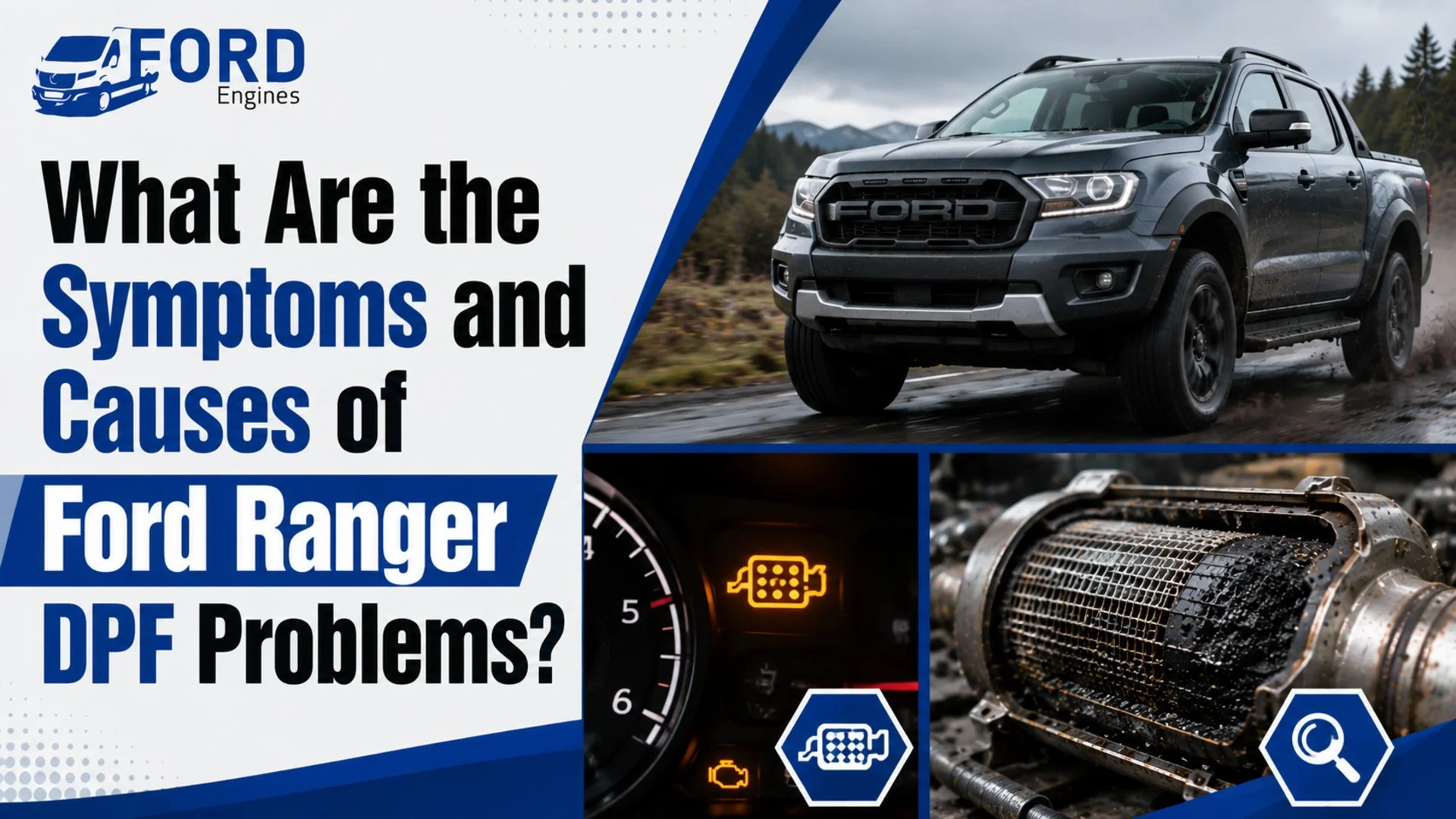
A Diesel Particulate Filter (DPF) sits in the exhaust system and physically traps soot particles produced during combustion, stopping them from being released into the atmosphere. Over time, that trapped soot needs to be burned off through a process called regeneration, and when that process doesn't happen properly, problems start.
Ford Ranger DPF problems typically build up gradually rather than appearing overnight, which is actually good news: it means there's usually a window to catch things before you're facing a full blockage or a limp-mode breakdown on the side of the road.
What Are the Warning Signs of a Blocked Ford Ranger DPF?
Most owners first notice something's wrong through one of these signs:
- The DPF warning light illuminating on the dashboard, sometimes alongside the general engine management light
- Reduced engine power or a noticeable flatness under acceleration
- Limp mode, where the vehicle restricts revs and won't let you accelerate normally
- Increased fuel consumption, since the engine works harder to push exhaust gases through a restricted filter
- Excessive or unusual exhaust smoke, particularly black smoke under load
- A strong exhaust smell, sometimes described as sooty or acrid
- Repeated regeneration attempts, where the engine seems to be trying to clean the filter far more often than normal
If you're seeing more than one of these together, say, reduced power alongside a warning light, that's usually a sign the filter has moved from "needs attention soon" to "needs attention now."
DPF Warning Light, Limp Mode & "Drive to Clean" Message
One message worth calling out specifically is "Exhaust Filter Overloaded – Drive to Clean." This is Ford's own system telling you, in plain terms, that the DPF has accumulated enough soot that it needs a sustained high-speed run to trigger regeneration and burn it off.
Here's a genuinely common real-world scenario: an owner uses their Ranger almost exclusively for the school run and short trips to the shops, five or ten minutes at a time, rarely getting the engine properly warm. After a few weeks of this pattern, the "drive to clean" message appears. If it's ignored and the short-journey pattern continues, the message escalates to a solid warning light, followed by reduced power, and eventually limp mode. At that point, a fifteen-minute motorway run often isn't enough anymore, the soot load has built up beyond what passive or active regeneration can clear on its own, and a professional forced regeneration or DPF clean becomes necessary.
What Causes a Ford Ranger DPF to Block or Fail?
DPF blockage isn't usually caused by a single fault, it's typically the result of driving conditions and mechanical issues compounding each other over time.
Short Journeys, Urban Driving & Interrupted Regeneration
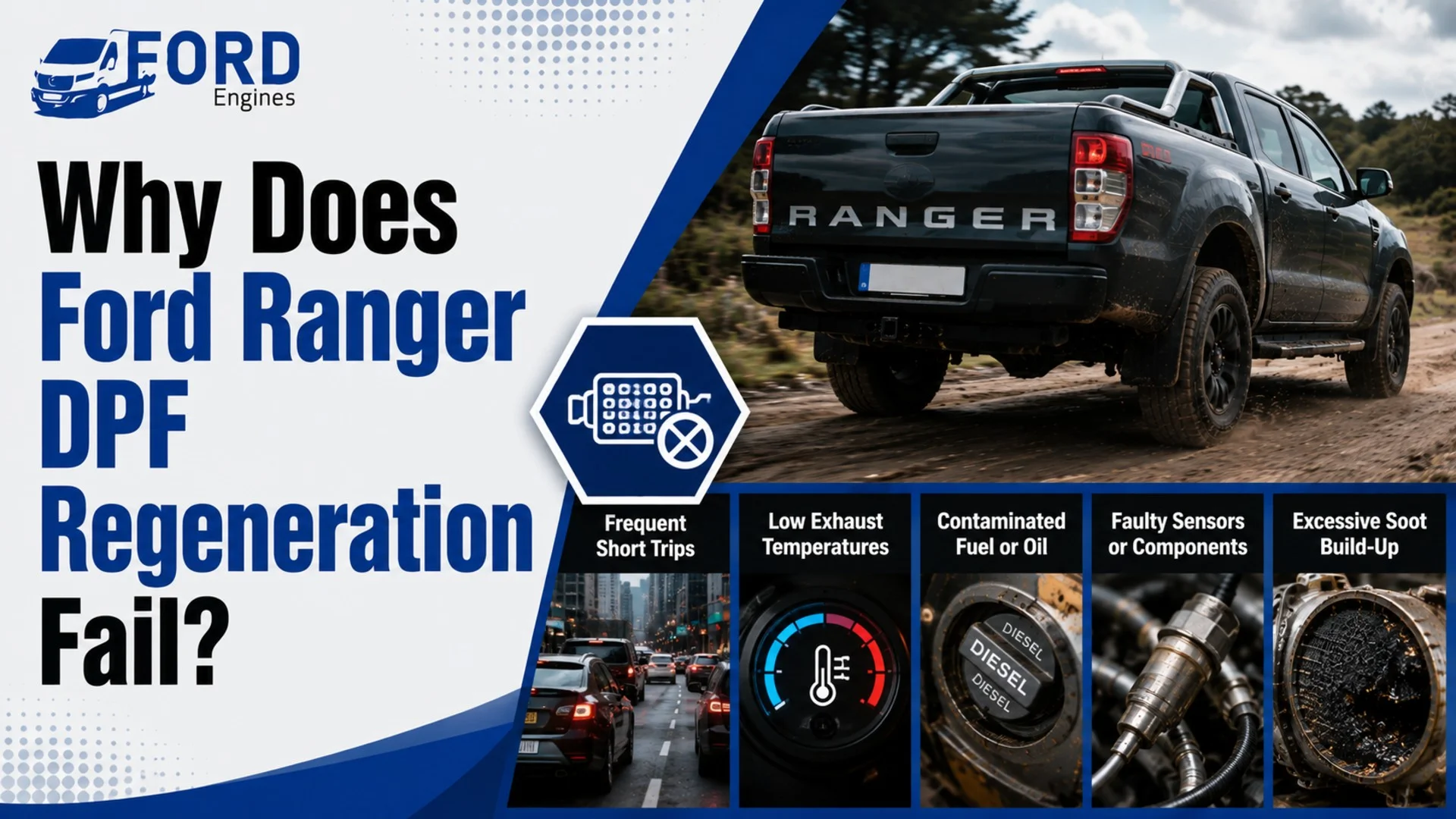
This is, by far, the most common root cause. The DPF needs sustained high exhaust temperatures to burn off trapped soot through regeneration. Short journeys, stop-start urban driving, and low-speed trips simply don't generate enough heat for long enough, the engine often shuts off again before regeneration has finished, which is what's known as interrupted regeneration.
Every interrupted cycle leaves a bit more unburned soot behind. Do this repeatedly, which is exactly what happens with a vehicle used mainly for short local trips, and soot accumulation builds steadily until the filter becomes restricted.
Faulty Sensors, EGR, Injector & Turbo Faults
Driving habits aren't the only cause. Mechanical and sensor faults elsewhere in the system can prevent regeneration from working correctly even on vehicles that get plenty of motorway miles:
- Faulty DPF pressure sensor, gives the ECU inaccurate readings on filter restriction, which can prevent regeneration from triggering when it's actually needed
- Faulty exhaust temperature sensor, if the ECU doesn't get an accurate temperature reading, it may not recognise that regeneration conditions have been met
- EGR valve or cooler faults, a sticking or leaking EGR valve changes combustion characteristics and can increase soot production
- Injector faults, poor fuel atomisation from worn injectors increases incomplete combustion, adding to soot load
- Turbocharger faults, reduced boost pressure affects combustion efficiency and exhaust flow, both of which influence regeneration
This is exactly why DPF problems that keep coming back, even after a clean or replacement, are often a sign that an underlying sensor or component fault was never properly diagnosed in the first place.
Why Does Ford Ranger DPF Regeneration Fail?
How Does DPF Regeneration Work? (Passive, Active & Forced)
Regeneration is the process of burning off accumulated soot inside the filter, and it happens in three different ways depending on driving conditions:
- Passive regeneration happens automatically during normal motorway-speed driving, where exhaust temperatures are naturally high enough to burn off soot continuously without the driver noticing anything.
- Active regeneration is triggered by the ECU when soot load reaches a set threshold. The engine management system adjusts fuel injection timing to deliberately raise exhaust temperature and burn off the soot, this is the process most owners notice as slightly changed engine note, a cooling fan running longer, or a temporary rise in idle speed.
- Forced regeneration is a manual process carried out with a diagnostic tool, typically by a technician, when the vehicle's own systems haven't managed to clear the filter through passive or active regeneration alone.
Understanding which type your Ranger is attempting (and failing) at helps massively when it comes to diagnosis, a vehicle that's failing active regeneration on the driveway is a very different problem to one that's already needed three forced regenerations in six months.
Why Won't My Ford Ranger DPF Regenerate?
If regeneration keeps failing or won't trigger at all, the cause is usually one of the following:
- Soot load has already exceeded the threshold where active regeneration alone can clear it
- A faulty pressure or temperature sensor is giving the ECU inaccurate data
- Driving pattern never sustains the conditions (speed, load, duration) needed to complete a cycle
- An underlying fault, EGR, injector, or turbo, is affecting combustion enough that regeneration can't complete properly
- The DPF has ash accumulation rather than just soot, which regeneration cannot burn off (ash is a non-combustible by-product of oil additives and requires physical cleaning or replacement)
That last point trips a lot of owners up. Regeneration burns off soot, but it does nothing for ash, a separate, non-combustible residue that gradually builds up over the life of the filter regardless of driving style. Eventually, even a perfectly maintained DPF will need cleaning or replacement simply because of ash accumulation, not because anything's gone wrong.
Common DPF Fault Codes (P2002, P242F, P2458, P2463)
A diagnostic scan is the fastest way to narrow down what's actually happening, and certain fault codes come up repeatedly on Ranger DPF issues:
- P2002, DPF efficiency below threshold, typically indicating restriction or a failing filter
- P2003, similar efficiency fault, often paired with P2002
- P242F, DPF ash accumulation indicated, pointing toward a cleaning or replacement need rather than a sensor fault
- P2458, DPF regeneration duration issue, suggesting incomplete or excessively long regen cycles
- P2459, DPF regeneration frequency issue, often linked to short-journey driving patterns
- P2463, soot accumulation detected, one of the most commonly reported Ranger DPF codes
- P2464, related soot/ash accumulation fault
- P246C / P244A, additional efficiency and pressure-related codes that can appear alongside the above
These codes are a starting point, not a final answer. A code pointing to soot accumulation doesn't automatically tell you why the soot built up, that's where proper diagnosis, covered below, comes in.
How Are Ford Ranger DPF Problems Diagnosed and Fixed?
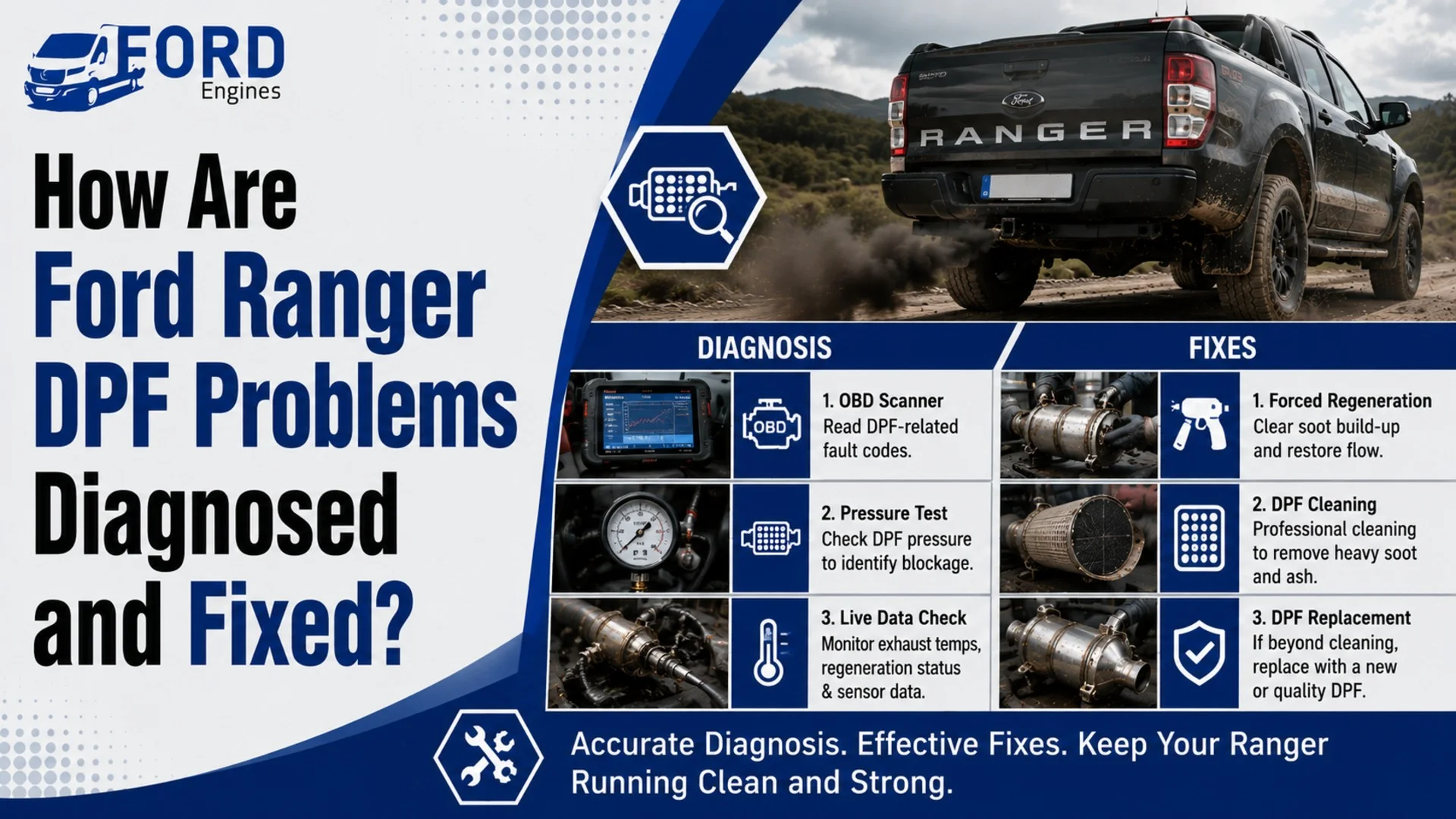
How Is a Ford Ranger DPF Problem Diagnosed?
A proper diagnosis goes well beyond simply reading and clearing a fault code. A thorough approach typically checks:
- Fault codes and freeze-frame data from the ECU
- Differential pressure across the DPF, to assess actual restriction
- Exhaust temperature readings, to see whether regeneration conditions are being met
- Soot load and ash load percentages via live data
- Regeneration history, to see how many cycles have been attempted and whether they completed
- Related systems, EGR, injectors, turbo, to rule out (or confirm) an underlying cause
Checking Pressure, Temperature, Soot Load & Live Data
This is where diagnosis genuinely separates a quick fix from a problem that returns within weeks. For example, if live data shows a soot load of 45% but the pressure sensor reading looks implausible against that figure, it strongly suggests the pressure sensor itself is faulty, not just the filter. Clearing the code and doing a forced regeneration in that case might get the warning light off temporarily, but the vehicle will likely be back with the same symptoms within a short period, because the actual fault (the sensor) was never addressed.
This is precisely the kind of detail that separates a specialist diagnosis from a quick code-read-and-clear, and it's why owners sometimes report DPF problems returning even after a replacement filter, when the real issue was a sensor or EGR fault the whole time.
Ford Ranger DPF Problems by Engine (2.2 TDCi, 3.2 TDCi, 2.0 EcoBlue)
Not every Ranger engine behaves identically when it comes to DPF issues. Here's how the three most common units compare:
Engine | Common DPF Tendency | Typical Contributing Factor |
| 2.2 TDCi | Frequent soot accumulation | Common on vehicles used mainly for short/urban journeys |
| 3.2 TDCi | Ash accumulation over time | Higher-mileage vehicles, often needs cleaning even with good driving habits |
| 2.0 EcoBlue | Combined DPF/SCR emissions faults | More complex system (works alongside AdBlue/SCR), so faults can involve multiple emissions components at once |
The 2.0 EcoBlue is worth a specific mention because it's the most mechanically complex of the three, it combines DPF technology with SCR (Selective Catalytic Reduction) and AdBlue dosing. A DPF-related warning on a EcoBlue Ranger can sometimes actually stem from an AdBlue system fault rather than the filter itself, which makes accurate diagnosis even more important on this generation.
DPF Cleaning vs Forced Regeneration vs Replacement, Which Do You Need?
This is usually the question owners actually want answered, and the right choice depends entirely on what the diagnosis reveals:
Situation | Likely Solution |
| Soot load high, filter otherwise healthy, no underlying fault | Forced regeneration |
| Soot and ash accumulated, filter structurally sound | Professional DPF cleaning |
| Filter physically damaged, cracked, or ash load beyond safe limits | DPF replacement |
| Regeneration keeps failing despite clean filter | Investigate sensors, EGR, injectors, not the filter |
A forced regeneration is the least invasive and cheapest option, but it only works if the filter itself is still in workable condition, it can't fix ash buildup or physical damage. Professional cleaning goes further, physically removing both soot and ash from the filter media. Replacement is the last resort, reserved for filters that are cracked, melted, or so heavily ash-loaded that cleaning won't restore proper flow.
How Much Does Ford Ranger DPF Repair Cost, and FAQs
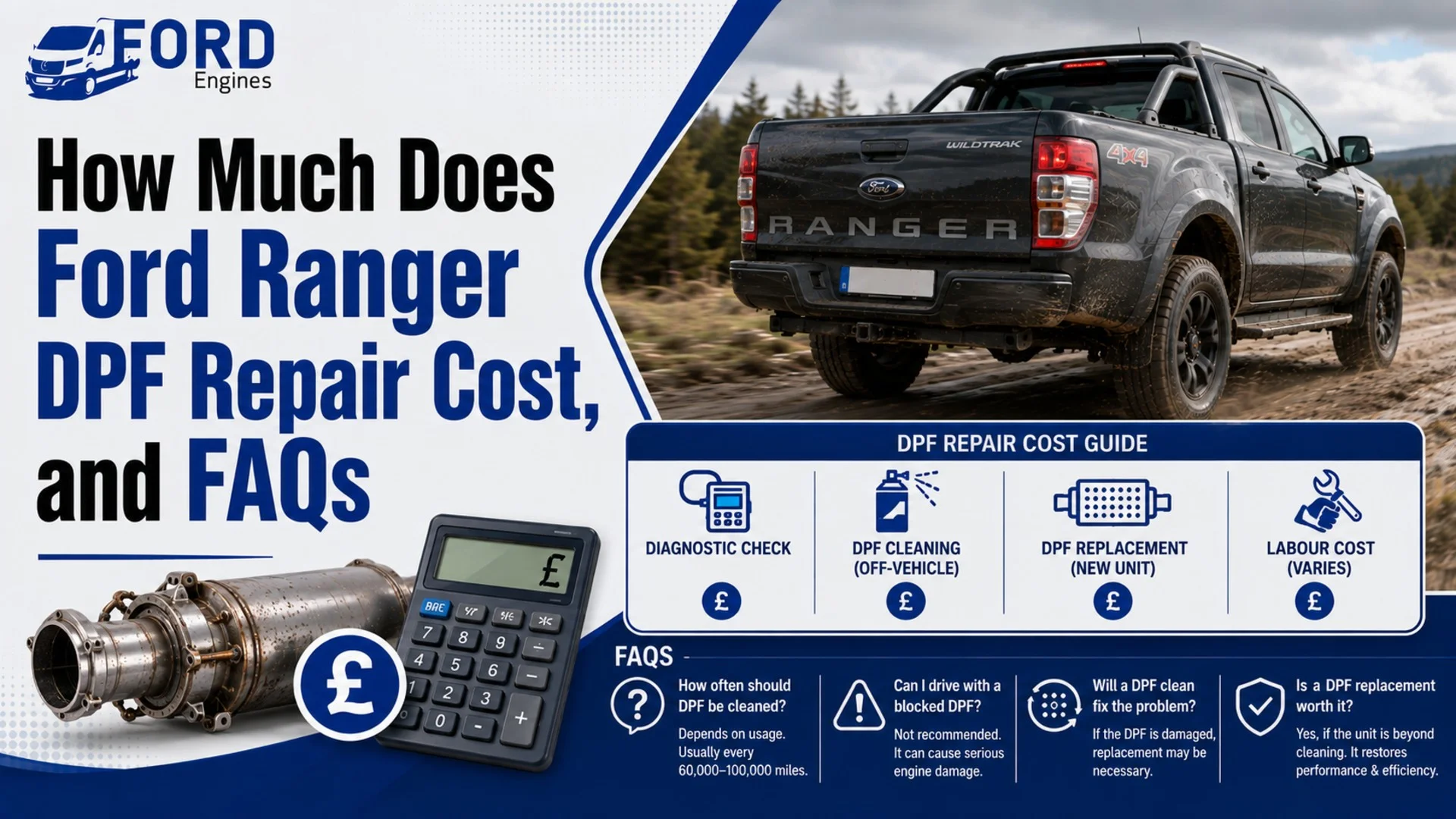
Ford Ranger DPF Cleaning & Replacement Cost in the UK
Costs vary depending on the specific issue, but as a general UK guide:
- Forced regeneration: typically the most affordable option, often in the £50–£150 range as a standalone service
- Professional DPF cleaning: commonly falls between £250–£450, depending on the extent of soot/ash buildup and whether the filter needs removing
- DPF replacement: the most expensive option, generally ranging from £900–£1,800+ depending on whether OEM or quality aftermarket parts are used, and whether related sensors need replacing at the same time
It's worth being cautious of unusually cheap "DPF delete" services, beyond the emissions and legal implications, removing the DPF doesn't fix the underlying cause of the problem, and an MOT will fail a vehicle with a removed or non-functional DPF.
How to Prevent Ford Ranger DPF Problems Returning
Once a DPF issue has been properly resolved, a few habits go a long way toward preventing it from coming straight back:
- Take a sustained motorway or dual-carriageway run (ideally 20+ minutes at higher revs) at least once every week or two if your normal driving is mostly short trips
- Use the correct, Ford-approved engine oil specification, since low-quality or incorrect oil can increase ash accumulation
- Don't ignore early warning messages like "drive to clean", responding immediately is far cheaper than waiting for limp mode
- Keep up with servicing, since worn injectors, a failing EGR valve, or turbo issues left unaddressed will keep loading the DPF with soot
- Avoid excessive idling, which doesn't generate enough heat for regeneration and just adds unburned fuel and soot to the system
Ford Ranger DPF FAQs
Why is my Ford Ranger DPF light on?
It usually means the system has detected soot or ash accumulation beyond a normal threshold, or a fault preventing regeneration. A diagnostic scan will confirm the specific cause.
Why does my Ford Ranger keep regenerating?
Frequent regeneration attempts typically point to a driving pattern that doesn't allow cycles to complete (short journeys), or a sensor issue causing the ECU to trigger regeneration more often than necessary.
Can short journeys damage a Ford Ranger DPF?
Yes. Short, low-speed trips are one of the leading causes of DPF blockage, since they don't generate enough sustained exhaust temperature for regeneration to complete.
Can a blocked DPF cause limp mode?
Yes. Once restriction reaches a certain point, the ECU limits engine power to protect the engine and encourage the driver to address the issue, this is limp mode.
Should I clean or replace my Ford Ranger DPF?
It depends on the filter's condition. If it's structurally sound but clogged with soot and ash, cleaning is usually sufficient and considerably cheaper than replacement. A proper diagnosis will confirm which applies to your vehicle.
Can an EGR fault cause DPF problems?
Yes. A faulty EGR valve can alter combustion and increase soot production, contributing to DPF blockage even if the filter itself starts out in good condition.
How long does Ford Ranger DPF regeneration take?
Active regeneration typically takes 10–20 minutes of sustained driving to complete. Forced regeneration carried out by a technician usually takes around 30–45 minutes
DPF problems rarely fix themselves, and the longer a warning light or "drive to clean" message goes ignored, the more likely you are to end up facing a full replacement instead of a straightforward regeneration or clean. If your Ford Ranger is showing any of the symptoms covered here, whether that's a warning light, reduced power, or regeneration that just won't complete, get it properly diagnosed rather than guessing. A specialist who works on Ranger diesels regularly can pinpoint whether you're dealing with straightforward soot buildup or an underlying sensor, EGR, or injector fault, and get you back on the road with a fix that actually lasts.