
Your Ranger has lost its pull on the hills. Or it's pouring smoke, knocking on a cold start, or flashing a warning light and dropping into limp mode. Now you're wondering whether the Ford Ranger engine 2.2 can be fixed, or whether the garage is about to tell you it needs a new one.
The honest answer is that it depends on what has failed. Many 2.2 TDCi faults, such as a sticking turbo actuator, a clogged DPF, a dirty EGR valve or tired injectors, are repairable without touching the engine itself. Bearing failure, low oil pressure damage and seizure are different. Those usually mean a replacement engine.
This guide helps you work out which situation you're in. It covers what the 2.2 Duratorq is, how to identify your exact engine, which faults are fixable, and what a Ford Ranger 2.2 replacement engine really costs in the UK. At fordengines.co.uk we supply reconditioned and replacement engines with
What Is the Ford Ranger 2.2 TDCi Engine, and Which Ranger Models Use It?
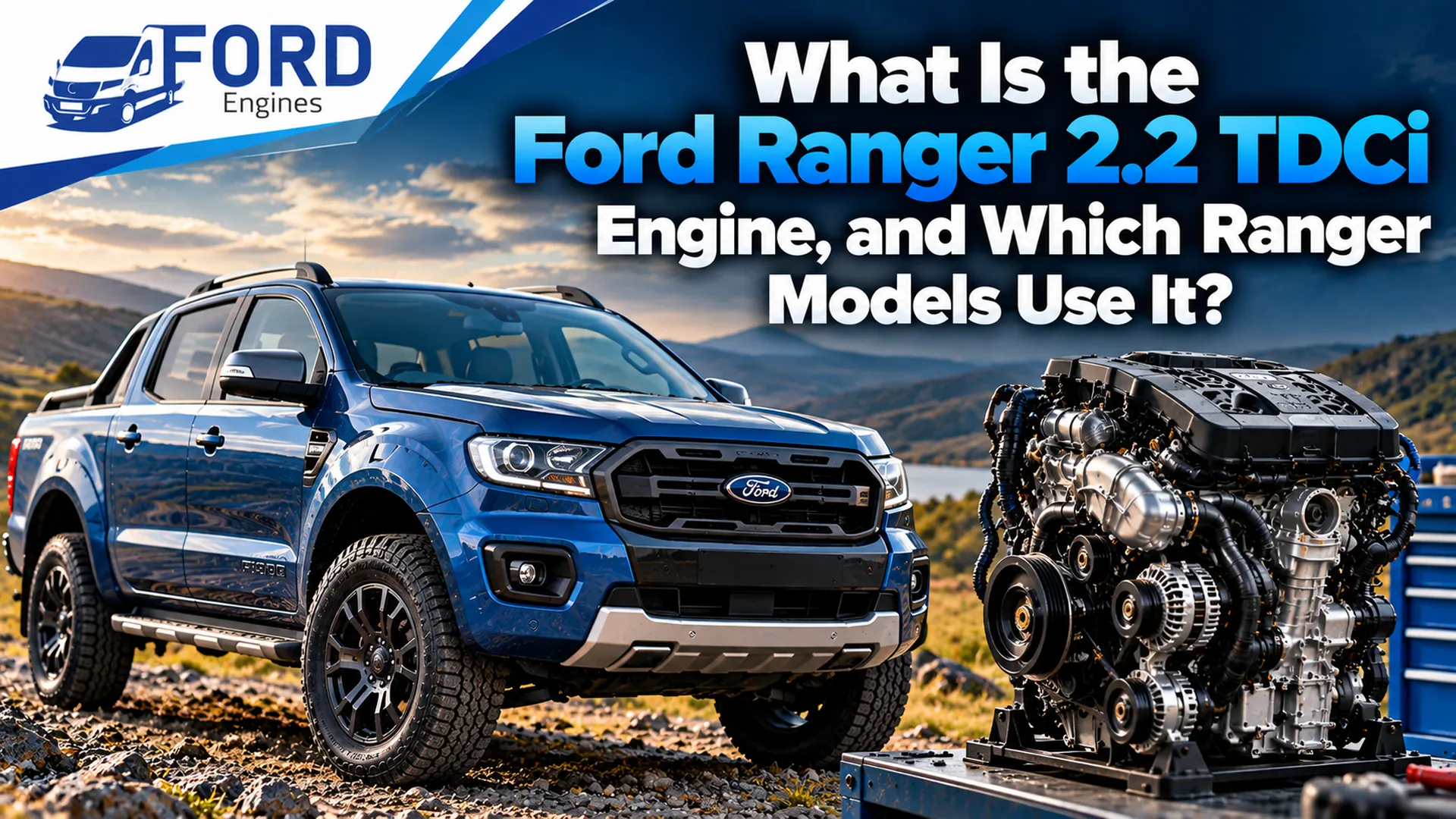
The Ford Ranger 2.2 engine is a 2.2 litre (2,198cc) four-cylinder, turbocharged, common-rail direct-injection diesel from Ford's Duratorq family, sometimes referred to as the Puma diesel. It powers the Ranger T6 generation (often called the PX, PX1 and PX2 depending on the facelift) in trim levels from XL and XLT through to Limited and Wildtrak. It's also fitted to the Ford Transit family and, in other markets, shares its design with the Mazda BT-50 and the Ford Everest. We only comment on Ranger engines here, because fitment across other models is a separate question that needs its own check.
In the UK, the 2.2 is the smaller diesel in the Ranger line-up, sitting below the 3.2 five-cylinder, and later alongside the 2.0 EcoBlue that replaced it. It's a popular choice with tradespeople and small fleets because it's economical, capable of a proper towing load, and cheaper to run than the 3.2.
What Are the Ford Ranger 2.2 Engine Specifications, Power Outputs and Engine Codes?
Here's the quick reference. Items marked should be checked against your records or Ford documentation before publishing.
Detail | Ford Ranger 2.2 TDCi |
| Engine type | Four-cylinder turbocharged diesel, common-rail direct injection |
| Engine family | Ford Duratorq / Puma, often listed as P4AT |
| Displacement | 2,198cc |
| Power outputs | Commonly 125, 150 and 160 PS depending on version and year |
| Torque | verify by output Nm |
| Emissions | Euro 5 on earlier trucks, Euro 6 on later ones |
| Gearboxes | Six-speed manual and six-speed automatic, depending on version |
| Timing system | Timing chain |
Power and emissions go hand in hand. Early 2.2 trucks were Euro 5, and later models were updated to meet Euro 6, which brought changes to the emissions equipment and the engine management. That means two Rangers with a "2.2" badge can need quite different engines, so don't assume a 2.2 is a 2.2.
Engine codes are how suppliers tell these variants apart. You'll see families such as QJ2R, QW2R, QJ2S, QW2S, QJ2W and QW2W, as well as longer GBVA-prefixed codes like GBVAJQJ and GBVAJQW, used on some listings. Which code belongs to which power output and year differs between sources, and published lists often contradict each other. For that reason we match against your registration and your actual engine, not against a generic table.
Where to find yours:
- The V5C logbook gives the engine capacity and often the engine number
- The engine itself carries a stamped number or label, usually on the block
- The vehicle identification number (VIN) lets us look up the factory specification
- Your registration is the quickest route, and it's all we need to get started
Related reading: Ford Ranger 2.2 TDCi engine codes explained and Ford Ranger 2.2 vs 3.2 TDCi: which is better?
How Do I Find My Ranger's Engine Code, and Will a Replacement 2.2 Engine Fit My Van?
Fitment depends on much more than engine size. The right replacement has to match your registration and VIN, the engine code, the power output, the Euro standard, the transmission and the ECU and wiring. Ancillary parts such as the turbo, fuel system and emissions equipment also need to line up.
Here's a scenario we see far too often. An owner finds a "Ranger 2.2 TDCi engine" advertised cheaply online and orders it because the capacity matches. It arrives, and the injection system or sensors don't suit their Euro standard. The engine goes back, the van sits on the drive for another week, and the supposed saving turns into a bill for delivery both ways and extra labour.
A quick checklist before you order anything:
- Registration and VIN
- Engine code and power output (125, 150 or 160 PS)
- Euro 5 or Euro 6
- Manual or automatic
- Any previous engine changes or modifications
Send us your details and we'll confirm the right engine before dispatch.
What Are the Most Common Ford Ranger 2.2 TDCi Engine Problems, and Do They Mean You Need a New Engine?
Is the Ford Ranger 2.2 engine reliable? Generally, yes, when it's serviced on time and not asked to do more than it should. Many 2.2 trucks pass 150,000 miles without major internal work. But like any modern turbo diesel, it has weak points, and most of them sit in the ancillary systems rather than the engine's core.
That's good news. It means the first step is a proper diagnosis, not a replacement.
Why Has My Ranger 2.2 Lost Power, Started Smoking or Gone Into Limp Mode?
Symptoms overlap, which is why guessing is expensive. This table shows the usual suspects and whether the fix normally involves the engine itself.
Symptom | Likely causes | Usually repairable without a new engine? |
| Loss of power / limp mode | Turbo or actuator fault, blocked DPF, sticking EGR valve, boost leak, injector fault, low fuel pressure | Yes, in most cases |
| Black smoke | Injector fault, air intake restriction, EGR or DPF problem | Usually yes |
| Blue smoke | Turbo seal wear, worn piston rings or valve seals | Depends |
| White smoke | Coolant entering the cylinders head gasket, injector fault, unburnt fuel on cold start | Depends |
| Rough idle | Injectors, EGR, fuel system, air leaks, low compression | Usually yes |
| Hard starting | Glow plugs, battery, fuel pressure, injectors, low compression | Often yes |
| Whistling | Turbo, boost hose, intercooler pipe or actuator | Yes |
| Knocking | Bearing wear, timing system, injectors, low oil pressure | Often no |
A common real-world example is the DPF. A Ranger used for short, low-speed trips never gets hot enough to regenerate properly, so soot builds up, the truck loses power, and the warning light appears. Owners sometimes assume the engine is dying. In reality, a forced regeneration, a clean or a DPF replacement fixes it, at a fraction of the cost of an engine.
Turbo trouble can look alarming too. Whistling, smoke and low boost often come from the actuator or a split hose, not a destroyed turbo. And an injector fault can mimic everything from rough running to hard starting, so it's worth testing before replacing parts.
If you'd like a deeper look, see Ford Ranger 2.2 turbo problems, Ford Ranger 2.2 DPF problems, Ford Ranger 2.2 EGR problems and Ford Ranger 2.2 injector problems.
When Is It Cheaper to Repair a Ranger 2.2 Engine, and When Should You Replace It?
Repair when the fault is in a component, not the core of the engine. Replace when the engine's internals are damaged beyond sensible repair. This table summarises the general picture:
Situation | Repair | Replace |
| Turbo failure | Yes | Usually not needed |
| DPF blockage | Yes | No |
| Injector fault | Yes | No |
| EGR valve fault | Yes | No |
| Head gasket failure | Often | Sometimes |
| Crankshaft damage | Occasionally | Often |
| Severe bearing damage | Rarely | Often |
| Seized engine | No | Usually |
| Major internal damage | Depends | Often |
One more consideration. If the truck itself is worth less than the repair, or the body and gearbox are in poor shape, a new engine may not make financial sense. We'll tell you that straight. It's better to lose a sale than to put an engine in a vehicle that isn't worth saving.
What Are the Warning Signs Your 2.2 TDCi Engine Is Beyond Repair?
Some symptoms point to serious internal damage. If you see any of the following, stop driving and get the truck inspected, because continuing can turn a repairable engine into a scrap one.
- Knocking that doesn't fade when the engine warms up, a classic sign of bearing wear
- The oil pressure warning light, on or flickering, which means oil isn't reaching the bearings
- Metal particles in the oil or on the filter, which indicates internal wear
- Heavy oil consumption between services
- Low compression, found in a compression test
- Overheating and coolant loss, which may signal head gasket failure
If you've already had a diagnosis and aren't sure what to do next, talk to us. We'll help you weigh the options.
Should You Buy a Used, Reconditioned or Remanufactured Ford Ranger 2.2 Engine?
If you've decided the engine needs replacing, the next question is which kind of replacement to buy. The terms are used loosely, and different suppliers mean different things by them, so it helps to compare them side by side.
How Does a Reconditioned Ford Ranger 2.2 Engine Compare With a Used, Rebuilt or Remanufactured One?
Used | Reconditioned | Rebuilt / Remanufactured | New / OE | |
| Condition | Taken from a donor truck as it came | Stripped, inspected, worn parts replaced | Fully restored, often to a stricter specification | Factory new |
| Parts replaced | None or minimal | Wearing parts such as bearings, rings, gaskets and seals | Most internal wear parts | All new |
| Testing | Often limited | Measured and tested before dispatch | Measured, tested and often documented | Factory tested |
| Warranty | Short or none | Your warranty terms | Your warranty terms | Manufacturer's |
| Risk | Highest, unknown history | Lower | Lowest outside new | Lowest |
| Price | Lowest | Mid-range | Mid to high | Highest |
| Best suited to | Short-term fixes, low-value trucks | Working trucks you plan to keep | Maximum confidence | Cost no object |
In practice, "reconditioned", "rebuilt" and "remanufactured" overlap. The label matters less than what was actually done to the engine and what the supplier will put in writing. Whoever you buy from, including us, ask three questions: which parts were replaced, what was tested, and what does the warranty cover?
With a used engine, the risk is the unknown. You rarely know its service history, how it was treated or why the donor vehicle was scrapped.
Here's how we recondition a Ford Ranger 2.2 engine:
- Strip-down and cleaning: the engine is fully dismantled and every component is degreased and inspected
- Crack testing and measuring: the block and head are checked for cracks and warping, and bores, crankshaft journals and bearing clearances are measured
- Cylinder head testing and machining: heads are pressure-tested and machined where needed
- Parts renewal: pistons, rings, bearings, gaskets and seals are replaced as required
- Oil pump and timing checks: the oil pump, pickup and timing chain components are inspected, because oil starvation is a leading cause of engine failure
- Turbo and injector checks: a good engine with a worn turbo or tired injectors will fail again
- Reassembly and torque checks: the engine is rebuilt to Ford's specifications
- Testing before dispatch: describe your tests, such as compression or pressure checks
How Long Does a Reconditioned Ranger 2.2 Engine Last, and Is It Worth the Money?
For a properly built engine that's correctly fitted and well maintained, the realistic answer is many years of working life. No one can promise a specific mileage, though, because lifespan depends on factors outside the supplier's control:
- Build quality: measured, machined and tested, not just cleaned
- Correct fitting: including new fluids, filters and ancillaries checked at installation
- Oil change discipline: the single biggest factor in long diesel engine life
- Cooling and DPF health: an overheating or clogged system shortens engine life
- How the truck is used: heavy towing and short trips are harder on a diesel
Is it worth it? For a working Ranger you plan to keep, usually yes. It gets you back on the road for much less than a new engine and with far more confidence than a used one. For a truck worth less than the repair, probably not. Next to a used engine, it's the difference between a warranty and a gamble.
How Much Does a Ford Ranger 2.2 Replacement Engine Cost in the UK, and What Does Supply and Fit Include?
Anyone who quotes a single flat price for a Ranger 2.2 engine without asking about your truck isn't giving you the full picture. Prices vary with engine code, condition, what's included and whether it's fitted.
What Affects the Cost of a Ranger 2.2 Engine Replacement, and Is Supply and Fit Better Value?
The total cost of a Ford Ranger 2.2 engine replacement is more than the engine alone. Here's what makes up the final bill:
- The engine: varies by code, power output and type (used, reconditioned or remanufactured)
- Labour: if you choose supply and fit
- Fluids and filters: oil, coolant and filters should be renewed with a new engine
- Diagnostics: confirming the cause of failure so the new engine isn't damaged by the same problem
- Ancillary components: turbo, injectors, seals, belts or hoses that may need replacing
- VAT: check whether prices include it
- Delivery or collection: and whether it's included
- Warranty level: longer or fuller cover can affect price
Supply-only or supply and fit? Supply-only suits garages and fleet workshops with their own technicians. You get the engine at a lower price and handle installation yourself.
Supply and fit suits owners and small businesses who want a single point of accountability. The team that builds or sources the engine also installs it, so if something goes wrong, nobody can point at someone else. It often works out better value than it first appears.
What's included with our engines confirm all:
- Warranty: length, mileage limits and what is covered
- Delivery: timescales and UK coverage
- Testing documentation: what you provide
- Fitting: your service areas or partner garages
The cheapest quote isn't necessarily the best value. Before you commit, ask what's been replaced, what's been tested and what the warranty actually covers.
Ford Ranger 2.2 Engine FAQs
How much does it cost to replace a Ford Ranger 2.2 engine?
It depends on the engine type, code, labour and extras. Ask for a fixed quote based on your registration so every cost is visible.
How long does a Ford Ranger engine replacement take?
It depends on whether the engine is in stock, and on the condition of the truck.
Is the Ford Ranger 2.2 engine reliable?
Generally yes, with regular servicing. Most common faults involve the turbo, DPF, EGR valve and injectors rather than the engine's core.
How long does a Ford Ranger 2.2 engine last?
Many reach well over 150,000 miles with proper care. Oil changes, cooling system health and driving conditions all play a part.
Can a Ranger 2.2 engine be rebuilt?
Yes, if the damage is limited and the block and crankshaft are sound. Replacing it with a reconditioned unit is often faster.
What engine code is the Ford Ranger 2.2?
There are several, including the QJ2R, QW2R and later variants, depending on year and power output. Check your engine or send us your registration.
Is the Ford Ranger 2.2 better than the 3.2?
The 2.2 is cheaper to run and lighter on fuel. The 3.2 has more power and torque for heavy towing. The right choice depends on how you use the truck.
Is a reconditioned Ranger engine worth buying?
For a truck you plan to keep and rely on, usually yes. For one worth less than the repair cost, it may not be.
Should I buy a used or reconditioned engine?
A used engine is cheaper but carries more risk. A reconditioned engine costs more and brings testing, replaced wear parts and a warranty.
Can I get a Ranger 2.2 engine supplied and fitted?
We offer supply and fit / supply only / both.
Get Your Ranger Back on the Road
A failing engine is stressful, but the decision doesn't have to be. Get the fault diagnosed properly, check whether it's a repair or a replacement, and if it's a replacement, choose a supplier that matches the engine to your truck and stands behind it.
At fordengines.co.uk we supply Ford Ranger 2.2 reconditioned engines and replacement engines across the UK, with,and supply and fit options. We confirm compatibility before dispatch and give you a clear quote with no pressure.