
Typing your engine code into a parts search and getting three different answers is one of the most frustrating parts of owning a Ford Ranger. One catalogue says GBVAJQW, another says ENQW, a third just lists "2.2 TDCi" with no code at all, and suddenly you're not sure if you're even looking at the right engine.
That confusion isn't your fault. Ford has used overlapping code systems across the Ranger's lifespan, different codes sometimes describe the same physical engine, and the jump from 2.2 TDCi to 3.2 TDCi to 2.0 EcoBlue has scattered information across parts databases, forums, and workshop manuals that rarely agree with each other.
This guide pulls it into one place. Below you'll find a full Ford Ranger engine codes list broken down by engine family, a master specification table, clear instructions on how to find your own code, and honest guidance on what actually matters when you're sourcing a replacement engine.
Ford Ranger Engine Codes List by Engine Family
Ford Ranger engines fall into a handful of core families, and almost every code you'll come across belongs to one of these groups. Understanding the family first makes the individual codes far easier to place.
Ford Ranger 2.2 TDCi Engine Codes
The 2.2 TDCi is the most common engine you'll find across T6-generation Rangers (PX, PX1, PX2), and it's also the one with the most code confusion, because Ford used several near-identical codes to represent different power outputs of essentially the same Duratorq engine block.
GBVAJPF, GBVAJQW & GBVAJQJ Explained
These three codes all sit within the 2.2 TDCi family, and parts catalogues consistently link them to specific output levels:
- GBVAJPF (also referenced as ENPF), associated with the lower-output 2.2 TDCi variant, typically around 120 PS
- GBVAJQW (also referenced as ENQW), associated with a mid-range output, typically around 125 PS
- GBVAJQJ (also referenced as ENQJ), associated with the higher-output 150 PS variant
You'll also see T22DD0P appear alongside GBVAJQJ in some catalogues, referring to a later 160 PS revision of the same core engine. This is a good example of why code-matching matters: two vans that look identical on the outside can carry genuinely different engine codes depending on the exact production year and trim.
Are GBVAJQJ and GBVAJQW Interchangeable?
Not directly, and this is a question worth taking seriously before you commit to a replacement engine. While these codes come from the same engine family and share a huge amount of common architecture, they represent different power outputs, and in some cases different fuelling and turbo setups.
Fitting a GBVAJQW where a GBVAJQJ was originally specified can work mechanically in some cases, but you may run into ECU mapping mismatches, incorrect power delivery, or fault codes triggered by the vehicle expecting a different engine profile. Always treat matching codes as the safe default, and only deviate from that with guidance from a specialist who can confirm compatibility for your specific van.
Ford Ranger 3.2 TDCi Engine Codes
The 3.2 TDCi is the five-cylinder option used across higher-spec T6 and PX-era Rangers, prized for its torque but known for being a genuinely different engine to the 2.2, not just a bored-out version of it.
SAFA & P5AT, What's the Difference?
SAFA and P5AT are the two codes most commonly associated with the 3.2 TDCi across parts catalogues, both describing the same 3,198cc five-cylinder Duratorq unit producing roughly 200 PS. In practice, these designations often reflect application-specific or regional catalogue variations rather than fundamentally different engines, but as with the 2.2 TDCi codes, exact matching is the safest approach for replacement work.
You may also see P4AT referenced in some parts listings, this typically relates to earlier or lower-output applications within the same 3.2 TDCi family, so it's worth confirming which code your specific Ranger uses before ordering parts.
Ford Ranger 2.0 EcoBlue Engine Codes
The 2.0 EcoBlue is Ford's newer four-cylinder diesel, introduced as the Ranger moved into its later T6/PX3 generations. It replaced the 2.2 and 3.2 TDCi lineup entirely in newer models, bringing a belt-in-oil (wet belt) timing system, a detail that matters enormously for anyone planning long-term ownership.
T20DD0J, YN2X & BC2X, Single Turbo vs Bi-Turbo
The 2.0 EcoBlue splits into two distinct configurations, and the codes reflect that:
- T20DD0J, the base engine code covering the single-turbo 2.0 EcoBlue, generally producing around 130 PS
- BC2X, associated with the higher-output single-turbo variant, typically around 170 PS
- YN2X, associated with the Bi-Turbo 2.0 EcoBlue, producing significantly more power, often cited around 213 PS
This is one of the more genuinely useful distinctions to understand, because a single-turbo and bi-turbo 2.0 EcoBlue are mechanically different in meaningful ways, different turbo hardware, different ECU tuning, and different performance characteristics, even though they share the same core 1,996cc block. If you're sourcing a replacement engine, confusing YN2X with T20DD0J is a common and costly mistake.
Ford Ranger Engine Code and Specification Table
Here's the master reference table pulling every major engine family together in one place:
Engine | Code | CC | Cylinders | Power | Years | Fuel |
| 2.2 TDCi | GBVAJPF / ENPF | 2,198cc | 4 | ~120 PS | 2011+ | Diesel |
| 2.2 TDCi | GBVAJQW / ENQW | 2,198cc | 4 | ~125 PS | 2011+ | Diesel |
| 2.2 TDCi | GBVAJQJ / ENQJ | 2,198cc | 4 | ~150 PS | 2011+ | Diesel |
| 2.2 TDCi | GBVAJQJ / T22DD0P | 2,198cc | 4 | ~160 PS | 2015+ | Diesel |
| 3.2 TDCi | SAFA / P5AT | 3,198cc | 5 | ~200 PS | T6/PX era | Diesel |
| 2.0 EcoBlue | T20DD0J | 1,996cc | 4 | ~131 PS | 2019+ | Diesel |
| 2.0 EcoBlue | T20DD0J / BC2X | 1,996cc | 4 | ~170 PS | 2019+ | Diesel |
| 2.0 EcoBlue | T20DD0J / YN2X | 1,996cc | 4 | ~213 PS | 2018+ | Diesel |
A quick note on using this table: engine codes and their associated outputs can vary slightly by market, production batch, and catalogue source. Treat these figures as a strong starting reference, but always confirm your exact code against your own vehicle's identification plate or VIN before ordering a replacement engine or major parts.
Ford Ranger How to Find Your Engine Code
Before you can match anything against the table above, you need your actual code, and there are several reliable ways to get it, ranging from a quick visual check to a full VIN decode.
Where Is the Engine Code Located?
The most direct method is physically locating the code stamped on the engine itself. This is the definitive source, since it reflects the engine actually fitted to your van, not just what left the factory originally, which matters if your Ranger has ever had an engine replacement.
Checking the Engine Bay & Identification Plate
Ford typically stamps the engine code onto the engine block itself, often near the front of the engine or on a machined flat surface, though the exact position varies by engine family. You may also find a build/identification plate elsewhere in the engine bay listing the code alongside other vehicle build data.
If you're not confident identifying the correct stamp among the various numbers cast into the block, this is genuinely one of the easier things to get wrong, a torque spec or casting number can look similar to an engine code at a glance. When in doubt, a photo sent to a specialist is often faster and more reliable than guessing.
Can You Find the Engine Code From the VIN?
Yes, in most cases. Your vehicle identification number (VIN) encodes information about the engine variant fitted at the point of manufacture, and specialists or dealers can decode this to confirm the original engine code. This is particularly useful if physically accessing the engine block isn't practical, or if you want to cross-check what's stamped on the block against what should be there.
Keep in mind the VIN reflects the original factory-fitted engine. If your Ranger has had an engine swap at any point in its history, the VIN and the physical engine code may no longer match, which is exactly why checking both is good practice.
Is the Engine Code on the V5C Logbook?
Not directly, and this trips a lot of owners up. The V5C logbook lists general vehicle details, including engine size in litres, but it typically doesn't list the specific manufacturer engine code (like GBVAJQW or T20DD0J). It's a useful cross-reference for confirming engine size and fuel type, but not a substitute for checking the VIN or the physical block stamp when you need the exact code.
Ford Ranger Engine Code vs Diagnostic Fault Code, What's the Difference?
This is a distinction worth clarifying, because it's a genuinely common source of confusion. When people search "Ford Ranger engine code," they're often actually looking for one of several different things:
- Engine identification code, the manufacturer code (e.g., GBVAJQW) identifying which specific engine is fitted, used for parts and replacement matching
- Diagnostic trouble code (DTC), an OBD fault code (like P0299 or P0087) generated by the ECU when it detects a problem, entirely unrelated to engine identification
- VIN, the vehicle's unique identifier, from which the engine variant can be decoded
- ECU code, a separate identifier for the engine control unit's software calibration, related to but distinct from the physical engine code
If you landed here after your dashboard warning light came on and a code reader gave you a string like "P0234," that's a diagnostic fault code, not an engine identification code, and it points to a different kind of problem entirely, usually something worth investigating through a proper diagnostic check.
Ford Ranger Engine Codes and Common Problems
Knowing your engine code isn't just useful for buying parts, it also tells you exactly which known issues to watch for, since problems tend to cluster by engine family rather than by model year alone.
2.2 TDCi Common Engine Problems
The 2.2 TDCi is generally regarded as a robust engine, but high-mileage examples commonly develop issues with the turbocharger, EGR valve, and DPF (diesel particulate filter), particularly on vans used for a lot of short, low-speed journeys that never let the DPF regenerate properly. Injector wear and reduced fuel efficiency are also common complaints as mileage climbs past the 100,000-mile mark.
3.2 TDCi Common Engine Problems
The five-cylinder 3.2 TDCi shares many of the same turbo and EGR sensitivities as the 2.2, but its size and complexity mean repairs tend to run more expensive when things do go wrong. Owners commonly report issues with fuel injectors, turbo actuators, and, on higher-mileage examples, timing chain wear, since the 3.2 uses a chain rather than a belt-in-oil system.
2.0 EcoBlue Common Engine Problems
The 2.0 EcoBlue introduces a different set of considerations, largely centred around its newer belt-in-oil timing design rather than the turbo/EGR issues that dominate the older TDCi engines.
2.0 EcoBlue Wet Belt & Timing System Issues
Unlike the 2.2 and 3.2 TDCi, the 2.0 EcoBlue uses a wet belt (belt-in-oil) timing system rather than a traditional dry cambelt or timing chain. This belt runs submerged in engine oil, and if it isn't replaced at the correct interval, degrading belt material can contaminate the oil system and lead to serious engine damage.
If your Ranger runs the 2.0 EcoBlue engine, whether that's the single-turbo T20DD0J/BC2X or the bi-turbo YN2X variant, this is genuinely one of the most important maintenance items to stay on top of. We've covered the mechanics of this system, warning signs, and replacement guidance in detail in our Ford wet belt guide, which is worth reading alongside this page if you own a 2.0 EcoBlue Ranger.
Ford Ranger Engine Replacement & Compatibility
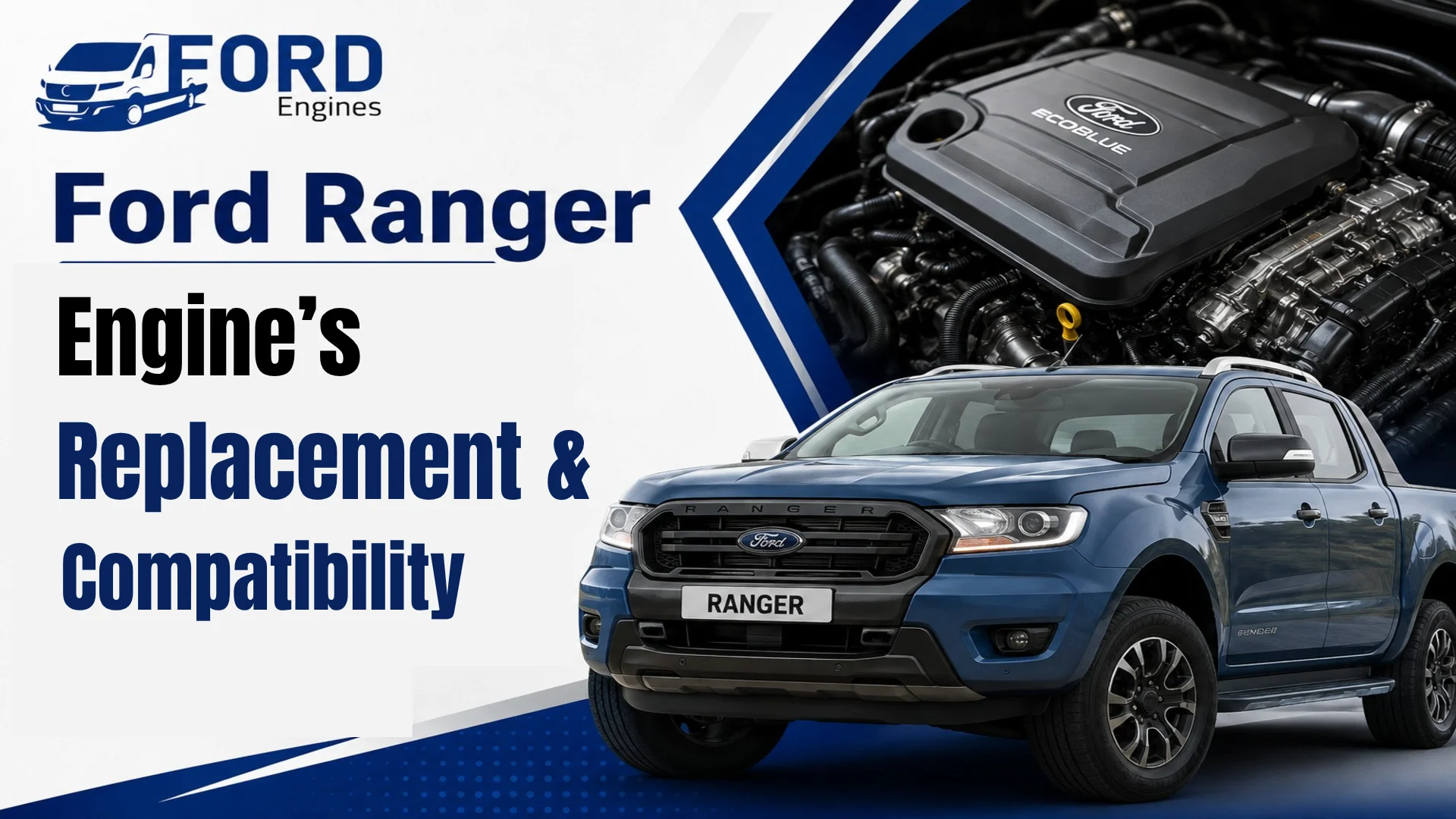
If you've landed on this page because your Ranger's engine has failed or is due for major work, the code you've identified above becomes the single most important piece of information for sourcing the right replacement.
Does a Replacement Engine Need to Match the Exact Code?
In almost all cases, yes, and this is worth being firm about, because getting it wrong is an expensive mistake. Matching the exact engine code ensures the replacement engine's power output, fuelling, turbo setup, and physical mounting points align with what your Ranger's ECU and ancillary systems expect.
Fitting an engine with a different code, even within the same broad family, like swapping a GBVAJPF for a GBVAJQJ, can result in incorrect power delivery, ECU fault codes, emissions non-compliance, or ancillary components that simply don't line up. There are some cases where cross-compatible codes exist, but confirming that requires genuine expertise, not guesswork.
Checking ECU, Wiring & Transmission Compatibility
Engine code matching is only part of the compatibility picture. A complete replacement also needs to account for:
- ECU compatibility, the engine control unit's software must match the engine's fuelling and timing requirements
- Wiring harness, connectors and sensor layouts can differ even between similar engine codes
- Transmission compatibility, particularly important when comparing manual and automatic Rangers, or older and newer generations
- 4x4/drivetrain compatibility, some engine variants were paired with specific drivetrain configurations from the factory
This is exactly why a straightforward-looking engine swap can turn into a much bigger job than expected if compatibility isn't fully checked beforehand.
Used vs Reconditioned vs Rebuilt Ford Ranger Engines
If your engine code search has led you here because you're facing a replacement decision, it helps to understand the real differences between your options:
Option | What It Means | Best For |
| Used engine | A tested, running engine removed from a donor vehicle | Budget-conscious repairs where mileage/history is verified |
| Reconditioned engine | Rebuilt with new wear components (bearings, seals, gaskets) to factory tolerances | Owners wanting reliability without full rebuild cost |
| Rebuilt engine | Fully stripped and rebuilt, often with upgraded or genuine OEM parts throughout | Long-term ownership, higher-mileage vans staying in service |
Each option carries a different balance of cost, warranty, and long-term reliability. A used engine with the correct matching code and clear history can be a perfectly sound choice, but always ask for documented mileage and provenance before committing.
Get a Ford Ranger Replacement Engine Quote
Once you've confirmed your engine code, the next step is sourcing a replacement that's genuinely compatible, not just similar. Our team works with the full range of Ranger engines covered in this guide, from 2.2 TDCi through to 3.2 TDCi and 2.0 EcoBlue, including both single-turbo and bi-turbo variants.
Get in touch with your engine code (or a photo of the block stamp if you're not sure) and we'll confirm exact compatibility, availability, and pricing before you commit to anything.
Frequently Asked Questions
What is my Ford Ranger engine code?
Your engine code is a manufacturer identifier, such as GBVAJQW, T20DD0J, or SAFA, stamped on the engine block or decodable from your VIN, indicating exactly which engine variant is fitted to your van, including its power output and specification.
How do I find my Ford Ranger engine code?
Check the code stamped on the engine block itself, decode it from your VIN, or send a photo of the block stamp to a specialist for confirmation. The V5C logbook lists engine size but usually not the specific manufacturer code.
Is the engine code the same as a diagnostic fault code?
No. The engine code identifies which engine is fitted to your vehicle for parts and replacement purposes. A diagnostic fault code (like P0299) is generated by the ECU when it detects a specific fault, and relates to a completely different kind of vehicle data.
Are GBVAJQJ and GBVAJQW interchangeable?
Not directly. Both are 2.2 TDCi variants, but they represent different power outputs and potentially different fuelling setups. Matching codes exactly is the safest approach for any replacement engine.
What engine code is the Ford Ranger 2.0 EcoBlue?
The 2.0 EcoBlue uses T20DD0J as its base code, with BC2X typically indicating the higher-output single-turbo variant and YN2X indicating the bi-turbo variant, which produces significantly more power.
Does a replacement engine need to match the exact code?
In almost all cases, yes. Matching the exact code ensures compatibility with your ECU, wiring, and ancillary systems. Fitting a different code, even within the same engine family, can cause fuelling, timing, or emissions issues.
What engine code is the Ford Ranger 3.2 TDCi?
The 3.2 TDCi is typically associated with the codes SAFA and P5AT, referring to the 3,198cc five-cylinder Duratorq engine producing approximately 200 PS.
How many cylinders does the Ford Ranger engine have?
This depends on the engine family. The 2.2 TDCi and 2.0 EcoBlue are both four-cylinder engines, while the 3.2 TDCi is a five-cylinder engine, one of the defining differences between the two older diesel options.