
If your Ford Ranger has started losing power on hills, making a noise that wasn't there last month, or lighting up the dashboard with warnings you don't recognise, you're probably here because something feels wrong, and you want to know how wrong before it gets expensive.
That instinct is worth trusting. Engine failure on a Ford Ranger almost never happens without warning. There's a build-up: small symptoms that get dismissed, then bigger ones that get "monitored," and eventually a breakdown that could have been avoided with an earlier diagnosis. The gap between those two points is exactly where this guide is aimed.
Below, we walk through every major symptom of Ford Ranger engine failure, what's likely causing it, how the picture changes depending on whether you've got a 2.2 TDCi, 3.2 TDCi, or 2.0 EcoBlue under the bonnet, and what you should actually do the moment you notice something's off.
What Are the Symptoms of Ford Ranger Engine Failure?
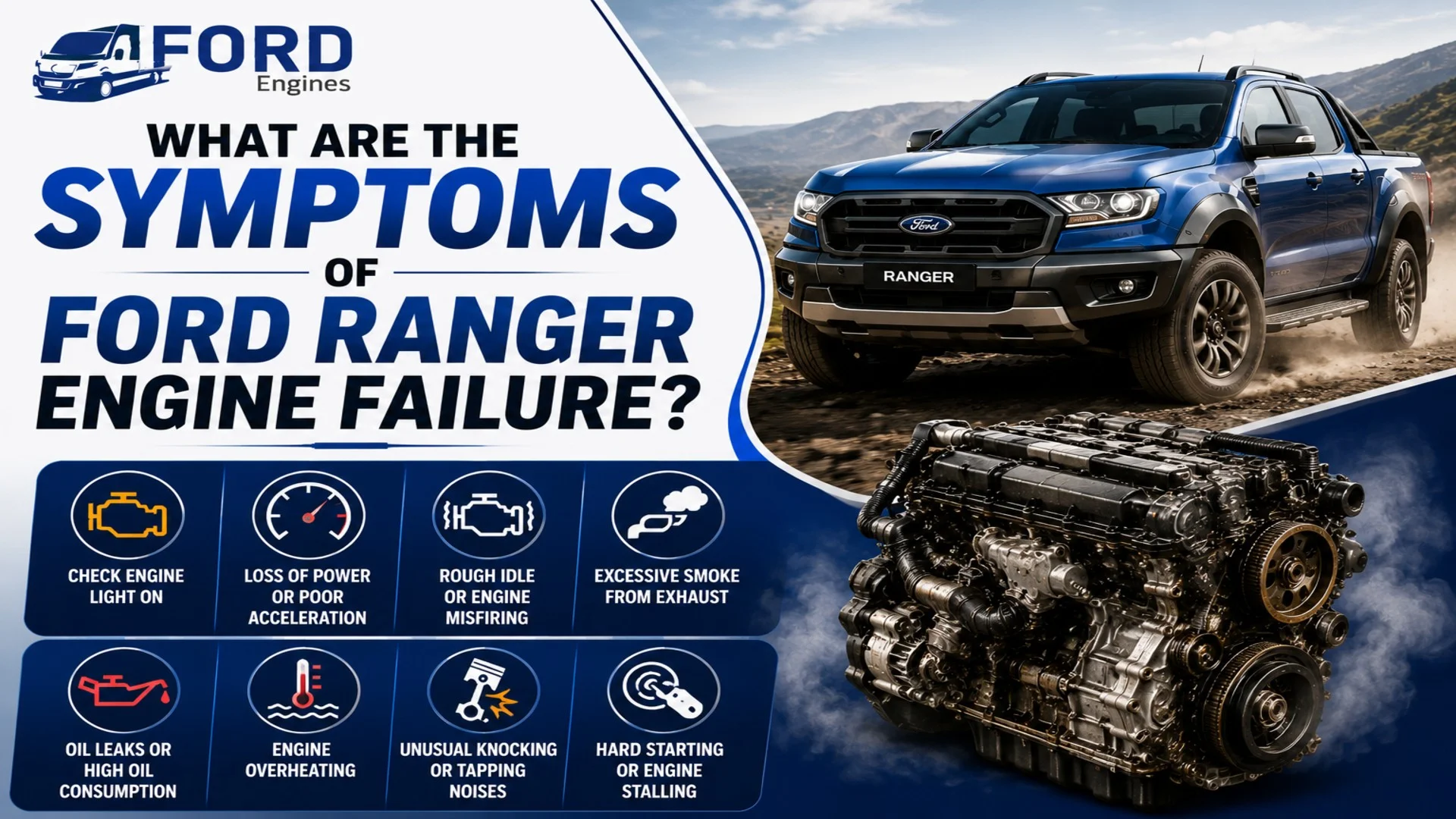
Engine failure symptoms don't all carry the same weight. Some mean "book a service soon." Others mean "pull over now." Knowing which category you're in changes everything about how you respond.
Early Warning Signs of Engine Trouble
At this stage, the engine is telling you something's developing, but you likely haven't caused lasting damage yet. This is the cheapest, easiest point to intervene.
- Slight loss of power, especially noticeable on inclines or when towing
- Poor fuel economy that's crept up gradually rather than appeared overnight
- Rough idle when stationary at traffic lights or in a queue
- Small coolant loss that requires occasional topping up
- Intermittent warning light that comes on, then disappears
None of these individually mean disaster. But together, or left unaddressed, they're often the first chapter of a much longer and more expensive story.
Serious Symptoms That Need Immediate Attention
This is where the engine has moved from "developing an issue" to "actively struggling." Continuing to drive normally at this stage increases the risk of turning a repair into a rebuild.
- Low oil pressure warning appearing on the dash
- Persistent knocking that doesn't go away with engine temperature
- Heavy exhaust smoke, visible consistently rather than occasionally
- Severe overheating, with the temperature gauge climbing into the red
- Major oil consumption, needing regular top-ups between services
If you're seeing any of these, the safest move is to stop driving the vehicle for anything beyond getting it to a specialist. We'll cover exactly why shortly.
Signs of Imminent or Catastrophic Engine Failure
At this point, internal damage may already be happening, or may have already happened. These symptoms represent genuine emergencies.
- Engine seizure or the engine suddenly cutting out
- Severe knocking that's loud, constant, and worsening
- No oil pressure reading at all
- Metal contamination visible in the oil (a sign bearings or internal components are grinding)
- Severe overheating accompanied by loss of power or smoke
A Ford Ranger showing these signs should not be driven at all. This is engine-rebuild or engine-replacement territory, and every additional mile risks making the damage worse.
Loss of Power, Rough Idle & Misfire
Loss of power under acceleration, rough idle at a standstill, and misfiring often travel together, and they're some of the most commonly reported Ford Ranger engine problems across every generation. The underlying cause is usually one of four systems: the turbocharger, the DPF, the EGR system, or the fuel injectors. A Ranger that hesitates before picking up speed, struggles on a hill it used to handle easily, or shudders at idle is telling you one of those systems isn't doing its job properly.
Knocking, Ticking or Rattling Noises
Noise symptoms deserve extra attention because they map almost directly to severity. A light ticking on cold start might simply be normal diesel injector noise. A persistent knock that continues once the engine's warm is a different matter entirely, and it's one of the most reliable indicators of low oil pressure or developing bearing damage. Rattling from the front of the engine, particularly on 2.0 EcoBlue models, can point toward wet belt deterioration, a topic we'll cover in detail in the engine-specific section below.
What Causes Ford Ranger Engine Failure?
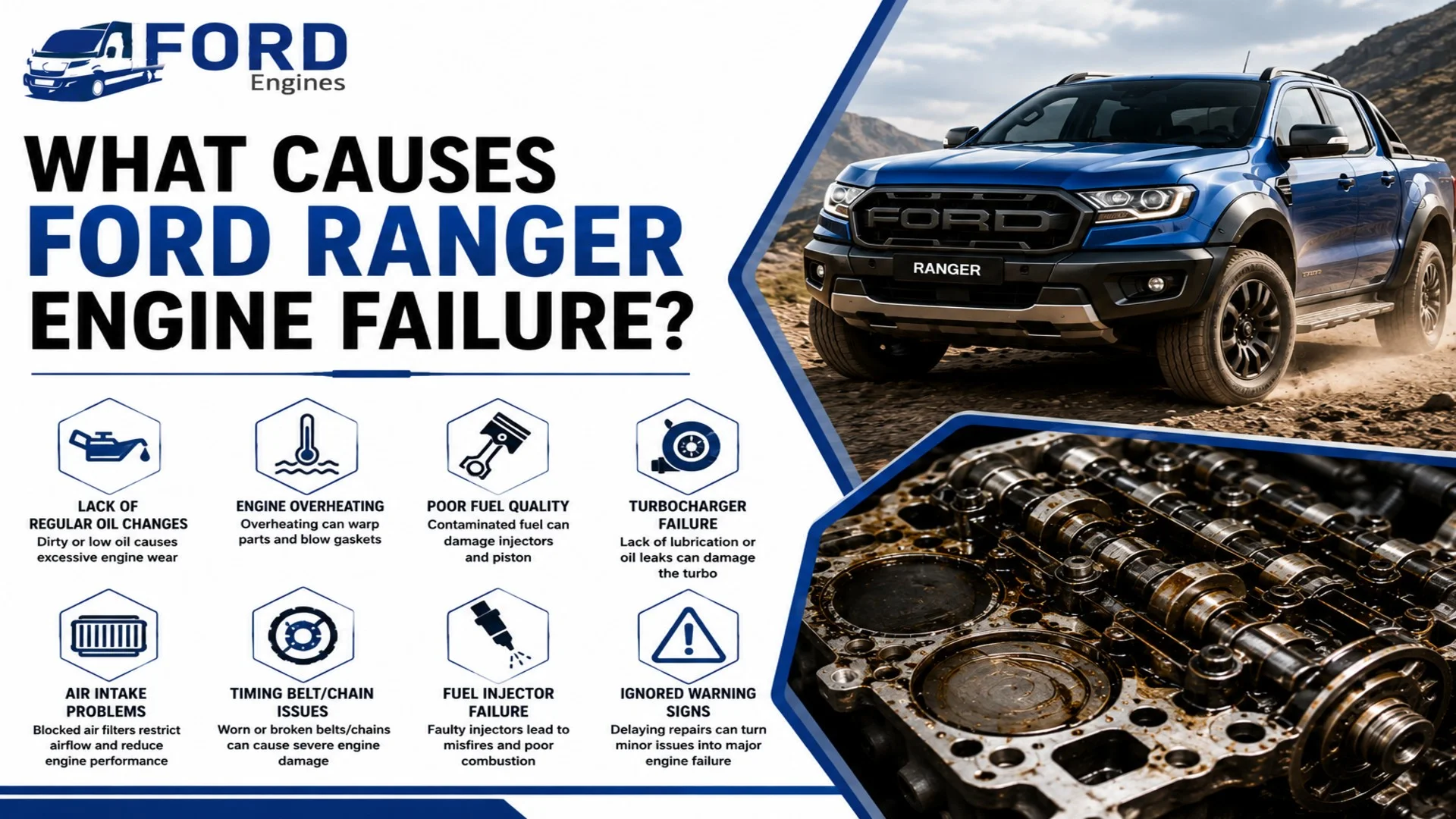
Symptoms tell you something's wrong. Causes tell you what's actually happening inside the engine, and that's the difference between guessing at a repair and fixing the right thing the first time.
Symptom-to-Cause Quick Reference
Because so many Ranger symptoms overlap, we've mapped the most common ones against their likely causes. This isn't a substitute for a proper diagnostic, but it's a useful starting point for understanding what you might be dealing with.
Symptom | Possible Cause |
| Loss of power | Turbo, DPF, EGR, or injector fault |
| Rough idle | Injector, MAF sensor, or EGR issue |
| White smoke | Coolant loss, EGR cooler, or head gasket |
| Black smoke | Fuel delivery, air intake, MAF, or turbo |
| Blue smoke | Oil consumption or turbo seal wear |
| Knocking | Low oil pressure, bearing wear, or internal damage |
| Low oil pressure | Oil pump fault, low oil level, or lubrication failure |
| Overheating | Cooling system fault, EGR cooler, or head gasket |
| Limp mode | DPF, turbo, sensor fault, or emissions system issue |
| Hard starting | Fuel system, injectors, or sensor fault |
| Engine stalling | Fuel, air, intake, or electrical fault |
Use this table as a rough map, not a diagnosis. The same symptom can have several different root causes, which is exactly why proper diagnostic testing matters more than guesswork, something we'll come back to later in this guide.
Oil Pump Failure & Low Oil Pressure
Oil pump failure is one of the most serious, and most preventable, causes of Ford Ranger engine failure. The oil pump is responsible for circulating engine oil under pressure to every moving part inside the engine: bearings, the crankshaft, the camshaft, and the cylinder walls. When the pump fails or oil pressure drops, lubrication stops reaching those components properly.
The consequence is oil starvation, and oil starvation is one of the fastest routes to catastrophic engine damage. Bearings can wear rapidly without oil film protection, and in severe cases, the crankshaft itself can be damaged beyond repair. This is why a low oil pressure warning light should never be treated as a "drive on and see" situation, it's one of the few dashboard warnings where continuing to drive can turn a moderate repair into a full engine rebuild within minutes.
Turbocharger, Injector, EGR & DPF Problems
These four systems are responsible for the majority of "loss of power" and "limp mode" complaints on the Ford Ranger, and they're closely interconnected.
- Turbocharger failure reduces boost pressure, causing sluggish acceleration, smoke, and in advanced cases, unusual whining or whistling noises. Turbo failure is often linked to oil supply problems, since the turbo relies on clean, pressurised oil for lubrication and cooling.
- Injector failure disrupts fuel delivery and combustion timing, leading to rough idle, misfires, poor fuel economy, and increased smoke.
- EGR valve and EGR cooler problems affect exhaust gas recirculation, contributing to carbon buildup, rough running, and, in the case of a failing EGR cooler, coolant loss and white smoke.
- DPF blockage restricts exhaust flow as soot accumulates faster than the filter can regenerate, triggering reduced power, warning lights, and frequently, limp mode.
Because these systems interact so closely, a single symptom like reduced power rarely points to just one cause. That's exactly why a structured diagnostic process, rather than a single component swap, is the only reliable way to fix the problem properly rather than repeatedly.
White, Black & Blue Smoke Explained
Exhaust smoke colour is one of the most useful diagnostic clues a Ranger owner can observe, and it's worth knowing the difference:
- White smoke usually points to coolant entering the combustion chamber, often via a failing EGR cooler or, in more serious cases, a head gasket fault
- Black smoke typically indicates an overly rich fuel mixture, often linked to air intake restrictions, MAF sensor faults, or turbo boost problems
- Blue smoke signals oil burning within the combustion chamber, frequently tied to worn turbo seals or excessive oil consumption
None of these should be ignored, but white smoke paired with coolant loss deserves particularly fast attention, since it often sits upstream of overheating and head gasket damage.
Check Engine Light & Limp Mode
The check engine light and limp mode are the Ranger's way of protecting itself. Limp mode restricts engine power and rev range specifically to prevent further damage while a fault is present, it's a safety mechanism, not a separate fault in itself. When limp mode activates, it's almost always tied to a fault code stored in the engine management system, commonly relating to the turbo, DPF, EGR, or a sensor reading outside its expected range. Reading those fault codes properly is the fastest way to understand what triggered it.
Do Engine Failure Symptoms Differ by Ford Ranger Engine Type?
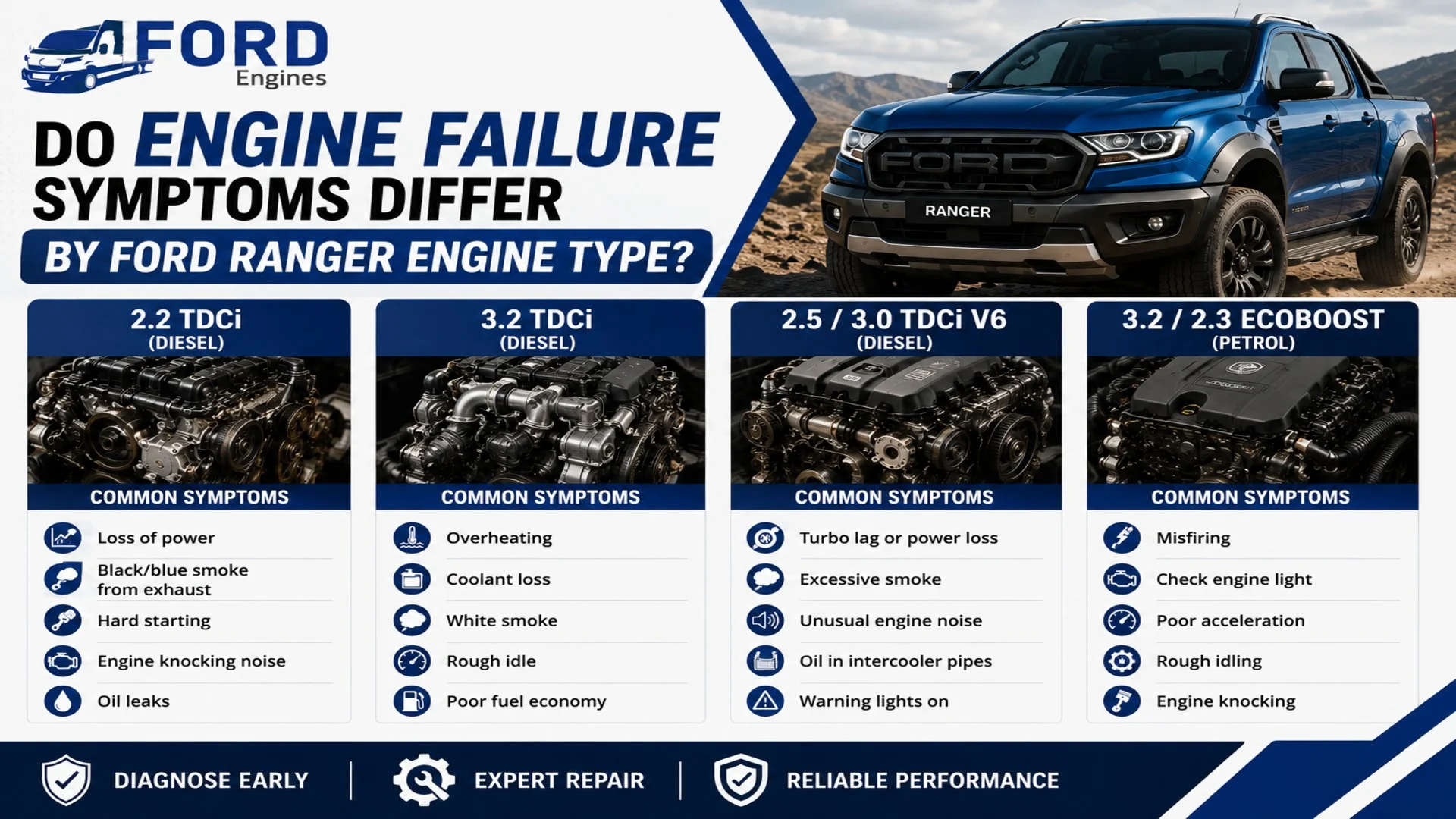
Not every Ford Ranger engine fails the same way. The T6/PX generation Rangers were fitted with different diesel engines over the years, and each one has its own known weak points.
Ford Ranger 2.2 TDCi Engine Problems
The 2.2 TDCi Duratorq engine, fitted to earlier PX and PXII Rangers, is generally regarded as durable, but it isn't without its known issues. Owners most commonly report oil pump wear, DPF regeneration problems on vehicles used for frequent short journeys, EGR carbon buildup, and injector faults as the engine and its mileage climb. Coolant system issues can also develop over time, particularly on higher-mileage examples that haven't had consistent servicing.
Ford Ranger 3.2 TDCi Engine Problems
The five-cylinder 3.2 TDCi, found in higher-spec and Wildtrak models, shares several of the same failure points as the 2.2, but with a few of its own. Turbocharger wear tends to show up more frequently on this engine, particularly on vehicles used for towing or heavy loads, alongside EGR cooler failure, oil pump concerns, and DPF-related power loss. Because the 3.2 is a larger, more complex unit, repair and rebuild costs on this engine tend to run higher than the 2.2 when problems are left unaddressed.
Ford Ranger 2.0 EcoBlue Engine Problems (Wet Belt Included)
The 2.0 EcoBlue, fitted to newer PXIII Rangers, introduced a design change that owners of older Rangers won't be familiar with: a wet timing belt, also known as a belt-in-oil system. Unlike a conventional external timing belt, this belt runs submerged in engine oil, and on certain EcoBlue applications, it also drives the oil pump.
That second detail is significant. If the wet belt deteriorates and sheds material into the oil, debris can restrict the oil pickup, causing oil pressure to drop. Because the belt may also be driving the pump itself, failure here doesn't just risk timing, it can cause a rapid and serious loss of lubrication throughout the engine.
Beyond the wet belt, 2.0 EcoBlue Rangers can also experience DPF and EGR-related power loss, turbo issues, and AdBlue/SCR system faults affecting emissions performance. If your Ranger is an EcoBlue model and you've noticed a rattle on cold start combined with any oil pressure warning, that combination should be treated as urgent rather than routine.
What Should You Do If You Notice These Symptoms?
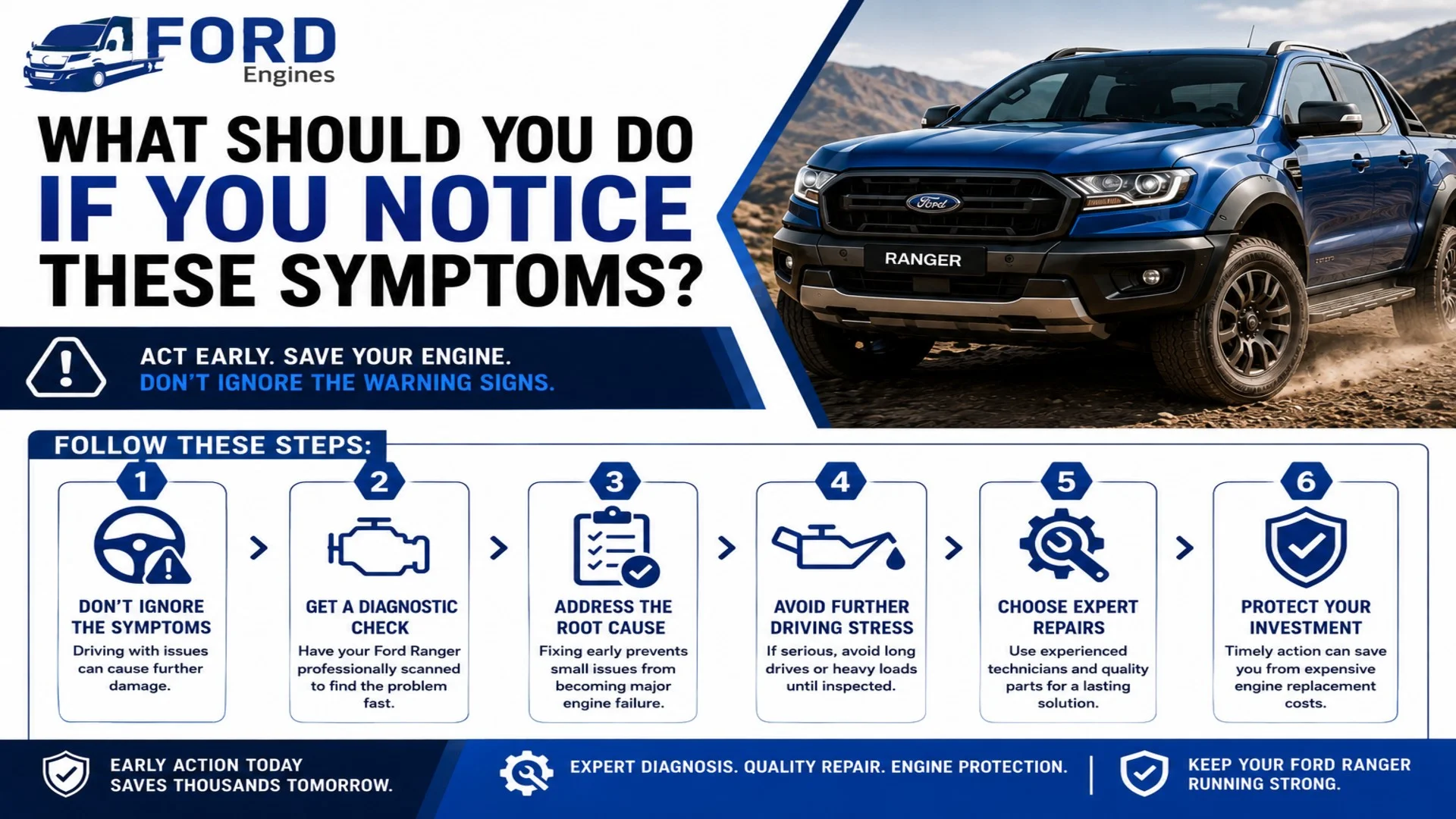
Knowing what's wrong is only half the picture. What you do next determines whether this becomes a straightforward repair or a much larger bill.
Should You Keep Driving? What to Check First
Not every symptom means stop immediately, but some absolutely do. Here's how to think about it in the moment:
- Stop driving immediately if the oil pressure warning light is on, this is not a "get home first" situation
- Check your engine oil level using the dipstick once it's safe to do so; low oil can itself trigger pressure warnings
- Check coolant level only when the engine is cool, never remove a coolant cap on a hot engine
- Don't continue driving with severe or worsening knocking, this is a strong sign of internal damage in progress
- Don't ignore overheating, pull over safely and let the engine cool rather than pushing on to your destination
- Look for visible oil or coolant leaks underneath the vehicle or around the engine bay
- Have the fault codes scanned as soon as possible, even if the warning light has gone out, stored codes remain even after the light clears
Following this checklist won't fix the underlying problem, but it can be the difference between a repair bill and a replacement engine bill.
How We Diagnose Ford Ranger Engine Failure
At Ford Engines, we don't guess at Ranger engine problems, we work through a structured diagnostic process designed to identify the actual root cause before recommending any repair.
Our process typically includes:
- Symptom review, understanding exactly what you've noticed and under what driving conditions
- Fault code scan, reading stored and active diagnostic trouble codes from the ECU
- Oil level and oil pressure testing, confirming whether pressure sits within Ford's specification
- Coolant system inspection, checking for leaks, loss, or contamination
- Turbocharger inspection, assessing boost performance and physical condition
- Injector testing, checking fuel delivery and combustion performance
- DPF and EGR system inspection, identifying blockages or carbon buildup
- Compression testing where internal damage is suspected
- Full damage assessment, confirming whether the fix is a component repair or something more extensive
This approach means you get an accurate answer, backed by testing rather than assumption, and a fixed-price quote based on what's actually wrong with your Ranger.
Ford Ranger Engine Failure FAQs
What is the most common Ford Ranger engine problem?
Oil pump failure, turbocharger wear, DPF blockage, and EGR-related faults are among the most frequently reported issues across the Ranger range, with wet belt problems specifically affecting 2.0 EcoBlue models.
What are the first signs of engine failure on a Ford Ranger?
Early signs typically include a slight loss of power, rough idle, gradually worsening fuel economy, and an intermittent warning light, all worth investigating before they progress further.
Can low oil pressure cause Ford Ranger engine failure?
Yes. Low oil pressure means components aren't being lubricated properly, which can lead to rapid bearing wear and, in severe cases, catastrophic internal engine damage if driving continues.
How long can a Ford Ranger drive with low oil pressure?
It shouldn't be driven at all once a low oil pressure warning appears. Damage from oil starvation can occur within minutes, not miles.
Can a failed turbo damage a Ford Ranger engine?
Yes. A failing turbo can send debris into the engine's oil system or cause excessive smoke and power loss, and continuing to drive on a failing turbo often causes secondary damage.
Is Ford Ranger engine failure common?
Engine failure isn't inevitable, but certain faults, oil pump wear, turbo issues, DPF problems, and wet belt deterioration on EcoBlue models, are well-documented across the range, particularly on higher-mileage or poorly serviced vehicles.
Which Ford Ranger engine is most reliable?
Each engine has its own known weak points rather than one being universally superior. The 2.2 TDCi is generally considered robust with regular servicing, while the 3.2 TDCi and 2.0 EcoBlue each carry their own specific risk areas outlined above.
How much does Ford Ranger engine repair cost?
Cost depends entirely on what failed and how early it was caught. A straightforward component repair, such as an injector or EGR valve, costs considerably less than a repair involving internal engine damage from oil starvation or overheating.
Final Thoughts: Catch It Early, Fix It Right
Ford Ranger engine failure rarely happens without warning, it happens without attention. The gap between a slight loss of power and a seized engine is usually measured in weeks or months, not seconds, and that gap is your opportunity to step in before the damage becomes severe or irreversible.
If your Ranger is showing any of the symptoms covered in this guide, a warning light, a new noise, smoke that wasn't there before, or a dip in performance, the right move is a proper diagnostic, not a guess.
Get in touch with Ford Engines today to book a diagnostic assessment for your Ranger's engine, whatever the age or engine type. We'll identify exactly what's wrong, explain your options clearly, and give you a fixed-price quote before any work begins.