
You glance at the dashboard and the service reminder is on. Or worse, you can't remember when the Ranger was last in. Was it 18,000 miles ago? 30,000? And does it matter?
It does. A Ranger is built to work hard, but it only keeps doing so when oil, filters, fluids and the diesel emissions system get attention on time. Skip the basics and small problems turn into DPF blockages, turbo wear and, eventually, an engine that no longer wants to run.
This guide sets out the Ford Ranger maintenance schedule in plain terms: what is due and when, how it changes by engine, how towing and short trips alter the picture, and what it costs. We are an independent UK supplier and are not affiliated with Ford Motor Company.
One important point first. Service intervals differ by generation, engine and market, and UK schedules are not the same as US ones. Treat the figures below as a guide, and always confirm your exact intervals in your owner's manual, service book or with a Ford dealer using your VIN.
How Often Should a Ford Ranger Be Serviced, and What Is Due at Each Mileage?
The short answer: a Ford Ranger is serviced by time and mileage, whichever comes first. Most UK diesel Rangers follow an annual or mileage-based interval, with extra items added at set milestones. The exact figure depends on your generation, engine and how the truck is used, so confirm it against your service book.
That "whichever comes first" rule catches people out. A low-mileage Ranger that sits on a drive still needs its oil and brake fluid changed on time, because both degrade with age, not just distance.
What Is the Ford Ranger Service Schedule by Mileage and Time in the UK?
Owners search for this in several ways: service intervals by mileage, an annual service, an interim service, a full service or a major service. Here is how those stages generally fit together.
Stage | Typical timing | What is usually covered |
| First service | Per service book | Engine oil and filter, fluid levels, multi-point inspection |
| Interim service | Roughly every 6 to 12 months or set mileage | Oil and filter, fluid top-ups, tyres, brakes, lights, safety checks |
| Annual / full service | Every 12 months or set mileage | Everything in an interim service plus air filter, cabin (pollen) filter, wider inspection of suspension, steering and exhaust |
| 20,000 to 40,000 miles | Per service book | Cabin filter, fuel filter where scheduled, brake and suspension inspection |
| 60,000 miles | Per service book | Fuel filter, coolant and brake fluid checks, drivetrain inspection, accessory drive belt inspection |
| 100,000 miles | Per service book | Major service items depending on engine, including timing system checks and a full drivetrain review |
| 150,000 miles | Per service book | Transmission, differential and transfer case fluid service where specified, wider component review |
A few things worth knowing before you use any table like this:
- Time-based items run on their own clock. Brake fluid and coolant are typically replaced by age, so a low-mileage truck still needs them.
- Service history matters. A complete, stamped record adds real value when you sell and helps if a warranty or goodwill claim comes up.
- Fluid specifications matter. Use the oil grade and specification listed in your owner's manual for your engine, since the wrong oil can harm the DPF and turbo.
Keep your service book up to date, and keep receipts for anything done between services.
Does the Maintenance Schedule Change for the 2.2 TDCi, 3.2 TDCi, 2.0 EcoBlue and 3.0 V6 Ranger?
Yes. Ford has used several diesel engines across the Ranger's life, and they are not serviced identically. The generation matters too: the T6 and facelift (PX2/PX3) trucks differ from the current next-generation Ranger.
Engine | Typical generation | Maintenance points to know |
| 2.2 TDCi | T6 / PX | Earlier DPF and EGR arrangement; check timing system details for your build |
| 3.2 TDCi (5-cylinder) | T6 / PX | Heavier-duty engine, popular for towing; oil and coolant condition are key |
| 2.0 EcoBlue (single and bi-turbo) | Later PX3 / next-gen | Modern emissions hardware including DPF and AdBlue; sensitive to oil specification and short journeys |
| 3.0 EcoBlue V6 | Next-gen | Newer powertrain; follow the manufacturer schedule strictly |
| Ranger Raptor engines | Raptor variants | Harder use profile; check the dedicated Raptor schedule |
Two practical tips:
- Identify your engine before you buy parts or book a service. Your registration or VIN confirms it quickly.
- Do not assume a belt or a chain. The timing arrangement differs between engines, so check before relying on a general "cambelt interval" you read online.
How Do Towing, Short Trips and Diesel Emissions Change Your Ranger's Maintenance?
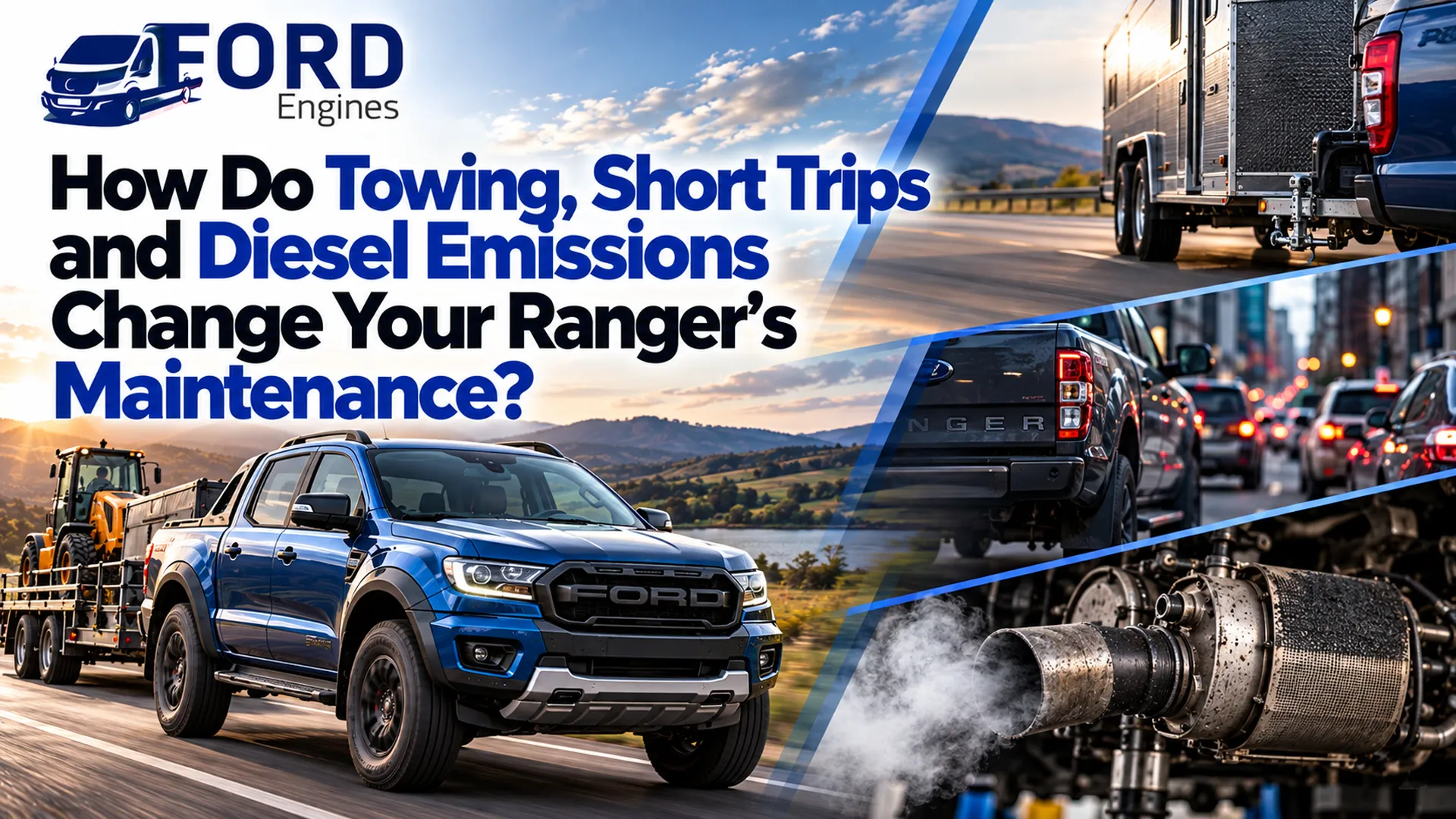
The published schedule assumes "normal" use. Plenty of Rangers don't live that life. They tow caravans and plant trailers, carry heavy loads, idle on site, cover short runs between jobs and drive down dusty tracks. All of that counts as harder use.
Why Do Towing, Off-Road Work and Short Journeys Mean Shorter Service Intervals, and How Do You Protect the DPF and EGR?
Heavier use puts more heat, load and contamination through the engine and drivetrain. Oil breaks down faster, brakes wear sooner and the emissions system struggles to keep clean. Many specialists suggest shortening intervals for severe use, and your manual may define exactly what counts as severe.
Component | Normal use | Towing, off-road or heavy commercial use |
| Engine oil and filter | Per schedule | Consider more frequent changes |
| Transmission fluid | Per schedule | Check condition earlier; shorten interval if heavily loaded |
| Differential and transfer case oil (4x4) | Per schedule | Inspect more often, especially after water crossings or off-road work |
| Brakes | Routine inspection | Check pads, discs and fluid more often |
| Coolant | Per schedule | Check level and condition regularly |
| Tyres and suspension | Routine checks | Inspect for uneven wear and load-related damage |
| Air filter | Per schedule | Inspect more often in dusty conditions |
A scenario we see regularly. A tradesperson makes six or seven short trips a day, each only a few miles. The engine never reaches the sustained temperature the DPF needs to burn off soot. Within months the warning light appears, the truck feels flat and the EGR valve starts to clog. The fix is rarely dramatic: a proper motorway run, a forced regeneration or a professional DPF clean. But ignoring it can lead to turbo and injector trouble.
To protect the diesel emissions system:
- Let the DPF regenerate. When the warning light shows, a sustained run at steady speed often helps. Avoid switching off mid-regeneration.
- Mix in longer drives. Regular journeys of 20 minutes or more at road speed help keep the DPF and EGR cleaner.
- Use the correct oil. Low-ash oil specified for your engine protects the DPF.
- Keep AdBlue topped up on models that use it. Running out can stop the engine restarting.
- Look after the turbocharger. Clean oil and a short cool-down after hard towing protect the turbo's bearings.
- Use quality diesel. Poor fuel can contribute to injector and fuel filter problems.
For commercial users, a simple routine helps:
- Daily: walk-round, tyres, lights, warning lights
- Weekly: oil, coolant and screenwash levels, AdBlue level
- Monthly: tyre condition, brake wear, underbody and drivetrain check, leaks
Small habits catch problems early, and early is cheap.
What Does Ford Ranger Maintenance Cost in the UK, and What Happens If You Skip a Service?

Servicing costs money. Skipping it usually costs more. Here is how to weigh both.
How Much Does a Ford Ranger Service Cost in the UK?
Prices vary by garage, region, engine, mileage and which service you need. A main dealer will usually charge more than an independent specialist, though dealers offer manufacturer-backed work and warranty benefits. Both are valid, and the right choice depends on your situation.
Beyond the service itself, an annual running-cost estimate should include:
- Routine servicing
- Filters and fluids
- Brake pads and discs
- Tyres
- Drivetrain items such as differential and transfer case oil
- A small allowance for unexpected repairs
Ask any garage for an itemised quote that shows what is included.
What Happens If You Miss or Delay a Ford Ranger Service?
Missing one service by a few weeks is unlikely to do lasting harm. Missing several is a different story. Over time you can expect:
- Oil degradation, which leaves less protection for the engine and turbo
- A clogged DPF or EGR, leading to power loss and limp mode
- Brake and drivetrain wear that goes unnoticed until it is expensive
- Overheating risk if coolant condition is ignored
- A patchy service history, which reduces resale value and buyer confidence
If you have already missed a service, don't panic and don't ignore it. Book the work, ask the garage to check oil condition and scan for fault codes, and keep records from this point on.
When Is a Neglected Ranger Engine Beyond Repair, and What Are Your Replacement Options?
Sometimes neglect or a major fault leaves an engine too damaged to justify further repair. These signs point that way:
- Metal particles in the oil or filter
- Repeated overheating
- Low compression on one or more cylinders
- Persistent knocking from the bottom end
- Heavy oil consumption with blue or grey smoke
If two or more apply, get a written assessment before spending more on parts.
When replacement makes sense, you have three routes:
Used engine | Reconditioned engine | Remanufactured engine | |
| What it is | From a donor vehicle, tested as is | Inspected, worn parts renewed, tested | Fully stripped and rebuilt to specification |
| Warranty | Usually limited | Defined | Typically the longest |
| Price | Lowest | Mid-range | Highest |
| Best for | Lower-value trucks | Most working Rangers | Trucks you plan to keep long term |
Why fordengines.co.uk? We supply reconditioned Ford engines to UK drivers, tradespeople and fleets. Every engine is matched to your registration before you order, so you get the right code the first time.
Ford Ranger Service Checklist: What to Check at Every Service
Use this as a quick reference when you book a service or review a garage's invoice.
- Engine: oil and filter, oil level, leaks, accessory drive belt condition
- Filters: air, cabin (pollen) and fuel filter where scheduled
- Fluids: coolant, brake fluid, power steering and screenwash levels
- Brakes: pads, discs, hoses and handbrake operation
- Tyres and wheels: pressure, tread depth, wear pattern, spare
- Suspension and steering: ball joints, tie-rod ends, shock absorbers
- Drivetrain (4x4): driveshaft, U-joints, halfshaft boots, differential and transfer case levels
- Exhaust and emissions: exhaust system, heat shields, DPF and EGR condition, AdBlue level
- Electrics: battery, lights, warning lights, diagnostic scan for fault codes
Frequently Asked Questions About Ford Ranger Maintenance
How often should a Ford Ranger be serviced?
By time or mileage, whichever comes first. Most owners follow an annual service with additional items at set mileage milestones. Confirm the exact interval in your service book.
What is included in a Ford Ranger full service?
Oil and filter change, replacement of scheduled filters, fluid checks, and a wider inspection of brakes, tyres, suspension, steering, exhaust and electrics. A major service adds further scheduled items depending on mileage.
What is the difference between an interim, full and major service?
An interim service covers the basics and key safety checks. A full service adds more filters and a deeper inspection. A major service includes mileage-specific items such as additional fluids or timing system work.
Does the Ford Ranger have a timing belt or chain?
It depends on the engine and generation. Check your engine code before assuming either.
Does towing change my Ford Ranger service intervals?
It can. Towing and heavy loads put extra strain on oil, brakes, transmission and the cooling system, so many specialists recommend shorter intervals.
Can an independent garage service my Ford Ranger?
Yes. Independent garages can service a Ranger, and many specialise in them. Make sure they follow Ford's schedule, use the correct oil and fluid specification, and record the work in your service book.
How much does a Ford Ranger service cost in the UK?
It varies by garage, engine and service type. Ask for an itemised quote and compare what is included.
What oil does a Ford Ranger take?
It depends on the engine. Check your owner's manual for the correct grade and specification.
What happens if I miss a Ford Ranger service?
One late service is rarely a disaster. Repeated gaps increase the risk of oil degradation, DPF and EGR problems, and engine wear. Book the work as soon as you can and keep records from then on.
Does short-distance driving affect Ford Ranger maintenance?
Yes. Short trips stop the DPF regenerating properly and can clog the EGR. Mix in regular longer drives.
Final Word
A well-kept Ranger will keep earning its place on the drive or the job site. The ford ranger maintenance schedule isn't complicated, but it does reward attention: the right oil on time, filters changed when due, fluids checked, and an honest look at how hard the truck really works.
Check your service book, match your engine, and shorten intervals if you tow, haul or do mostly short runs. And if the engine has already suffered, a correctly matched reconditioned replacement can get you back to work.
Send us your registration and we will confirm the right engine and give you a clear quote.