
If your Transit's dashboard has just lit up with a warning light, or you've heard a rattle from under the bonnet that wasn't there last week, you're probably here for one reason: you need to know whether your Ford Transit 2.0 EcoBlue engine is in trouble, and what it's going to cost you if it is.
You're not alone. The 2.0 EcoBlue is one of the most widely used diesel engines in Ford's commercial range, powering everything from single-van tradesmen to full delivery fleets across the UK. It's a capable engine, but it also has a well-documented weak point that catches a lot of owners out. This guide walks through exactly what the engine is, where it tends to go wrong, how to look after it properly, and what your options are if a replacement becomes unavoidable.
What Is the Ford Transit 2.0 EcoBlue Engine?
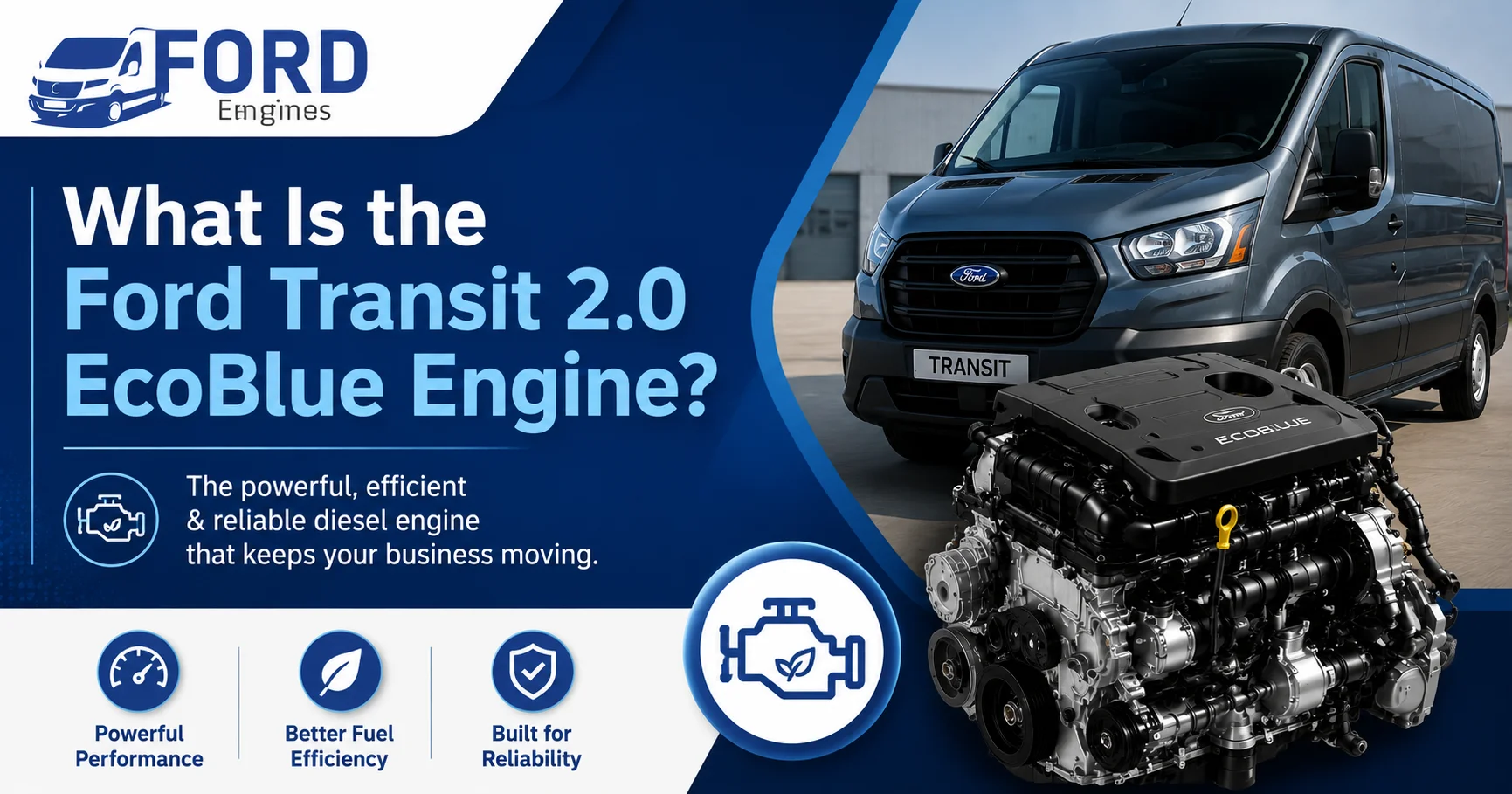
The 2.0 EcoBlue is Ford's modern turbo-diesel unit, introduced as the successor to the older 2.2 TDCi Duratorq engine. It was designed primarily to meet Euro 6 emissions standards while improving fuel economy and reducing NOx output, which is why you'll find AdBlue (SCR) systems, EGR valves, and a diesel particulate filter (DPF) all working together on this engine.
Under the bonnet, it's a four-cylinder, common-rail turbo-diesel with a cast iron block and aluminium cylinder head, a fairly conventional layout for a modern van engine, but with a couple of technical details that set it apart from what came before it.
Engine Specifications, Power & Torque Figures
The 2.0 EcoBlue was released across a range of power outputs, so two Transits with the "same" engine can perform quite differently depending on the tune. Typical outputs include:
- 105PS entry-level output, common on lighter panel vans
- 130PS the most common variant fitted across the Transit range
- 170PS higher-output tune, often found on heavier-duty and dual-cab models
Torque figures scale with power output too, generally sitting between roughly 360Nm and 405Nm depending on the state of tune. This matters in practice: a 105PS van will feel noticeably more strained when loaded compared to a 130PS or 170PS model, particularly on motorway inclines.
Which Ford Models Use the 2.0 EcoBlue Engine?
The 2.0 EcoBlue isn't unique to the standard Transit. Ford fitted it across several models in the same generation, including:
- Ford Transit (MK8 and MK9, L2/L3/L4 body variants)
- Ford Transit Custom the 2.0 EcoBlue is the dominant engine option here
- Ford Tourneo Custom the passenger-carrying sibling of the Transit Custom
- Ford Tourneo Connect smaller platform, but shares the same EcoBlue family
If you're trying to identify whether your van has this engine, checking the badge or logbook is a start, but it's not always definitive which is where engine codes come in.
Engine Codes & How to Identify Your Variant (105PS / 130PS / 170PS)
Ford uses specific engine codes to distinguish EcoBlue variants, and these are far more reliable than relying on the badge alone (vans get retrofitted, badges get swapped, and dealers don't always update paperwork consistently).
The safest way to confirm exactly what's fitted to your van is to check the engine code stamped on the block itself, or look it up against your VIN. If you're planning to buy a replacement or reconditioned engine, this step isn't optional fitting the wrong variant, even one that "looks the same," can cause compatibility issues with the ECU, wiring loom, and mounts. If you're unsure how to read your engine code, our team can identify it from your VIN or registration before you order.
Is the Ford Transit 2.0 EcoBlue Reliable?
This is the question most people searching for this engine actually want answered. The honest answer: the 2.0 EcoBlue is a reasonably solid engine overall, but it has one design decision that has caused real problems for a meaningful number of owners and it's worth understanding before it costs you a full engine replacement.
The Wet Timing Belt Explained (Why It's a Known Risk)
Unlike older Ford diesels that used a timing chain, or a conventional dry timing belt, the 2.0 EcoBlue uses what's called a wet timing belt, a belt that runs inside the engine, submerged in the engine oil, rather than externally.
On paper, this design has advantages: it reduces friction and noise, and Ford intended it to last the life of the engine under normal conditions. In practice, it's become one of the most searched-for issues connected to this engine, for a simple reason when a wet belt fails, it doesn't just leave you stranded like a snapped external belt would. Because it sits inside the engine, a failed wet belt can shed rubber debris directly into the oil system, contaminating the oil galleries, clogging the oil pump pickup, and in worse cases, causing the belt to jump time or break entirely, which usually means valve-to-piston contact and a destroyed engine.
This is genuinely the single biggest risk factor for anyone running a 2.0 EcoBlue, and it's the primary reason we see so many otherwise well-maintained vans come in for full engine replacement.
Common Turbo, Injector, DPF & AdBlue Faults
The wet belt gets most of the attention, but it isn't the only area worth watching. Across the vans we see, the recurring issues tend to fall into a few categories:
- Turbocharger wear the variable geometry turbo (VGT) can develop actuator or vane sticking issues over time, often showing up as sluggish power delivery or whistling noises
- Injector faults piezo injectors can develop leaks or coding mismatches, leading to rough idling, poor fuel economy, or fault codes
- DPF blockages common on vans doing mostly short, low-speed journeys where the filter doesn't get hot enough to regenerate properly
- AdBlue/SCR faults NOx sensor failures or AdBlue system errors can trigger reduced power modes, sometimes limiting the van to a low speed until resolved
None of these are unique to the EcoBlue, most modern Euro 6 diesels share similar wear points. But knowing what to listen and look for means you can often catch a developing fault before it becomes a five-figure repair bill.
Warning Signs of Engine Failure (Symptom Checklist)
If you're worried your engine might be heading toward serious trouble, these are the signs worth taking seriously:
- Metallic rattling or knocking from the front of the engine, especially on cold start, a classic early wet belt symptom
- Sudden drop in oil pressure or an oil pressure warning light
- Milky or discoloured oil on the dipstick, which can indicate contamination
- Loss of power or limp mode activating without an obvious trigger
- Excessive smoke particularly blue smoke, which points to oil burning
- Unusual vibration at idle that wasn't there previously
If you're seeing more than one of these at once, it's worth getting the van inspected immediately rather than continuing to drive it, pushing on with a developing wet belt fault is how a repairable issue turns into a full engine replacement.
Maintenance & Care: Keeping Your 2.0 EcoBlue Running
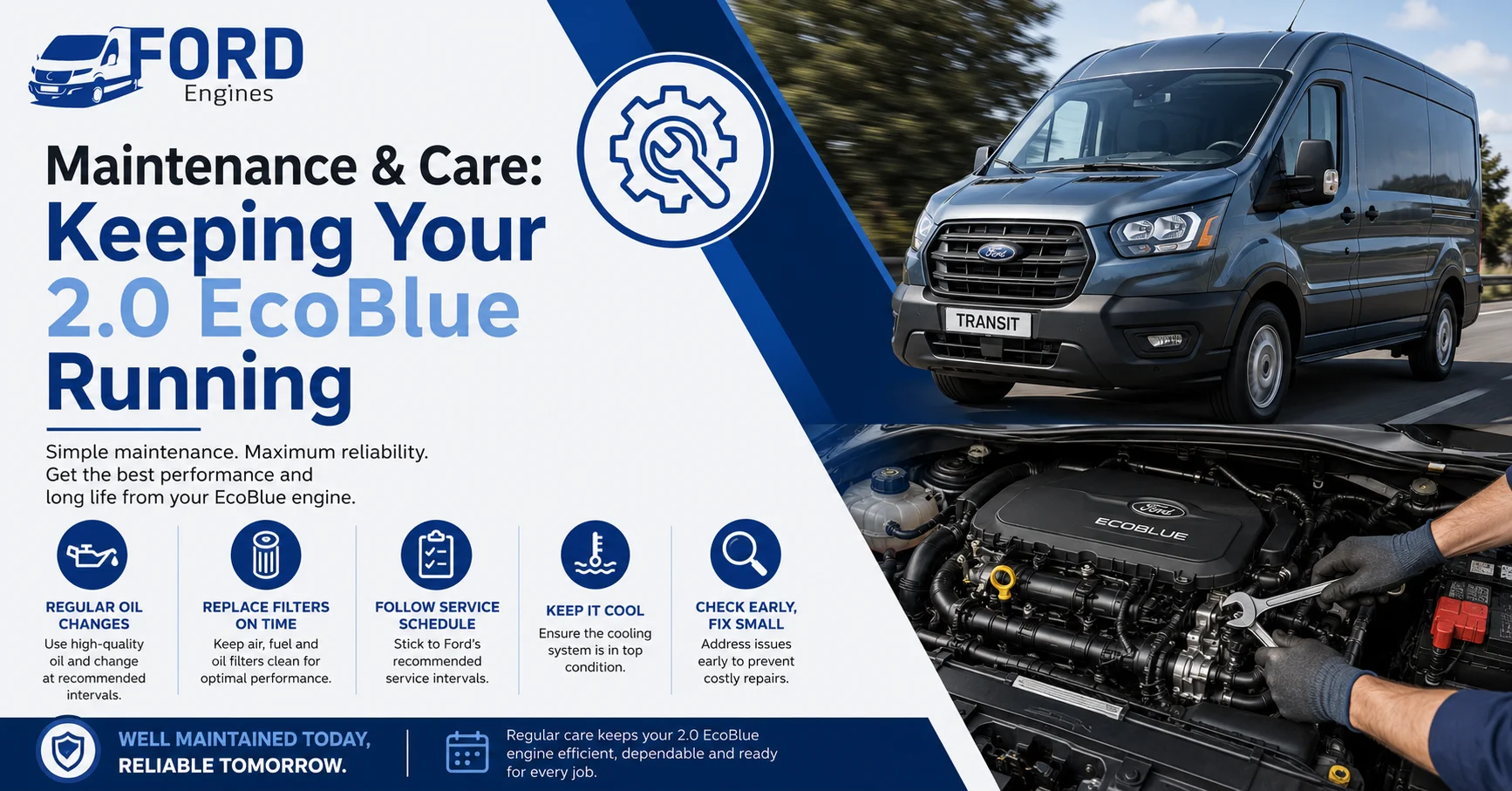
The good news is that most of the serious failures associated with this engine are preventable with the right maintenance approach, and the wet belt issue in particular is largely a servicing and awareness problem, not an unavoidable design flaw.
Recommended Engine Oil & Service Intervals
Because the timing belt runs inside the oil system, oil quality and change intervals matter more on this engine than on most. Using the wrong oil specification, or stretching service intervals too far, accelerates belt wear and increases contamination risk if the belt does start to degrade.
Always use the Ford-approved oil specification for your specific engine variant, and stick to manufacturer-recommended change intervals rather than extended "long-life" intervals if your van does a lot of short journeys or stop-start driving, both accelerate wear on the belt and the oil itself.
Wet Belt Replacement Interval & Cost
This is the section most owners searching for "ford transit 2.0 ecoblue timing belt" actually want. Ford's original guidance suggested the wet belt could last the lifetime of the engine under ideal conditions. In real-world use, high mileage, frequent short trips, extended oil change intervals, many specialists now recommend proactive replacement well before that point, rather than waiting for a failure.
Replacement cost varies depending on labour rates and whether other components (oil pump, gaskets, seals) are replaced at the same time, but it's a significant job requiring careful stripping and reassembly around timing components. Compared to the cost of a full engine replacement following a belt failure, proactive replacement is, in almost every case, the cheaper and lower-risk option.
Preventative Maintenance Schedule (Avoid Costly Failures)
If you want to minimise your risk of an expensive failure, a sensible approach looks like this:
- Every service check oil condition and colour, not just level
- Every oil change use only the correct Ford-approved specification
- Around mid-life mileage have the wet belt inspected by a specialist familiar with EcoBlue engines, even if it "seems fine"
- Any unusual noise investigate immediately rather than waiting for the next scheduled service
- Fleet vehicles build wet belt condition into your maintenance planning rather than treating it as a reactive repair
This kind of proactive approach is exactly what separates a Transit that reaches 200,000+ miles without drama from one that needs a full engine rebuild at 90,000 miles.
Replacement & Reconditioned 2.0 EcoBlue Engines, What Are Your Options?
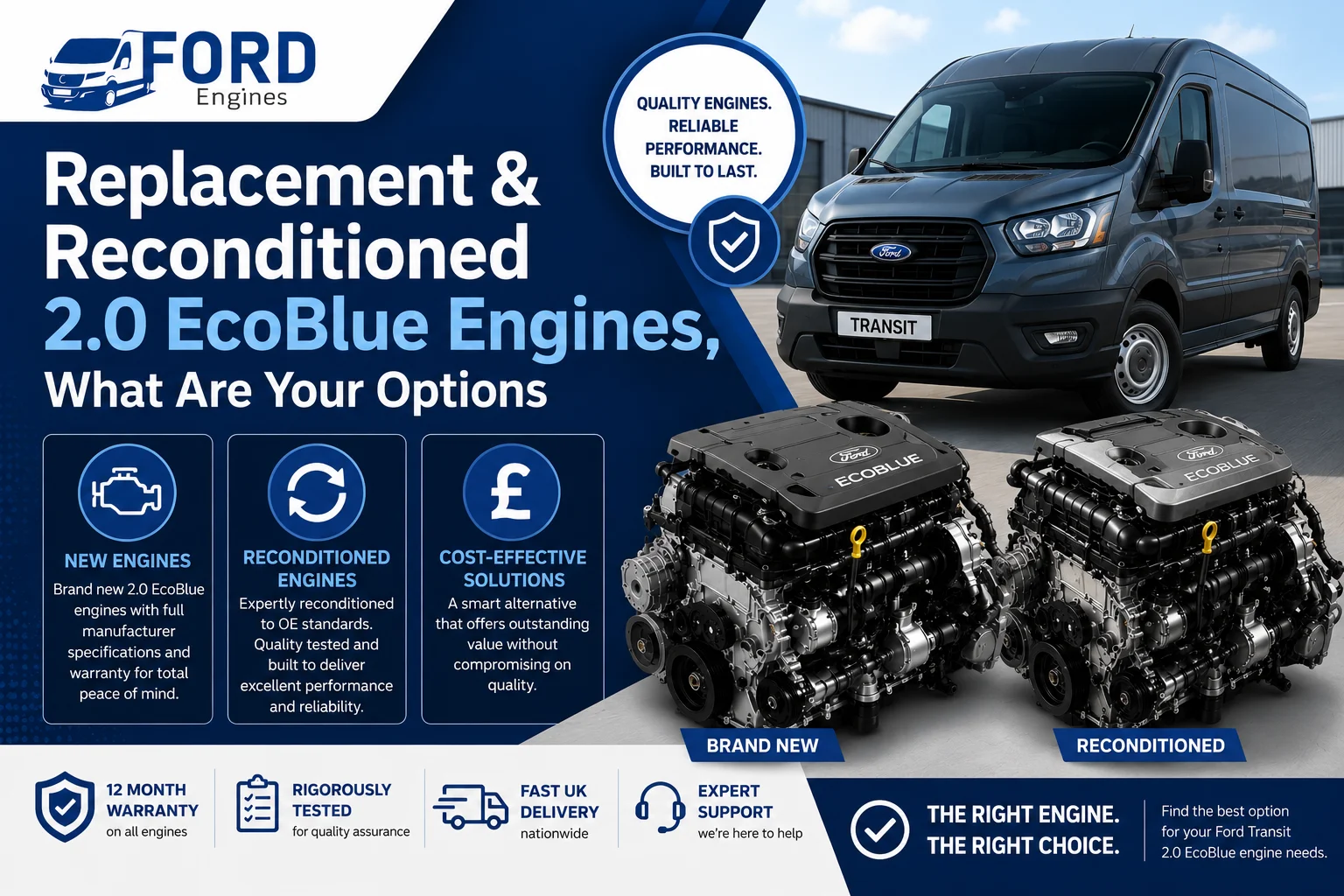
If the damage is already done, whether from a wet belt failure, turbo failure, or simple high-mileage wear, you're left with a decision that has real financial consequences. Here's how the main options actually compare.
Reconditioned vs Used vs Remanufactured Engines, Which Should You Buy?
These terms get used loosely across the industry, which causes a lot of confusion. Here's the practical difference:
Option | What It Means | Risk Level | Typical Warranty |
| Used engine | Pulled from a donor vehicle, tested for basic function, not stripped or rebuilt | Highest unknown wear on internals, belt condition often unverified | Short or none |
| Reconditioned engine | Stripped, worn components replaced, rebuilt to working spec | Moderate quality varies significantly between suppliers | Typically limited |
| Remanufactured engine | Fully stripped, every component inspected against tolerance, wear parts replaced as standard, rebuilt to original spec | Lowest closest to a new engine's condition | Usually the longest and most comprehensive |
For an engine with a known wet belt risk like the 2.0 EcoBlue, this distinction matters more than usual. A "used" engine with an unknown belt history carries the same risk you're trying to fix by replacing it in the first place. A genuinely remanufactured engine, where the belt and oil pump have been replaced as part of the rebuild process, removes that risk entirely.
What's Included in a Reconditioned EcoBlue Engine Supply & Fit?
A proper supply-and-fit service should go well beyond simply bolting in a replacement unit. At minimum, it should include:
- Full strip-down and inspection of the replacement engine before fitting
- Replacement of wear-critical components, including the wet belt and oil pump where applicable
- New gaskets, seals, and filters as standard, not reused from the old engine
- Removal and disposal of your old engine
- Post-fit diagnostics and road testing to confirm everything runs correctly, including ECU/injector coding where required
Ask any supplier directly what's included before comparing prices, a cheaper quote that excludes belt replacement, new gaskets, or proper diagnostics often isn't cheaper once you factor in what's missing.
Warranty, Pricing & How to Get a Quote
Warranty terms vary significantly across the industry, so it's worth asking specifically what's covered, for how long, and whether labour is included if a warranty claim requires the engine to come back out. Pricing depends on your exact engine variant (105PS, 130PS, or 170PS), your van's model and year, and whether you need supply-only or supply-and-fit.
The most reliable way to get an accurate figure is to provide your registration or VIN so the correct engine code and variant can be confirmed, this avoids the common problem of a quote being adjusted after your old engine has already been removed.
Request a Callback / Get Your Engine Quote Today
If your Transit, Transit Custom, or Tourneo is showing signs of engine trouble, don't wait for a small issue to become a total engine failure. Get in touch with our team for a straightforward quote on a reconditioned or remanufactured 2.0 EcoBlue engine, supply-only or fully fitted, with clear warranty terms and no surprises. Request a callback today, and we'll confirm the right engine variant for your van before you commit to anything.
Frequently Asked Questions
Is the Ford Transit 2.0 EcoBlue reliable?
Overall, yes, it's a capable and widely used engine. The main reliability concern is the wet timing belt, which can cause serious damage if it fails and hasn't been proactively maintained or replaced.
Does the EcoBlue have a wet belt?
Yes. The 2.0 EcoBlue uses a wet timing belt that runs inside the engine, submerged in oil, rather than an external dry belt or timing chain.
When should the wet belt be replaced?
There's no single mileage figure that applies to every van, since it depends on usage patterns and servicing history. Many specialists recommend proactive inspection or replacement well before Ford's original lifetime-belt guidance, particularly for high-mileage vans or those doing frequent short journeys.
What happens if the wet belt fails?
Because the belt sits inside the oil system, a failure can contaminate the oil galleries with debris and, in more serious cases, cause the belt to jump time or snap, often resulting in significant internal engine damage that requires a full rebuild or replacement.
How much does a Ford Transit 2.0 EcoBlue engine replacement cost?
Costs vary depending on the engine variant, whether you choose used, reconditioned, or remanufactured, and whether it's supply, only or supply, and-fit. Get in touch with your registration details for an accurate, no-obligation quote.
Is a reconditioned engine worth buying over a used one?
In most cases, yes, particularly for an engine with a known wet belt risk. A properly reconditioned or remanufactured engine has had wear-critical components replaced and tested, whereas a used engine carries unknown history and risk.
Which Ford models use the 2.0 EcoBlue engine?
The Ford Transit, Transit Custom, Tourneo Custom, and Tourneo Connect all use variants of the 2.0 EcoBlue engine, across power outputs of 105PS, 130PS, and 170PS.
Final Thoughts
The Ford Transit 2.0 EcoBlue engine is, on balance, a strong and efficient unit, but the wet timing belt design means it rewards proactive owners and punishes reactive ones. Regular oil changes with the correct specification, awareness of the early warning signs, and a willingness to inspect the belt before it becomes a problem will save most owners from ever facing a full engine replacement.
If you're past that point already, the priority is choosing a replacement engine that actually addresses the root cause, not just a used unit with the same unknown risk built in. A genuinely remanufactured engine, fitted by people who understand this platform's specific weak points, is the difference between solving the problem and paying for it twice.
Ready to get your van back on the road? Get in touch with our team today for a fast, accurate quote on your Ford Transit 2.0 EcoBlue engine, supply-only or fully fitted, with clear warranty terms from the start.