

If your Ford Transit has started knocking, losing power on hills, or blowing smoke you've never seen before, you're not alone, and you're probably not imagining it either. The 2.2 TDCi Duratorq engine has powered thousands of MK7 and MK8 Transits across the UK, and while it's generally a solid workhorse, it comes with a well-documented set of faults that tend to show up like clockwork once the mileage climbs.
This guide walks through exactly what goes wrong, why it happens, what it'll cost to fix, and how to stop small issues turning into a written-off engine. Whether you're a fleet manager trying to budget for repairs or an owner-driver who just heard a rattle you didn't like, you'll find the answers here.
What Are the Most Common Ford Transit 2.2 TDCi Engine Problems?
Before diving into root causes, it helps to know what you're actually listening (and smelling) for. Most Ford Transit engine problems announce themselves well before they become catastrophic, the trick is catching them early.
Engine Knocking or Rattling Noise From the 2.2 TDCi
A knocking or rattling noise from the 2.2 TDCi engine is one of the most reported complaints among Transit owners, and it's rarely something to shrug off. This noise usually falls into one of two categories: a light rattle on cold start that disappears after a minute, or a persistent knock that gets worse under load.
What does a knocking noise from a Ford Transit 2.2 mean? A cold-start rattle that fades quickly is often the timing chain tensioner taking a moment to build oil pressure — annoying, but not always urgent. A knock that continues once warm, or gets louder when you accelerate, points toward something more serious: worn big-end bearings, a stretched timing chain, or in worse cases, piston slap from cylinder wear. If the noise changes pitch with engine speed, that's a strong sign it's mechanical rather than just a loose heat shield or bracket.
Loss of Power and Limp Mode
Few things are more frustrating than putting your foot down and getting a fraction of the power you expect, especially fully loaded on a motorway slip road.
Why does my Transit struggle uphill or under load?
Power loss in the 2.2 TDCi engine is almost always linked to one of these:
- A failing turbocharger — worn bearings or a sticking actuator reduce boost pressure, so the engine can't force in enough air
- Blocked DPF (diesel particulate filter) — once clogged with soot, exhaust backpressure builds and the ECU pulls power to protect the engine
- Faulty EGR valve — a stuck-open EGR dumps too much exhaust gas back into the intake, starving the engine of fresh air
- Injector problems — poor fuel atomisation means incomplete combustion and noticeably flat performance
If the van suddenly caps itself at low RPM and won't rev past 2,500-3,000, that's almost certainly limp mode, a protective response, not a random fault.
Black, White and Blue Exhaust Smoke
What does each smoke colour actually indicate? Smoke colour is one of the most useful diagnostic clues you have, and it costs nothing to check.
Smoke Colour | Likely Cause | Urgency |
| Black smoke | Excess fuel, dirty injectors, blocked air filter, faulty MAF sensor | Moderate, fix soon to avoid injector damage |
| White smoke | Coolant entering combustion chamber, head gasket failure, injector leak | High, stop driving, risk of overheating |
| Blue smoke | Oil burning in the combustion chamber, worn piston rings, failing turbo seals | High, indicates internal wear |
Excessive black smoke from the Ford Transit 2.2 TDCi engine under acceleration is common and often linked to injectors delivering too much fuel or an EGR valve gumming up the intake with carbon.
Engine Won't Start, Stalls, or Runs Rough at Idle
A Transit that cranks but won't fire, or idles unevenly, usually has one of these culprits: glow plug failure in cold weather, a weak fuel pump losing prime, air in the fuel lines, or a failing crankshaft position sensor confusing the ECU. Rough idle specifically tends to trace back to dirty injectors or a vacuum leak in the intake system.
Engine Overheating and Coolant Loss
Overheating rarely happens without warning. A failing water pump, a cracked radiator, a stuck thermostat, or a blown head gasket can all cause the temperature gauge to creep up. If you're topping up coolant regularly with no visible leak underneath the van, that's a red flag for a head gasket problem or internal coolant loss, get it checked before it turns into a cracked cylinder head.
What's Actually Causing These Ford Transit 2.2 TDCi Faults?
Symptom lists only get you so far. To actually fix the problem, or decide whether it's worth fixing, you need to understand what's failing underneath and why the 2.2 TDCi is prone to it.
Timing Chain Wear and Stretch
The timing chain is arguably the 2.2 TDCi's most infamous weak point, particularly on early MK7 models built before Ford revised the tensioner design.
How many miles before the timing chain typically fails? Most documented failures happen somewhere between 70,000 and 120,000 miles, though poor servicing history or extended oil change intervals can bring that forward considerably. Because the timing chain sits at the front of the engine and is expensive to access, a lot of owners ignore early warning rattles until the chain actually jumps time, at which point you're often looking at bent valves and a full engine rebuild instead of a straightforward chain replacement.
Ford Transit timing chain replacement cost typically runs from around £600 to £1,200 at an independent specialist, depending on whether the tensioner, guides, and sprockets need replacing alongside the chain itself. Main dealer pricing tends to sit higher.
Fuel Injector Failure
The 2.2 TDCi uses a Delphi or Bosch common rail fuel system depending on build year and market, and injector wear is one of the more predictable failure points as mileage rises.
Signs of a failing diesel injector:
- Rough idle or a noticeable misfire on one cylinder
- Increased fuel consumption without a change in driving style
- Excessive black smoke under acceleration
- A faint diesel smell in the cabin or engine bay
- Hard starting, especially in cold weather
Injector failure doesn't just hurt performance, a leaking injector can wash oil from the cylinder walls, accelerating bore wear and shortening the life of the whole engine. That's why catching this early matters more than it might seem.
EGR Valve and DPF Blockages
The EGR valve and DPF work together as part of the emissions system, and on the 2.2 TDCi, both are prone to carbon build-up, especially on vans used mostly for short, stop-start city journeys rather than sustained motorway runs.
A sticking EGR valve can cause rough idle, power loss, and increased fuel consumption. A blocked DPF triggers regeneration cycles that, if repeatedly interrupted by short trips, eventually clog to the point where the van goes into limp mode or refuses to start. Regular motorway driving that lets the DPF regenerate properly is one of the simplest ways to avoid this entirely.
Turbocharger Failure
Garrett turbochargers are commonly fitted to the 2.2 TDCi, and while generally durable, they're vulnerable to oil starvation if service intervals slip. Symptoms of turbo failure include a whistling or whining noise under acceleration, blue smoke from worn seals, and a noticeable drop in power. Left unaddressed, a failing turbo can send debris downstream into the intercooler and engine, turning a moderate repair into a much bigger one.
Is This a Known Fault on Specific Engine Codes?
Not every 2.2 TDCi is identical under the skin. Engine codes such as DRFA, DRFB, QVFA, CVFF, CYFA, CYFB, CYFF, SRFA, and SRFB correspond to different power outputs, emissions standards (Euro 4 and Euro 5), and in some cases different injector or turbo suppliers. If you're chasing a persistent fault, checking your engine code against known Technical Service Bulletins can save hours of guesswork, a specialist workshop familiar with Transit vans will typically know which code is prone to which issue.
Repair, Rebuild, or Replace? Making the Right Decision
This is the question that actually determines how much this is going to cost you, and it's the one most guides skip over.
How Do I Know If My Engine Needs Repair or Replacement?
As a general rule:
- Repair makes sense when the fault is isolated, a single injector, a turbo actuator, an EGR valve, or a water pump. These contain jobs with predictable costs.
- Rebuild becomes worthwhile when there's internal wear (bearings, piston rings, timing components) but the block and cylinder head are still in good condition.
- Replacement is usually the better financial decision when you're facing multiple compounding faults, a bent valve from a jumped timing chain, or an engine with high mileage and an already patchy service history.
A simple way to think about it: if the repair bill approaches 40-50% of a reconditioned engine's cost, replacement is almost always the more sensible long-term option, especially for a van you're relying on for daily work.
Ford Transit 2.2 TDCi Engine Replacement Cost
Reconditioned vs genuine vs used engines: cost breakdown
Engine Type | Typical Cost (Parts Only, UK) | Warranty | Best For |
| Reconditioned engine | £1,800 – £3,200 | Usually 12 months | Best balance of cost and reliability |
| Genuine new/dealer engine | £4,500+ | Manufacturer warranty | Buyers wanting full manufacturer backing |
| Used/second-hand engine | £900 – £1,800 | Rarely warrantied | Budget repairs, unknown history risk |
What's included in a reconditioned engine package?
A properly reconditioned Ford Transit engine should include new bearings, a refurbished or replaced cylinder head, new gaskets and seals, and a pressure/compression test before it leaves the workshop. Ask specifically what's been replaced versus simply cleaned and reused, this is where reconditioned engines vary hugely in quality between suppliers.
How Long Does an Engine Replacement Take?
For a straightforward swap with a specialist who has the part in stock, expect 2 to 4 working days. If the engine needs sourcing, or ancillary parts (mounts, sensors, belts) need replacing alongside it, this can extend to a week. Fleet operators should factor in this downtime when deciding between repair and full replacement — a van off the road for a week costs more than just the parts bill.
How to Prevent Engine Problems and Extend Engine Life
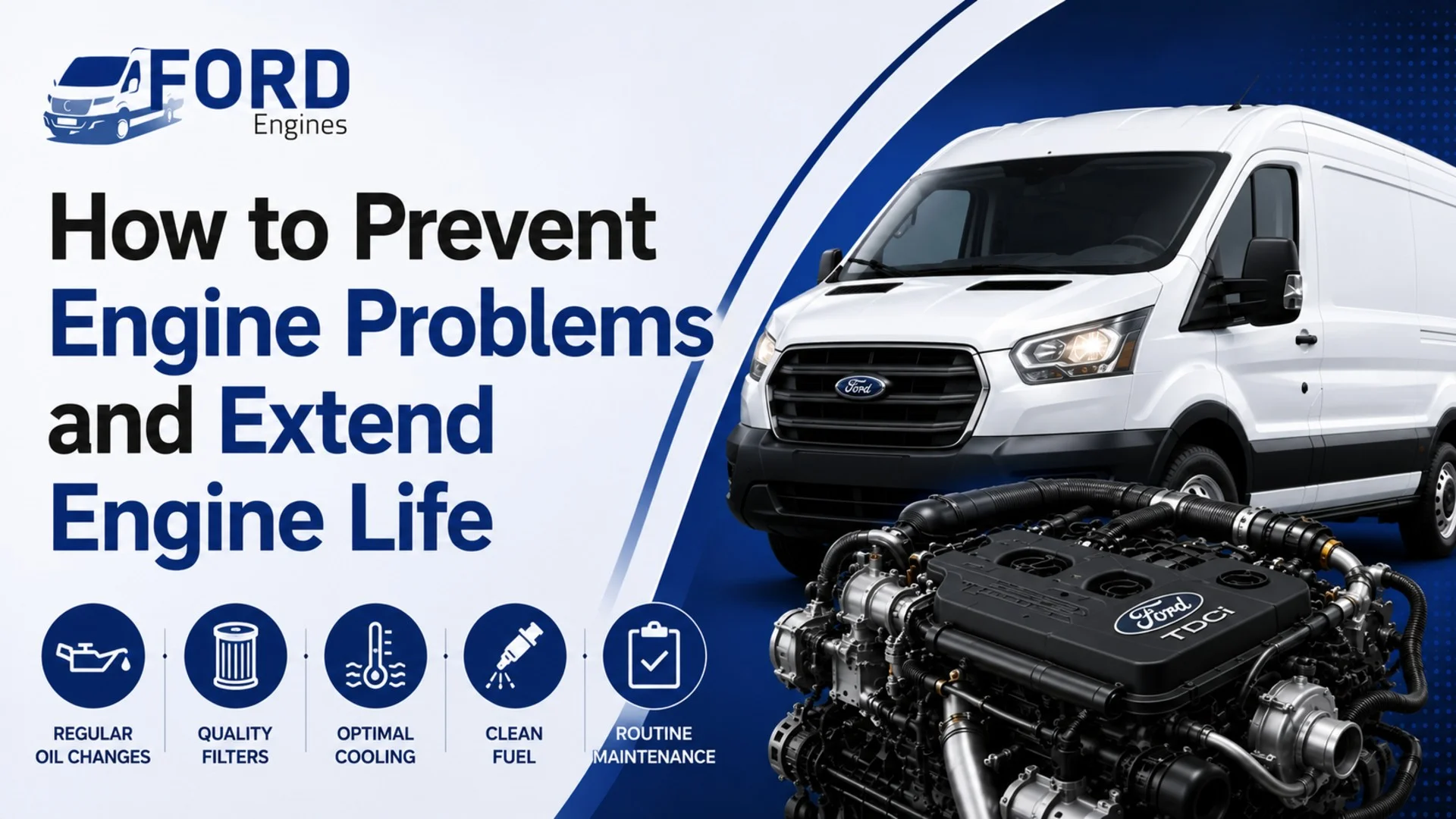
Most of what we've covered so far is preventable, or at least catchable early, with the right maintenance habits.
Preventive Maintenance Checklist
- Stick to oil change intervals — don't stretch beyond 10,000-12,000 miles, even if the service light hasn't triggered yet
- Use the correct oil specification — the wrong viscosity accelerates timing chain and turbo wear
- Let the DPF regenerate properly — take the van on a 20-30 minute motorway run periodically if it's mostly used for short trips
- Listen for changes — a new noise on cold start is far cheaper to diagnose than the same noise ignored for six months
- Check coolant and oil levels monthly — small drops often show up before a dashboard warning does
Recommended Oil Type and Service Intervals
Ford specifies a low-SAPS diesel oil (typically 5W-30) for the 2.2 TDCi to protect the DPF and reduce ash build-up. Using the wrong oil grade, even a "close enough" substitute, can contribute to faster injector wear and reduced turbo lubrication over time. Service intervals of 12 months or 12,000-18,500 miles (whichever comes first, depending on model year) are the standard recommendation, though heavy-use fleet vans often benefit from shortening this.
Warning Signs You Shouldn't Ignore
If you notice any combination of a warning light, a new noise, smoke that wasn't there last week, or a drop in performance, get it looked at rather than waiting for the next scheduled service. Early diagnosis is consistently the difference between a £200 fix and a £3,000 one.
Frequently Asked Questions
Is the Ford Transit 2.2 TDCi reliable?
Overall, yes, it's a proven engine used across millions of miles of commercial driving. Its main weak points (timing chain, injectors, EGR/DPF) are well documented and manageable with proper servicing, but neglect tends to compound quickly on this engine specifically.
How long does a 2.2 TDCi engine last?
With consistent servicing and no ignored warning signs, many 2.2 TDCi engines comfortably reach 150,000-200,000 miles. Poor maintenance can bring serious faults forward by tens of thousands of miles.
What causes limp mode on a Ford Transit?
Limp mode is most commonly triggered by a blocked DPF, a failing turbo, EGR faults, or sensor errors that make the ECU restrict power to protect the engine.
Can a blocked DPF damage the engine?
Yes. A severely blocked DPF increases exhaust backpressure, which can affect turbo performance and, in extreme cases, cause oil dilution from repeated failed regeneration attempts.
Should I repair or replace my Transit's engine?
It depends on the fault. Isolated component failures are usually worth repairing. Multiple compounding issues or internal mechanical damage (bent valves, worn bearings) usually make replacement the more cost-effective route.
What's the average cost of a Ford Transit engine rebuild?
A full rebuild typically runs from £2,000 to £3,500 depending on the extent of internal wear and whether the cylinder head needs machining or replacement.
Why is my Transit blowing white smoke?
White smoke usually means coolant is entering the combustion chamber, often from a head gasket failure or a cracked cylinder head. Stop driving and get it inspected promptly to avoid further damage.
Final Thoughts
The Ford Transit 2.2 TDCi is a capable engine that rewards attentive owners and punishes neglect — often quite expensively. Catching a rattle, a smoke change, or a dip in power early is almost always cheaper than waiting for a full failure. If you're weighing up a repair against a replacement, the honest answer depends on your van's history, mileage, and how the fault has progressed, not just the noise it's making today.
If your Transit is showing any of the symptoms covered here, it's worth getting a proper diagnostic rather than guessing. Get in touch with our team at Ford Engines for an honest assessment, a straightforward quote, and a reconditioned engine option built to get your van back on the road without the guesswork.