

You've either got a Transit 2.4 TDCi sitting in your driveway making a noise you don't like, or you're staring at a used van listing trying to work out if that engine code actually matches what the seller's claiming. Either way, generic spec pages aren't cutting it, you need real numbers, real engine codes, and a straight answer on whether this engine is worth trusting.
This guide covers exactly that. We'll break down the Ford Transit 2.4's full technical specifications, decode the engine variants properly, walk through reliability and common faults, and cover what your options are if you're facing a rebuild or replacement.
Ford Transit 2.4 Technical Specifications & Engine Codes
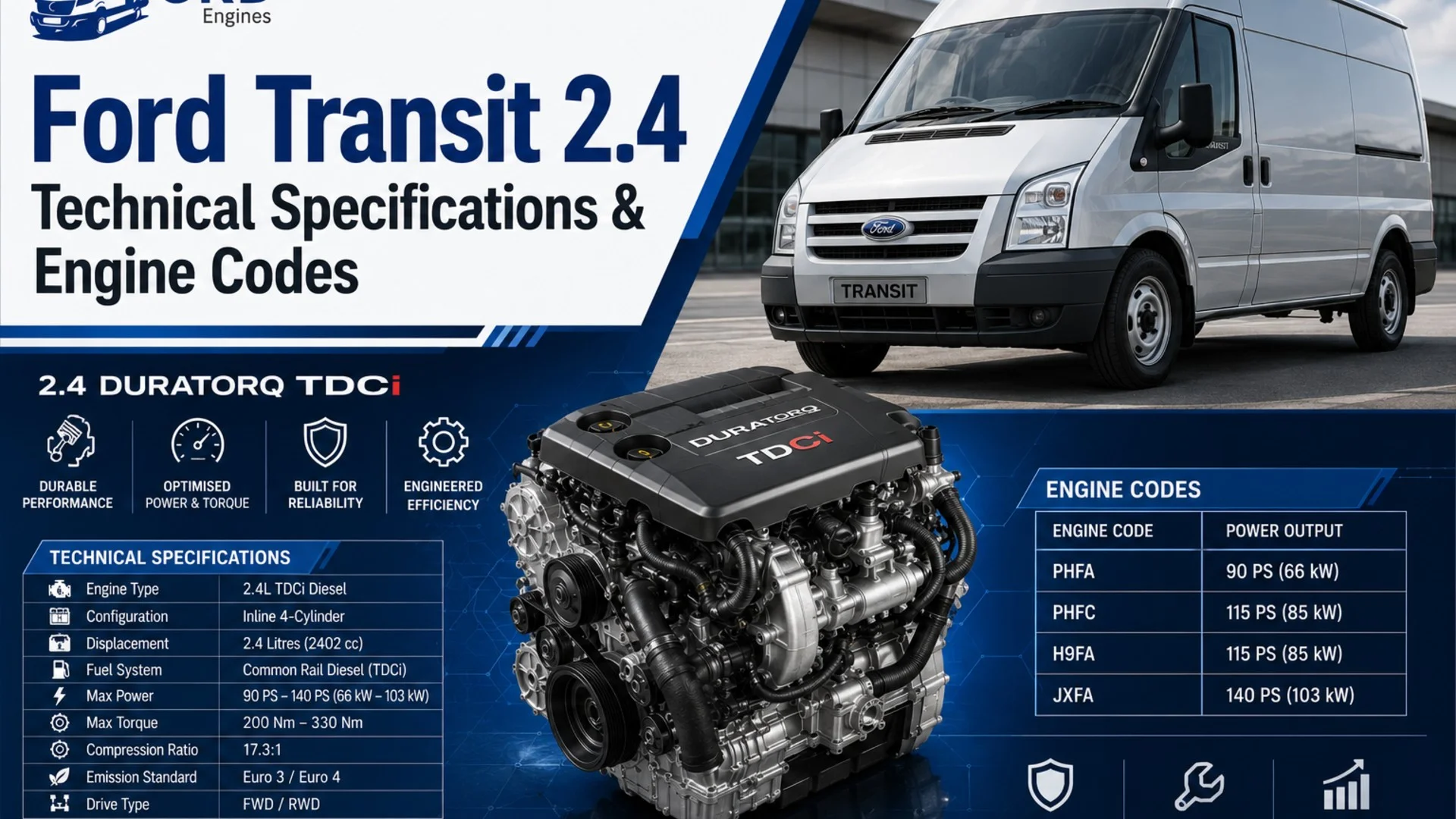
The Ford Transit 2.4 is part of the Duratorq TDCi family, built on the Ford Puma engine platform, a diesel engine architecture Ford used extensively across its Transit range through the Mk6 and Mk7 generations. It's a turbocharged diesel, running common rail injection, and was offered in several power outputs depending on year and specification.
Before diving into performance figures, it's worth understanding that "the 2.4 TDCi" isn't one single engine, it's a family of closely related variants, and getting the exact code right matters if you're sourcing parts or a replacement unit.
Ford Transit 2.4 Horsepower and Torque Output
Power output varied across the production run as Ford refined the Duratorq TDCi platform to meet tightening emissions standards and improve performance. Broadly, the 2.4-litre Transit engine was offered across a range of outputs:
Variant | Approximate Power | Approximate Torque |
| 2.4 TDCi (entry-level tune) | 90–100 bhp | 235–250 Nm |
| 2.4 TDCi (mid tune) | 115–120 bhp | 280–300 Nm |
| 2.4 TDCi (high-output tune) | 137–140 bhp | 330–350 Nm |
These figures give a solid general picture, but exact horsepower and torque depend on your specific engine code, production year, and whether the van is Euro 4 or Euro 5 compliant. Always confirm the exact figures against your V5C logbook or engine code rather than assuming based on the van's badge alone, Transit badging didn't always change consistently with power output changes.
Engine Codes Explained (H9FA, JXFA, PHFA & More)
This is where most competitor pages fall short, they'll quote a horsepower figure without ever addressing which specific engine code they're talking about, which makes the information close to useless if you're trying to source parts or a replacement engine.
Ford used several engine codes across the 2.4 TDCi range, including variants like H9FA, JXFA, and PHFA, among others. Each code corresponds to a specific power output, injection system revision, and emissions compliance level. Two Transits with visually identical "2.4 TDCi" badges can have meaningfully different engines under the bonnet depending on production year.
Why this matters practically:
- Parts compatibility injectors, turbos, and even gaskets can differ between engine code revisions
- Replacement engine sourcing if you're buying a reconditioned or replacement engine, matching the exact code prevents costly compatibility issues
- Emissions compliance Euro 4 and Euro 5 variants of the 2.4 TDCi have different EGR and DPF setups, which affects both performance and legal compliance if you're modifying or replacing components
Bore, Stroke, Compression Ratio & Engine Weight
For those wanting the deeper technical detail, mechanics, engine rebuilders, or simply thorough owners, the 2.4-litre Duratorq engine's core dimensions sit broadly in line with its displacement class:
- Displacement: approximately 2,402cc
- Compression ratio: typically in the range of 17.5:1 to 18.4:1, depending on variant
- Engine layout: inline-4, common rail direct injection
- Approximate dry weight: around 190–210kg depending on ancillaries fitted
These figures matter most if you're planning an engine swap, comparing against the 2.2 TDCi that eventually replaced it, or working through a rebuild where exact tolerances count.
How to Identify Your Engine Code Using Your VIN
The most reliable way to confirm your exact engine variant isn't the van's spec sheet, it's your VIN (Vehicle Identification Number). Here's the general approach:
- Locate your VIN on the vehicle's chassis plate, usually found under the bonnet or in the driver's door frame
- Cross-reference the VIN against Ford's vehicle data using a dealer parts system or a reputable VIN decoder
- Note the engine code listed, and use this, not the badge or advertised power figure, when sourcing parts or a replacement engine
If you're at all unsure, a specialist Ford engine supplier can usually confirm your exact engine code from the VIN in minutes, which saves considerable time and money compared to ordering the wrong part and discovering it doesn't fit.
Is the Ford Transit 2.4 TDCi Reliable? Common Problems & Fixes
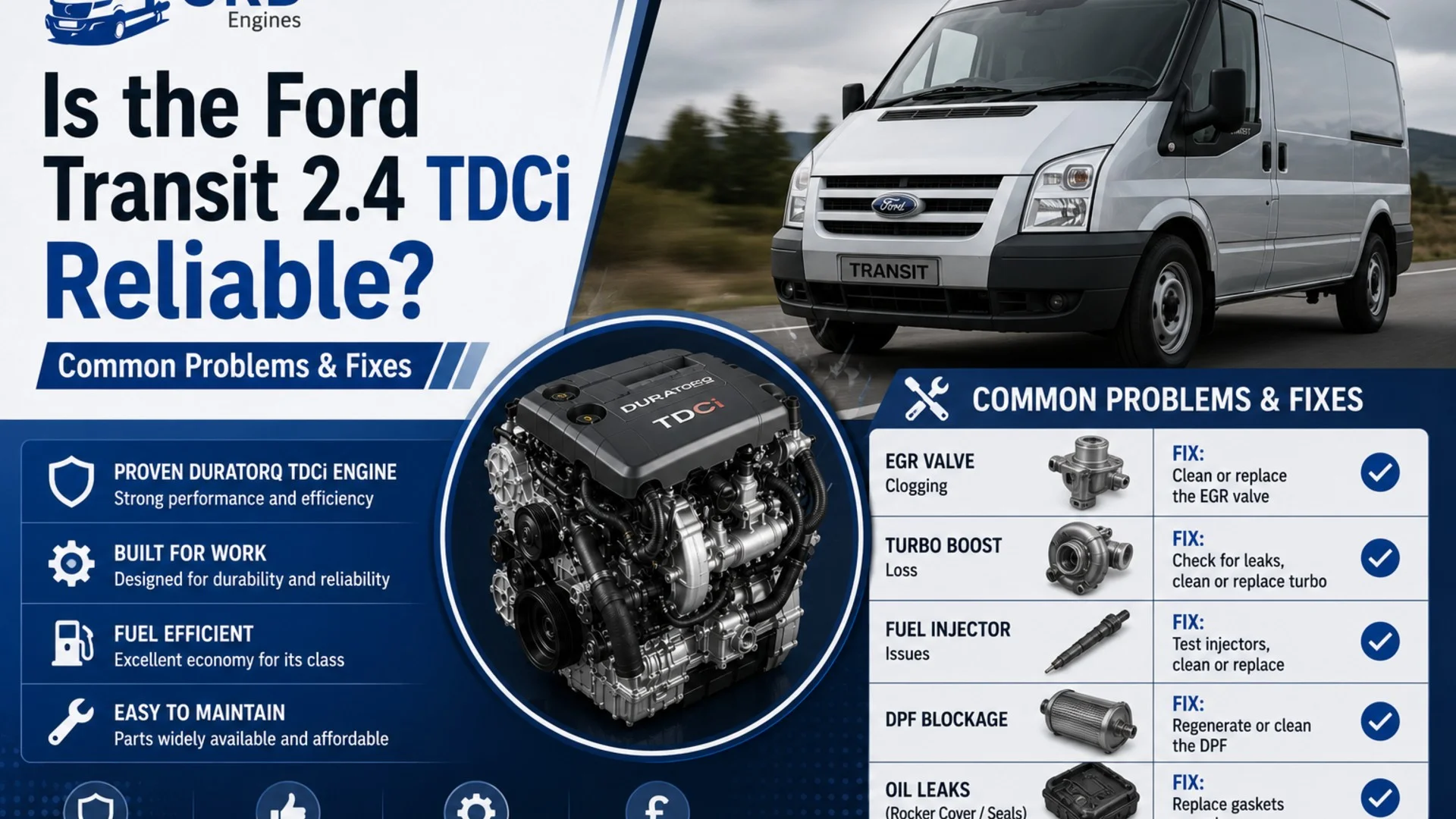
The honest answer: broadly, yes, the 2.4 TDCi has a solid reputation for durability when properly maintained, which is a big part of why it remained in production across two Transit generations. That said, no engine is fault-free, and knowing the common issues helps you catch problems early rather than facing an expensive surprise.
Known Timing Chain, Injector & Turbo Issues
Three areas tend to come up most often when owners discuss 2.4 TDCi reliability:
- Timing chain wear while more commonly associated with the later 2.2 TDCi, some 2.4 TDCi variants can experience chain stretch or tensioner wear at higher mileage, often signalled by a rattling noise on cold start
- Injector problems common rail injectors can develop leaks or lose calibration over time, leading to rough running, poor fuel economy, or a warning light; this is a known wear point across most common rail diesels, not unique to Ford
- Turbo issues turbo actuator failures or wear in the variable geometry mechanism can cause a loss of power or unusual whistling/whining noises under acceleration
Real-world example: A fleet operator running several Transit 2.4 TDCi vans noticed one unit developing a cold-start rattle that disappeared within a few seconds of running. Left unchecked, timing chain wear like this can eventually lead to chain failure, a catastrophic and expensive fault. Caught early through a routine inspection, it was a straightforward tensioner replacement rather than a full engine rebuild.
Ford Transit 2.4 Expected Engine Lifespan
With consistent maintenance, regular oil changes, timely fault diagnosis, and genuine or quality replacement parts, the 2.4 TDCi is capable of reaching well beyond 200,000 miles, and many fleet and tradesperson vans have exceeded this with proper care. Engine lifespan depends heavily on:
- Consistency of servicing and oil changes
- Driving conditions (short journeys and heavy loads accelerate wear)
- How early faults are caught and addressed
- Whether genuine or quality aftermarket parts are used for repairs
Neglect, particularly delayed oil changes or ignored warning signs, is the single biggest factor that shortens this engine's working life prematurely.
Typical Repair Costs by Fault Type
Repair costs vary significantly by region, garage, and whether genuine or aftermarket parts are used, but as a general guide:
Fault | Relative Cost Level |
| Injector replacement (single) | Moderate |
| Turbo replacement or rebuild | Moderate to high |
| Timing chain and tensioner replacement | High (labour-intensive) |
| EGR valve cleaning/replacement | Low to moderate |
| Full engine rebuild | High |
| Full engine replacement | Highest |
If you're facing a quote significantly above what a specialist Ford engine supplier suggests, it's always worth getting a second opinion, labour costs for engine work vary enormously between general garages and diesel specialists.
Ford Transit 2.4 Maintenance, Oil Capacity & Service Intervals
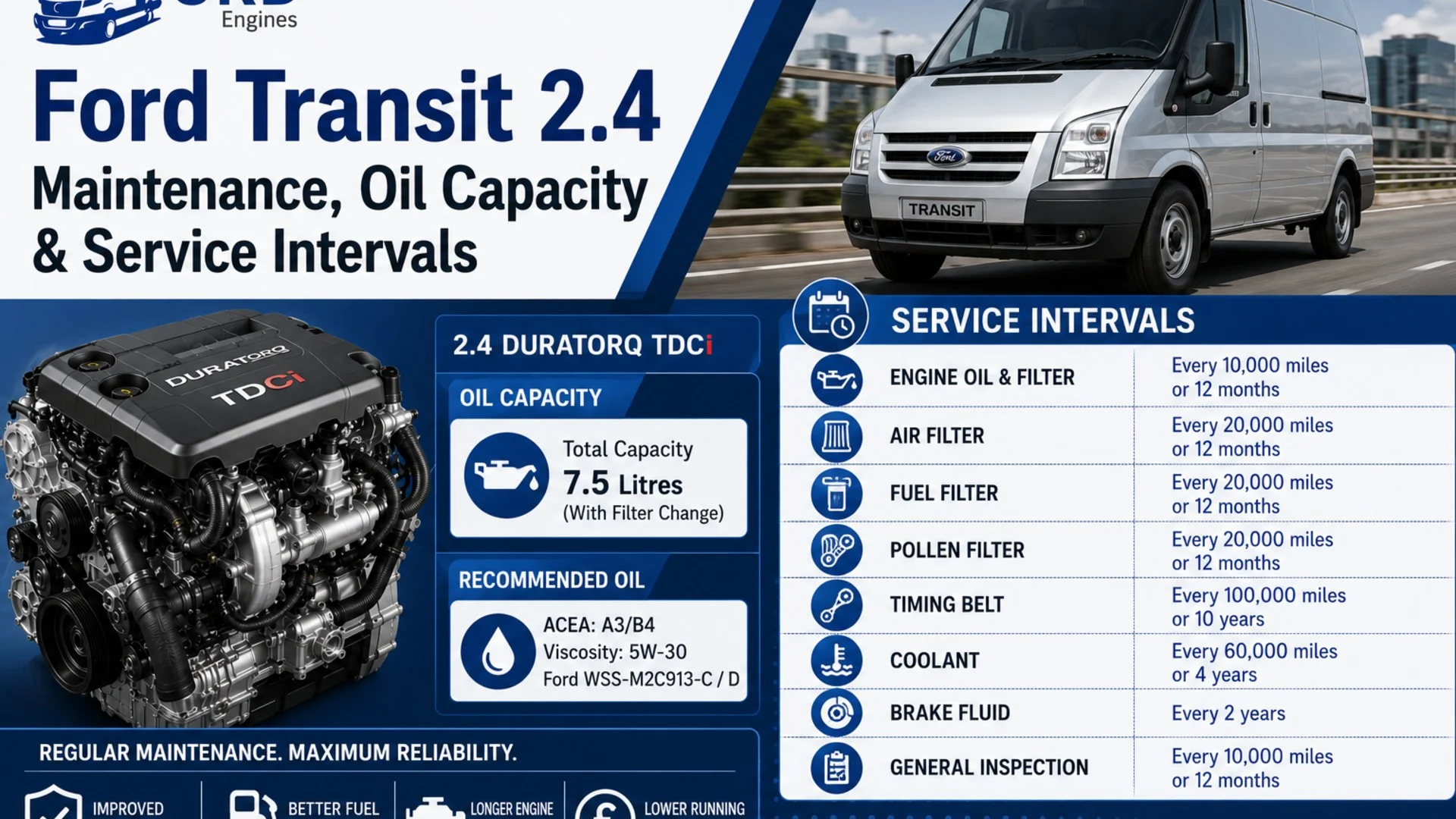
Preventive maintenance is where the 2.4 TDCi's reputation for reliability is either earned or lost. This engine rewards consistency and punishes neglect more than most.
Oil Specification & Coolant Capacity
Using the correct oil specification protects the engine's internals, particularly the turbocharger, which relies on consistent oil pressure and clean lubrication to survive its demanding operating conditions.
- Recommended oil: fully synthetic diesel engine oil meeting Ford's approved specification for the Duratorq TDCi range, always check your handbook for the exact spec, as this varied by production year
- Approximate oil capacity: typically around 8.4–8.5 litres with filter change, though this should be confirmed against your specific engine code
- Coolant capacity: approximately 10–11 litres, though again this varies by variant and cooling system configuration
As with horsepower figures, don't rely on generic online figures alone, cross-check against your handbook or engine code before ordering fluids in bulk.
Recommended Service Intervals & Preventive Maintenance
Ford's general guidance for the 2.4 TDCi recommends servicing at regular mileage or time-based intervals, though this can vary depending on usage type. As a practical guide:
- Standard use: service intervals around every 12,000–15,000 miles or 12 months
- Heavy use (towing, fleet, frequent short trips): shorter intervals are worth considering, similarly to how heavy-use Transit owners often reduce their oil change frequency
- Timing chain inspection: worth including as part of higher-mileage servicing, even outside a formal recall or bulletin, simply as a precaution
Beyond oil changes, preventive maintenance that genuinely extends this engine's life includes:
- Regular EGR valve inspection and cleaning to prevent carbon build-up
- DPF (diesel particulate filter) maintenance, particularly important if your Transit does frequent short journeys that prevent proper DPF regeneration
- Cooling system checks, since overheating accelerates wear on nearly every internal component
- Prompt investigation of any warning lights rather than waiting for the next scheduled service
Fuel Economy, What to Expect From the 2.4 TDCi
Fuel economy on the 2.4 TDCi varies by power output, load, and driving style, but owners typically report figures in the range of 28–34 mpg under mixed use, with lower figures under heavy load or frequent stop-start driving. Higher-output variants generally trade slightly worse economy for improved towing and payload performance, a reasonable trade-off for tradespeople and fleet operators prioritising capability over fuel savings.
Keeping the engine well-maintained, clean injectors, correct oil, and a functioning turbo, has a measurable impact on fuel economy over time, since a struggling engine burns more fuel to deliver the same output.
Replacement & Rebuilt Ford Transit 2.4 Engines
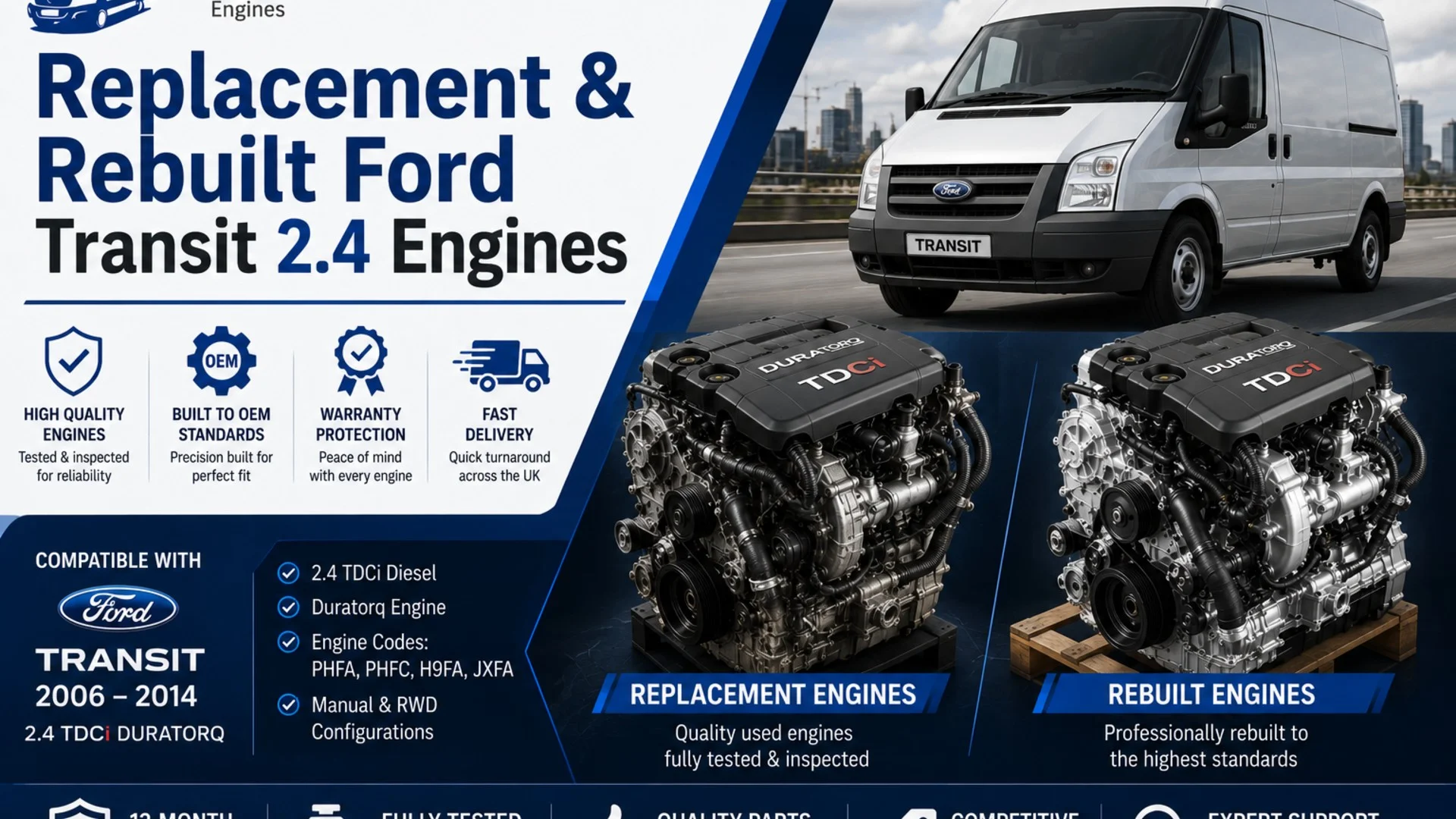
If you're past the point of routine maintenance and facing a genuine engine problem, it's worth understanding your realistic options before committing to a repair path.
When a Rebuild Makes Sense vs a Full Replacement
Both routes have their place, and the right choice depends on the extent of the damage and your van's overall condition:
- A rebuild makes sense when the core engine block and major components are sound, but specific parts, pistons, rings, bearings, or the timing chain, have worn or failed. This is often more cost-effective if the rest of the van is in good condition and worth continued investment
- A full replacement makes sense when damage is catastrophic (such as a snapped timing chain causing valve or piston damage), or when the cost of rebuilding approaches the cost of a quality replacement unit
Real-world example: A tradesperson's Transit 2.4 suffered a turbo failure that sent debris into the engine, causing internal damage beyond a straightforward rebuild. In this case, sourcing a reconditioned Transit engine was more cost-effective and lower-risk than attempting a rebuild with uncertain internal damage.
Engine Compatibility Across Transit Mk6 & Mk7
If you're sourcing a replacement engine, compatibility across generations is a common point of confusion. Broadly:
- Engines are generally compatible within the same engine code family, but not automatically interchangeable across all Mk6 and Mk7 variants
- Ancillary compatibility (turbo, injectors, wiring harness, ECU) can differ even between visually similar engine codes
- Always confirm compatibility using your VIN and engine code, rather than assuming based on model year or badge alone
This is precisely the kind of detail a specialist Ford engine supplier will check before supplying a replacement, it's worth confirming this upfront rather than after a unit arrives.
Buying a Reconditioned Transit 2.4 Engine, What to Check
If you're considering a reconditioned or remanufactured engine rather than a new replacement, a few checks protect you from a poor purchase:
- Confirm the exact engine code matches your vehicle, not just the general "2.4 TDCi" description
- Ask what's been replaced during the reconditioning process, timing chain, injectors, turbo, gaskets, versus simply cleaned and reused
- Check for a warranty, since a reputable supplier will stand behind their rebuild with a meaningful guarantee period
- Ask about mileage or hours run, if the unit isn't brand new, to understand its remaining working life
- Confirm fitting support, since correct installation matters as much as the quality of the engine itself
Get a Quote for a Rebuilt or Replacement Engine
Whether you're dealing with a worn timing chain, a failed turbo, or an engine that's simply reached the end of its economical repair life, getting an accurate, honest quote makes the decision easier. Get in touch for a no-obligation quote on a rebuilt or replacement Ford Transit 2.4 engine, matched precisely to your engine code, with clear guidance on what's included.
Frequently Asked Questions
What engine is in the Ford Transit 2.4?
The 2.4-litre Transit engine is part of Ford's Duratorq TDCi family, built on the Puma diesel engine platform, and was used across Transit Mk6 and Mk7 generations in various power outputs.
How much horsepower does a Ford Transit 2.4 have?
Power output ranges from around 90 bhp to 140 bhp depending on the specific engine code and tune, so it's worth confirming your exact variant via your VIN or logbook.
Is the Ford Transit 2.4 reliable?
Generally yes, with a reputation for durability when properly maintained. Common wear points include injectors, turbo components, and, at higher mileage, timing chain wear.
Does the Transit 2.4 have a timing chain?
Yes, the 2.4 TDCi uses a timing chain rather than a belt, though chain and tensioner wear can occur at higher mileage and is worth including in preventive maintenance checks.
Which years used the 2.4 engine?
The 2.4 TDCi was used across Transit Mk6 and into Mk7 production, before Ford transitioned to the 2.2 TDCi as its primary Transit diesel engine.
Is the 2.4 better than the 2.2?
Neither is strictly "better", the 2.4 tends to offer stronger low-end torque suited to towing and heavy loads, while the 2.2 generally offers improved fuel economy and updated emissions technology. The right choice depends on your priorities.
Can the engine be rebuilt?
Yes, in most cases where the block and major components remain sound. For more severe damage, a full replacement engine is often the more practical and cost-effective route.
Get the Right Engine Advice for Your Ford Transit 2.4
Whether you're confirming your exact engine code, chasing down a fault, or facing a genuine rebuild-or-replace decision, getting accurate, code-specific information protects you from costly mistakes. The Ford Transit 2.4 TDCi has earned its reputation as a dependable workhorse, but only when it's properly understood, maintained, and repaired with the right parts for your specific variant.
Get in touch today for expert advice, an accurate engine code match, or a no-obligation quote on a rebuilt or replacement Ford Transit 2.4 engine.