
Your Transit Connect starts fine, pulls hard for ten minutes, then drops into limp mode on the first long hill. Or the garage has called with the words nobody wants to hear: it's the engine.
Either way, you need straight answers. Is this a fault you can fix, or is it time for a replacement engine? And if it is, how do you avoid ordering the wrong one?
This guide covers the Ford Transit Connect 1.5 TDCi engine from every angle that matters: how to identify yours, what usually goes wrong, and how to choose between a repair, a rebuild and a replacement. We are an independent UK supplier and are not affiliated with Ford Motor Company.
Which Engine Is in the Ford Transit Connect 1.5 TDCi, and What Is Your Engine Code?
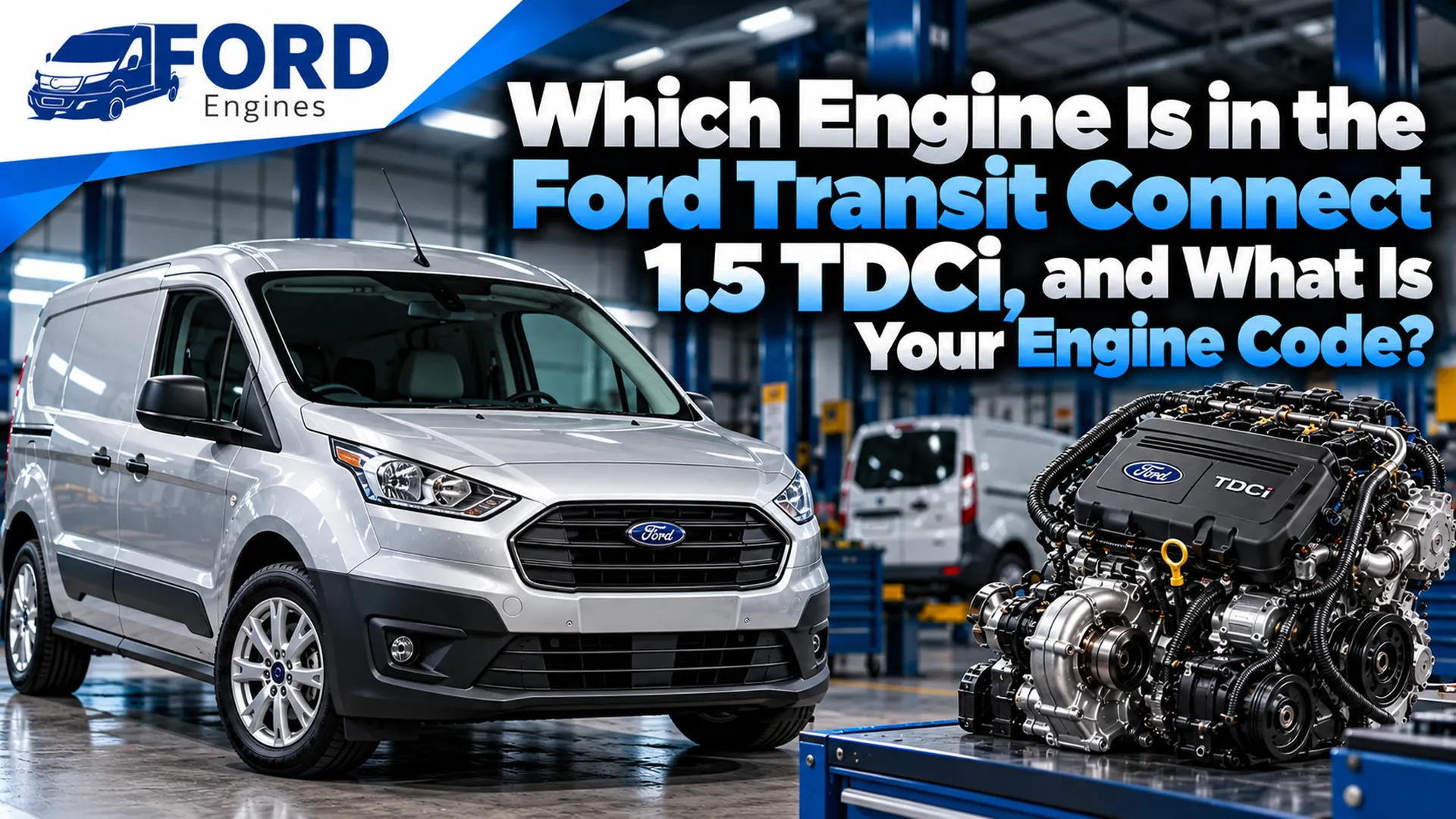
The 1.5 TDCi is a four-cylinder, 1,499cc turbocharged diesel with common rail direct injection. It belongs to Ford's Duratorq family, and in the second-generation (Mk2) Transit Connect it was offered in 75, 100 and 120 PS outputs. It was built for the stop-start, heavy-load reality of van work, where fuel economy and low running costs matter more than outright speed.
The catch is that "1.5 TDCi" does not describe one single engine. Ford changed the specification over the Mk2's life, and parts that look identical in a listing can differ in ways that stop an engine fitting properly. Identification comes first, before price, before supplier, before anything else.
What Are the Ford Transit Connect 1.5 TDCi Engine Codes and Power Outputs (75, 100 and 120 PS)?
Every engine carries a code, and that code is what a supplier should match against. Here is how the commonly quoted codes line up. Treat the table as a starting point, because codes and applications vary by build date and market.
Power | Earlier 1.5 TDCi (2015 onwards) | Later facelift engine (1.5 EcoBlue) |
| 75 PS | XUGA | BEGA |
| 100 PS | XVGA | Z2GA |
| 120 PS | XWGA | ZTGA |
A few practical points from the workshop side:
- Check the physical engine code, not just the V5C or the sales listing. Previous owners and previous garages have a habit of swapping parts.
- Power output affects more than horsepower. The 75, 100 and 120 PS versions can differ in turbo specification, injectors and engine management calibration.
- Your VIN and registration give the most reliable match. That is why we ask for your registration before quoting. It removes guesswork and costly returns.
Not sure what you have? Enter your registration and we will confirm the correct engine before you commit to anything.
How Is the 1.5 TDCi Different From the 1.5 EcoBlue in the Transit Connect?
This is where many buyers get caught out. Searching "Transit Connect 1.5 diesel engine" returns both, and some listings use the names as if they mean the same thing.
In simple terms, the 1.5 TDCi is the earlier Mk2 diesel (introduced in 2015), while the 1.5 EcoBlue arrived with the later facelift and was developed around tighter Euro 6 emissions requirements. The EcoBlue family uses a different engine management and emissions approach, including SCR/AdBlue in many applications, so the two are not interchangeable.
What this means when you are ordering:
- Do not rely on "1.5 diesel" alone. Always match year, code and power.
- The emissions hardware differs. DPF, EGR, NOx sensor and AdBlue components vary between versions.
- A mismatch costs real money. Ordering the wrong engine means lost days, extra labour and a van sitting off the road.
If you are comparing quotes, ask each supplier which engine code they are quoting. A vague answer is a warning sign.
What Are the Most Common Problems With the Transit Connect 1.5 TDCi Engine?
The 1.5 TDCi has a solid reputation overall, and many examples pass 150,000 miles without trouble. But like any modern diesel, it has known weak points, and most of them are linked to how the van is used. Short urban runs, long idling and missed services do more damage than distance alone.
Here is what we see most often, grouped by symptom so you can match it to your own van.
Why Is My Transit Connect 1.5 TDCi Losing Power or Going Into Limp Mode?
Loss of power is the most common complaint, and it is rarely caused by the engine's internals. More often the engine is being protected by its own management system after a sensor or emissions fault. The usual suspects are the DPF, EGR valve, turbocharger and injectors.
Symptom | Possible cause | Diagnostic check | Typical fix |
| Loss of power, warning light | Blocked DPF | Scan for soot loading and differential pressure data | Forced regeneration, cleaning or DPF replacement |
| Hesitation, rough idle, black smoke | EGR valve carbon build-up | Check EGR flow and valve operation | Clean or replace EGR valve |
| Whistling, weak acceleration | Turbo or boost leak | Boost pressure test, inspect hoses and intercooler | Repair leaks, replace actuator or turbo |
| Rattle or knock on cold start, rough running | Injector fault | Injector balance data, leak-off checks | Recode or replace injectors |
| Limp mode with no obvious cause | Sensor or wiring fault | Full OBD scan and live data review | Replace faulty sensor or repair wiring |
Here is a typical scenario. A delivery driver doing mostly short, stop-start runs notices the van feels flat and the DPF warning light appears. The DPF never gets hot enough, for long enough, to burn off soot. A sustained motorway run sometimes clears it. If not, a forced regeneration or professional clean is the next step, and it is far cheaper than ignoring it until the turbo or EGR is affected too.
The takeaway is to get a proper diagnostic scan before replacing anything. Parts guessing is expensive.
Can the 1.5 TDCi Suffer Head Gasket, Cambelt or Oil Pressure Failures?
Yes, and these are the faults that most often end in a replacement engine, because they involve the engine's core structure.
Head gasket failure. Watch for unexplained coolant loss, white smoke from the exhaust, overheating, or bubbles in the expansion tank. Coolant loss with no visible leak is a red flag. A pressure test of the cooling system helps confirm combustion gases are entering the coolant. Catching this early can save the cylinder head. Driving on it can destroy the engine.
Cambelt (timing belt) failure. If the belt breaks or jumps, valve and piston damage can follow quickly. Follow Ford's service schedule as an absolute minimum. For vans in heavy, high-mileage or stop-start use, many specialists recommend inspecting and replacing earlier than the maximum interval. Replace the belt together with the tensioner and associated components, not the belt alone.
Oil pressure faults. A low oil pressure warning is not always a failed pump. It can be a faulty sensor, a wiring problem, low oil level or a worn engine. The way to know is a mechanical pressure test, not guesswork. If the pressure is genuinely low, stop driving. Bearing damage can follow within minutes.
Regular oil and filter changes using the correct specification matter more than almost anything else for engine life. Skipped services are the single biggest pattern we see in failed engines.
How Do You Know When the Engine Is Beyond Repair?
Sometimes the honest answer is that repair no longer makes financial sense. These signs usually point that way:
- Metal particles in the oil or filter, which suggest internal wear
- Repeated overheating, especially if the head gasket has already been repaired once
- Low compression on one or more cylinders
- Persistent knocking from the bottom end
- Heavy oil consumption combined with blue or grey smoke
- A snapped cambelt where valve damage is confirmed
If two or more of these apply, ask for a written assessment before spending more on parts. A good garage will tell you plainly when repair costs approach the price of a replacement engine.
Think your engine has reached that point? Request a quote and we will help you work out the right next step.
Should You Repair, Rebuild or Replace a Ford Transit Connect 1.5 TDCi Engine?
Once the diagnosis is clear, the decision is mostly about money, downtime and how long you plan to keep the van.
- Repair makes sense when the fault is external: DPF, EGR, turbo, injectors, sensors. The engine's core is healthy.
- Rebuild means stripping your existing engine and replacing worn components. It can work, but it depends on the condition of the block and head, and your van is off the road while it happens.
- Replace means swapping in a used, reconditioned or remanufactured engine. This is usually the fastest route back to work, and the one that gives you a defined warranty.
What Does a Reconditioned 1.5 TDCi Engine Cost in the UK, and Is It Better Than a Used or Remanufactured One?
Prices depend on engine code, power output, availability and condition, so we do not publish one-size-fits-all numbers. What we can do is show you how the three options differ.
Used engine | Reconditioned engine | Remanufactured engine | |
| What it is | Taken from a donor vehicle, tested as is | Inspected, worn parts replaced, tested | Fully stripped, rebuilt to specification |
| Condition | Varies with donor mileage | Good, with key wear parts renewed | Closest to new |
| Warranty | Usually limited | Defined warranty | Typically the longest |
| Price | Lowest upfront | Mid-range | Highest |
| Best for | Older, low-value vans | Most working vans and fleets | High-mileage vans you plan to keep long term |
For most owners, reconditioning is the sensible middle ground. You avoid the unknown history of a used unit without paying remanufactured prices.
What the total replacement cost really includes. The engine itself is only part of the bill. Ask any quote to cover:
- Labour for removal and refitting
- Fresh oil, coolant and filters
- A new cambelt kit and water pump, where applicable
- Ancillary parts such as gaskets, seals and mountings
- Diagnostic work to confirm the engine was the real problem
- DPF and EGR inspection, so a new engine isn't hampered by an old blockage
A cheap engine quote that leaves these out often ends up costing more.
Before you buy, check:
- The engine code matches your van, confirmed against your registration or VIN
- Mileage and testing details are stated clearly
- Warranty terms are in writing, including what is and isn't covered
- The core return process is explained, if an exchange is required
- Fitting requirements are clear, including whether a cambelt kit or other parts must be replaced
- Delivery times are realistic for your business
Why choose fordengines.co.uk? We supply reconditioned Ford engines to UK drivers, tradespeople and fleets who need their vans back at work. Every engine is matched to your registration before you order.
Frequently Asked Questions
Is the Ford Transit Connect 1.5 TDCi engine reliable?
Generally, yes, when it is serviced on time. Most problems trace back to emissions components like the DPF and EGR, or to missed oil and cambelt changes, not to a flawed core design.
How long does a Transit Connect 1.5 TDCi engine last?
Many reach well beyond 150,000 miles with consistent servicing. Short trips, delayed oil changes and unresolved overheating shorten that considerably.
Does the Transit Connect 1.5 TDCi have a timing belt?
It uses a belt-driven timing system, so follow the manufacturer's replacement schedule and inspect it earlier if the van does heavy or stop-start work. Confirm the exact arrangement for your engine code.
What are the common problems with the Transit Connect 1.5 TDCi?
DPF blockage, EGR carbon build-up, turbo and boost faults, injector issues, head gasket failure, and oil pressure faults are the ones we see most.
Why is my Transit Connect 1.5 TDCi losing power or going into limp mode?
Usually a DPF, EGR, turbo or sensor fault. A diagnostic scan identifies it quickly and saves you replacing parts unnecessarily.
Is it cheaper to rebuild or replace a 1.5 TDCi engine?
It depends on the damage. A rebuild can cost less when only some internals are worn, but a reconditioned replacement is often faster, with a clear warranty and less downtime.
How much does a Transit Connect 1.5 TDCi engine cost?
It varies by code, power output and condition. Used is cheapest, remanufactured costs most, and reconditioned sits in between. Send us your registration for an accurate quote.
Final Word
The Ford Transit Connect 1.5 TDCi engine is a capable workhorse, but only if you match the right engine to the right van and diagnose faults properly before spending money. Identify your engine code, get a proper scan, and compare used, reconditioned and remanufactured options on warranty and fitting terms, not just price.
When you are ready, send us your registration. We will confirm the match and give you a clear quote, so you can get your van back on the road.