
Your Transit Connect starts to hesitate on a slip road. The engine light comes on, the power drops away, and now a job that should take an hour looks like it will cost you the day.
If that sounds familiar, you're in good company. The Transit Connect is one of the most widely used small vans in the UK, and most of them work hard. Most Ford Transit Connect engine problems come from a small group of faults: a clogged diesel particulate filter (DPF), a sticking EGR valve, a tired turbocharger, worn injectors, timing belt issues and low oil pressure. All of them are easier and cheaper to deal with when you spot them early.
This guide explains which engines suffer from what, what each symptom usually means, whether you can keep driving, and when it makes more sense to replace the engine than to keep repairing it. If you'd rather talk to someone now, the Ford Engines team can look at your van's details and point you in the right direction. Send us your registration number and a description of the symptoms for a free engine check.
What Are the Most Common Ford Transit Connect Engine Problems?
Transit Connects are not all mechanically the same. A 2008 van and a 2017 van have different engines, different emissions equipment and different weak points. Before you chase a fault, find out which engine you have. It's on the V5C and usually on the engine bay label, and your VIN confirms it.
Across the UK range, the same handful of faults appears again and again:
- DPF blockage on diesel vans, especially those used for short, stop-start trips
- EGR valve and cooler faults, which cause hesitation, rough running and warning lights
- Turbocharger wear or boost leaks, which show up as loss of power and whistling or whining
- Injector problems, such as leaking seals, poor spray patterns and hard starting
- Timing belt or wet belt deterioration, depending on the engine
- Cooling system faults, including coolant loss, a failing thermostat and head gasket trouble
- Low oil pressure, which is the most serious symptom on this list
These faults feed into each other. A blocked DPF raises exhaust back pressure, which stresses the turbo. A sticking EGR valve fills the intake with soot, which upsets sensor readings and fuelling. That is why a quick "clear the fault and carry on" approach so often brings the same warning light back within a week.
Problems by mileage
Wear follows a rough pattern, although usage matters as much as the odometer:
- Under 60,000 miles: DPF and EGR trouble on vans that mostly do short trips, plus occasional sensor faults.
- 60,000 to 100,000 miles: injector seals, turbo actuators and early signs of oil leaks.
- 100,000 to 150,000 miles: turbo wear, EGR cooler faults, timing component wear and rising oil consumption.
- 150,000+ miles: a mix of all the above, plus bottom-end wear. At this point a repair that costs a lot may not be worth it.
Which Transit Connect Engine Is Least Reliable: the 1.8 TDCi, 1.6 TDCi or 1.5 TDCi?
There is no single "bad" engine. Every one of them can last well when it's serviced on time and used properly, and every one of them can fail early when it isn't. What differs is where each tends to cause trouble.
Engine | Typical UK fitment | Where problems tend to show up |
| 1.8 TDCi (Duratorq) | First-generation vans (2002 to 2013) | Injectors, turbo, EGR, clutch and dual-mass flywheel wear, age-related leaks and wear on high-mileage vans |
| 1.6 TDCi | Second-generation vans (from 2013) | DPF and EGR on short-trip use, turbo and boost problems, injector seals, cooling system faults |
| 1.5 TDCi | Later second-generation vans | DPF behaviour, injector issues, timing system and oil-related concerns on higher-mileage vans |
| 1.0 EcoBoost (petrol) | Selected second-generation vans | Cooling system and oil-related faults, plus timing component wear. Check the service history carefully. |
Engine availability and timing-system design vary by year and variant, so always check your engine code before ordering parts or committing to a repair.
Our verdict: if you're buying used, the engine's history matters more than its badge. A 1.8 TDCi with a documented service record is a better buy than a younger 1.6 or 1.5 that has covered 80,000 miles of short urban trips with its oil changes overdue. For high-mileage commercial use, check the DPF history, the turbo condition and the oil level before anything else.
A typical scenario: a courier driving 40 miles a day across town in stop-start traffic never gives the DPF the sustained heat it needs to burn off soot. Within a year or two the warning light appears, regeneration fails, and the van starts losing power. The engine isn't defective. The duty cycle is wrong for the way the exhaust system works.
Why Is My Transit Connecting Losing Power or Going Into Limp Mode?
Loss of power and limp mode are the most common reasons people search for Ford Transit Connect engine problems. Limp mode is the engine computer's way of protecting the engine. It cuts boost, limits revs and sometimes shows a warning light.
The cause is usually one of the following:
Symptom | Likely cause | What to check first |
| Power loss under load, DPF light | Blocked DPF or failed regeneration | DPF pressure readings, soot load, driving pattern |
| Hesitation, rough idle, smoke | Sticking EGR valve or clogged intake | EGR operation, intake carbon, sensor data |
| Whistling, loss of boost | Turbo wear or a split boost hose | Boost pressure, hoses, intercooler, turbo play |
| Hard starting, misfire, black smoke | Worn or leaking injectors | Injector balance, fuel pressure, return flow |
| Sudden limp mode with a warning light | Sensor fault or intake leak | Stored fault codes and live data |
Fault codes help narrow this down. Codes you may see on these vans include P0401 (EGR flow), P0299 (turbo underboost), P2002 and P2463 (DPF efficiency and soot accumulation), P0087 (fuel rail pressure too low), P0101 (airflow sensor range) and P0300 to P0304 (misfires). A code points to a system, not necessarily to a failed part, and codes vary by engine. A proper diagnosis reads the live data as well as the stored codes.
Still in limp mode? Don't keep clearing the light. Get the van scanned properly, and we can quote for the repair or tell you if the engine itself is the problem.
Can I Still Drive My Transit Connect With an Engine Problem?
Sometimes you can, for a short distance and at low load. Sometimes you absolutely cannot. The difference is the symptom, and knowing which is which can save you from turning a repair into a replacement.
What Do Engine Warning Lights, Knocking, Overheating and Low Oil Pressure Mean?
Symptom | Safe to drive? | Urgency |
| Engine management light only, van drives normally | Short, gentle trips only | Medium |
| DPF warning light | Possibly, depending on severity | Medium |
| Limp mode | Avoid prolonged driving | High |
| White smoke with coolant loss | No | High |
| Low oil pressure warning | No | Critical |
| Overheating | No | Critical |
| Severe knocking | No | Critical |
Stop driving now if you see any of the following: the oil pressure light, a temperature gauge climbing into the red, steam from the bonnet, or a heavy knock from the engine. Every extra mile risks turning a repairable fault into a destroyed engine. Pull over safely, switch off and call for recovery.
Reading the signs
- Black smoke usually points to over-fuelling or restricted air, such as injector, intake or turbo problems.
- White smoke with a sweet smell and falling coolant levels can mean a head gasket problem.
- Blue smoke means oil is burning, often from turbo seals or worn engine internals.
- Knocking or rattling can come from the timing system, a failing bearing or fuel system problems. Never ignore it.
- Ticking at idle often relates to injectors, valve gear or an exhaust leak.
- Whining under acceleration often means a turbo is on its way out.
- Hard starting when cold can point to glow plugs, injectors or low compression.
Why short trips damage DPFs
A DPF cleans itself by burning off soot at high exhaust temperature. That needs a sustained run at speed, typically 20 minutes or more on a faster road. If your van mostly does short, slow trips, regeneration keeps getting interrupted, soot builds up and the filter clogs. A van that regularly runs a half hour on a dual carriageway often avoids the problem entirely.
What happens when a timing belt or wet belt fails?
On engines with a belt-driven timing system, a worn or broken belt can let the pistons and valves collide. On engines with a wet belt, which runs in engine oil, the belt can also shed material that clogs the oil pickup and starves the engine of oil. Either route can end in a total engine failure. Which type your van has depends on the engine, so ask for the manufacturer's replacement interval for your exact engine and follow it by time and mileage, whichever comes first. If a belt is overdue or its history is unknown, replace it before you rely on the van.
How to prevent most of these faults
- Use the correct grade of oil and change it on schedule. For hard-working vans, leaning toward the shorter interval is cheap insurance.
- Give a diesel van a proper motorway-speed run regularly so the DPF can regenerate.
- Fix small leaks, rough running and warning lights early.
- Replace the fuel filter and air filter on time.
- Check oil and coolant levels often, especially on high-mileage vans.
- Replace the timing belt by time or mileage, whichever is sooner, not only when it looks worn.
Should I Repair, Recondition or Replace My Transit Connect Engine?
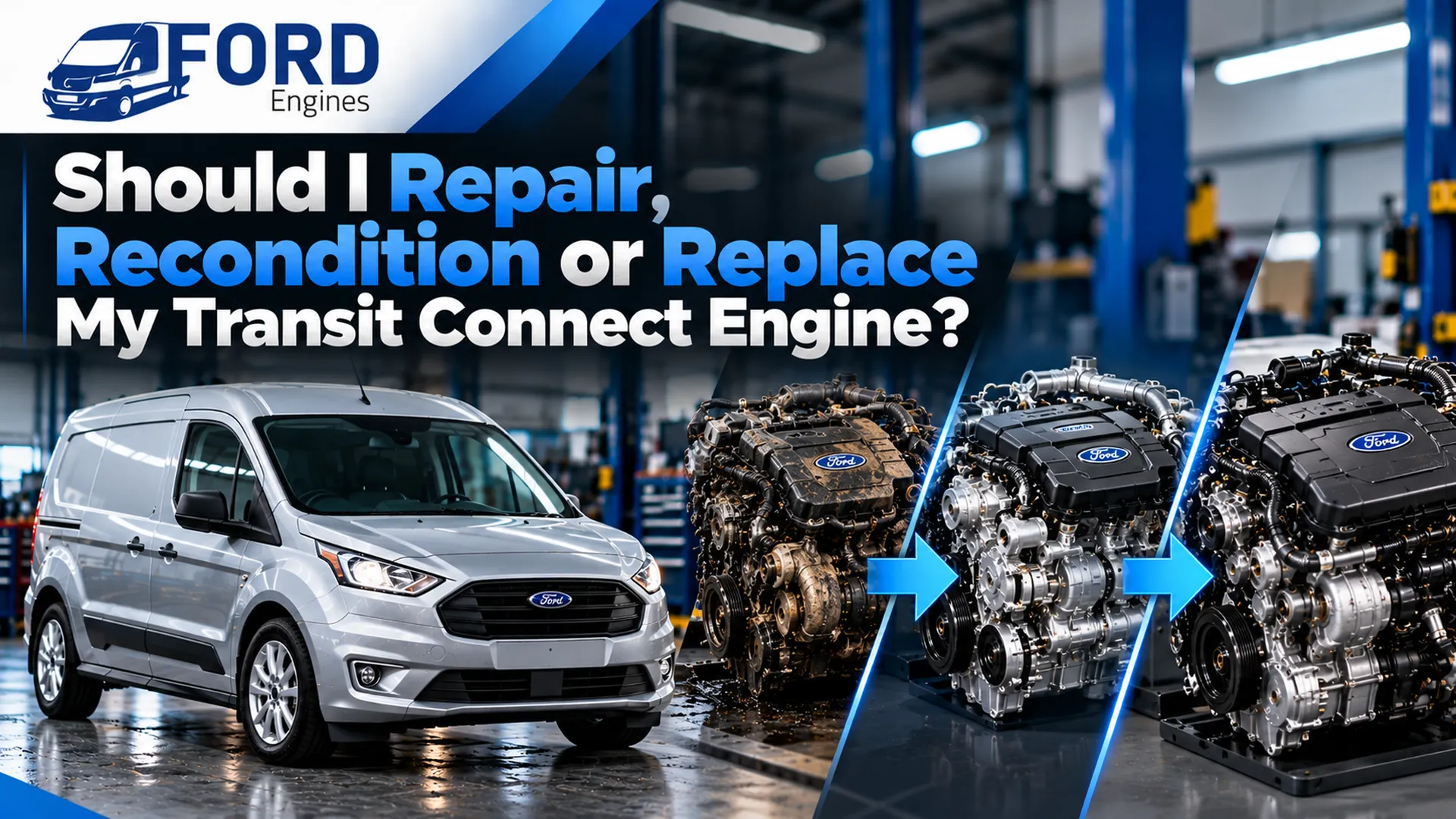
Most engine problems are repairable, and repair is usually the right first call. But there is a point where spending more on the existing engine stops making sense. Knowing where that point sits is the difference between a sensible decision and a drawn-out series of bills.
When Is It Cheaper to Repair, and When Does a Replacement Engine Make Sense?
Repair makes sense for a single, clear fault: a turbo, an EGR valve, a set of injectors, a DPF clean, a belt or a sensor. If the rest of the engine is healthy, a targeted repair is the cheapest route.
Replacement starts to make sense when there is internal damage or when repair costs are climbing past the engine's value. Warning signs include:
- Metal particles in the oil or a damaged oil filter
- Low compression or poor leak-down results
- Debris from a failed timing belt
- A seized, holed or badly knocking engine
- Repeated repairs that fail to cure the problem
Here is how the options compare:
Option | Best for | Main advantage | Main trade-off |
| Repair existing engine | A single, isolated fault | Lowest immediate cost, keeps your original engine | Doesn't help if there's wider internal wear |
| Used engine | Budget replacement on an older van | Lower upfront cost | Condition and history vary, so ask for proof |
| Reconditioned engine | Vans you plan to keep working | Worn parts replaced, usually with a warranty | Costs more than a used engine |
| Rebuilt engine | Rebuilding your own engine or a core | Tailored to the damage found | Needs workshop time, so the van is off the road longer |
| New engine | Rare, high-value cases | Maximum lifespan | Highest cost, often not justified on an older van |
A typical scenario: a 140,000-mile van that has thrown a belt and bent valves on a high-mileage engine is often a better candidate for a reconditioned or used replacement than for an extensive rebuild of a tired engine. A van with a sound bottom end and a failed turbo, on the other hand, usually justifies a turbo repair.
How Much Does a Ford Transit Connect Engine Repair or Replacement Cost in the UK?
Costs vary widely by engine, fault, mileage and whether you need fitting. As a guide to the main drivers:
- Engine type and condition. Diesel and petrol, and the specific variant, affect part prices.
- Used, reconditioned or rebuilt. Each tier carries a different price and warranty.
- Fitting. Supply-only is cheaper than supply and fit, but you'll need a competent workshop.
- Related parts. Belts, water pumps, clutches, flywheels and fluids are best replaced at the same time.
- Delivery. Charges depend on your location and how quickly you need the engine.
At Ford Engines, our current UK guide prices are:
- Repair (single fault):
- Used engine:
- Reconditioned engine:
- Supply and fit:
For an exact quote on your van, send us your registration number and the symptoms. We'll tell you whether repair or replacement is the sensible route, even when that means the cheaper option for you.
What Should I Ask Before Buying a Reconditioned or Used Transit Connect Engine?
A replacement engine is only as good as the supplier behind it. Before you pay, ask:
- What warranty comes with it, and what does it cover? Check the length, whether it covers parts and labour, and any fitting conditions.
- Can you prove the mileage and history? Ask for documentation, not just a verbal figure.
- Has it been compression and leak-down tested? A tested engine is far less of a gamble.
- Does it match my exact engine code? Years and variants differ, so give your registration or VIN.
- Is supply and fit available? Some warranties require professional fitting.
- What are the delivery times? For a working van, downtime costs money.
- What should I replace at the same time? Belts, seals, coolant and filters are worth doing now.
Get a free engine match. Enter your registration at Ford Engines or call, and we'll confirm the right engine for your van, with a UK warranty of and delivery across the country.
Frequently Asked Questions
What are the most common problems with a Ford Transit Connect?
The most frequent are DPF blockage, EGR faults, turbo wear, injector problems, timing belt issues, cooling faults and low oil pressure. Which of them you're likely to face depends on your engine, age, mileage and driving pattern.
How long does a Ford Transit Connect engine last?
With regular servicing, timely belt changes and sensible use, many engines run well past 150,000 miles. Short-trip use, missed oil changes and ignored warning lights shorten that considerably.
Why does my Transit Connect keep going into limp mode?
Usually because the engine computer has detected a problem with boost, fuelling, the DPF or a sensor. A full diagnostic scan with live data finds the cause. Clearing the code alone just hides it.
Can a blocked DPF damage a Transit Connect engine?
Yes, indirectly. A blocked DPF raises exhaust back pressure, which stresses the turbo and can contribute to oil dilution and further faults. Treat a DPF warning light as a prompt to act, not something to ignore.
How do I know if my timing belt is failing?
Symptoms can include ticking or rattling from the front of the engine, rough running or an unexpected warning light, but a belt can also fail with little warning. That is why replacement by age and mileage matters more than waiting for symptoms.
Is a used Ford Transit Connect worth buying?
Often, yes, if it comes with documented servicing. Check the oil condition, the DPF and turbo history, and the timing belt service record, and avoid any van with unexplained warning lights.
Is it worth replacing a Transit Connect engine?
When the body, gearbox and the rest of the van are sound, a reconditioned or used engine can add years of work for far less than the cost of replacing the van. When the van has other major issues, it may not.
Final Thoughts
Most Ford Transit Connect engine problems announce themselves early, through a warning light, a loss of power, a new noise or a change in smoke. The vans that end up with a scrapped engine are usually the ones where those signs were ignored for weeks. Catch the problem early, find out whether it's a one-part fix or something deeper, and compare repair against replacement before you commit.
If you're facing an engine fault right now, Ford Engines can help you work out what's wrong and what makes the most sense for your van and budget. Send us your registration number and a short description of the problem for a free engine check, or call for a quote.