
Buying, running, or fixing a Ford Transit Custom eventually leads to the same question: which engine have I actually got, and is it any good? Maybe you're checking specs before a purchase. Maybe your van's just ticked over 120,000 miles and you're wondering how much life is left under the bonnet. Or maybe you already know something's wrong and you're trying to work out whether a replacement engine makes more sense than another round of repairs.
Whichever situation brought you here, this guide covers it properly. We've worked with Transit Custom engines across every generation, from the older Duratorq and TDCi units through to the current 2.0 EcoBlue, and this article pulls that experience together into one place: what each engine actually is, how reliable it really is, what it costs to maintain, and what your options look like if a replacement engine becomes the sensible choice.
Let's start with the basics, because knowing exactly what engine you're dealing with changes every decision that follows.
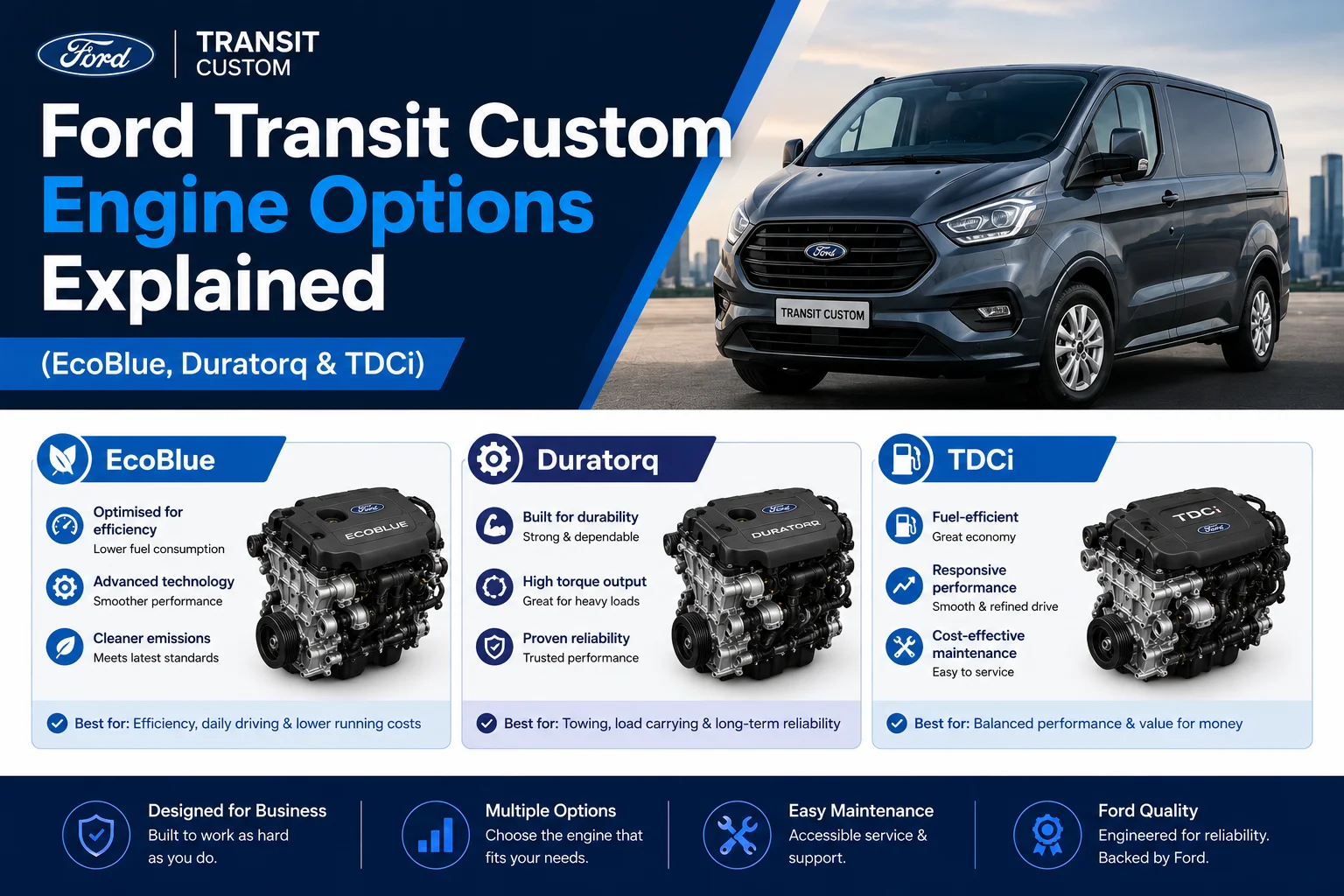
Ford Transit Custom Engine Options Explained (EcoBlue, Duratorq & TDCi)
The Ford Transit Custom has been through several engine generations since launch, and each one has a distinct reputation, specification, and set of quirks. Getting this right matters, a repair or replacement quote is only useful if it's based on the correct engine.
What Engine Does the Ford Transit Custom Use?
Since its 2012 launch, the Transit Custom has used three main diesel engine families:
- Duratorq TDCi – fitted to early Transit Custom models, based on Ford's long-running diesel platform
- 2.2 TDCi – a refined version of the Duratorq line, common in pre-2016 vans
- 2.0 EcoBlue – the current-generation engine, introduced from 2016 onwards, built on Ford's Panther/Puma diesel architecture and designed to meet Euro 6 emissions standards
Each of these sits in a specific production window, so the first step in any engine-related decision — repair, part ordering, or replacement, is confirming exactly which one your van has.
Engine Codes Explained: How to Identify Your Exact Engine
Every Transit Custom engine carries a unique engine code, usually stamped on the block itself and also listed in the vehicle's documentation. This code tells you the exact specification, not just "2.0 EcoBlue," but the specific power output, emissions standard, and internal revision.
The most reliable ways to check your engine code:
- VIN decode – your vehicle identification number links directly to the exact engine fitted from the factory
- Physical engine code stamp – typically located on the cylinder block, though position varies by engine family
- V5C logbook – often lists the engine capacity and sometimes the code itself
- Dealer or specialist parts lookup – using your registration or VIN to pull exact fitment data
This matters more than it sounds. Two vans that look identical on paper can have different engine codes with different injector types, turbo specifications, or ECU mapping, and ordering parts or a replacement engine against the wrong code leads to compatibility problems down the line.
Ford Transit Custom 2.0 EcoBlue Engine Specifications
The 2.0 EcoBlue is the engine you'll find in any Transit Custom from 2016 onwards, and it represents a genuine step forward in efficiency compared to the Duratorq and TDCi units it replaced.
Horsepower and Torque Figures by Variant
The EcoBlue comes in several power outputs depending on trim and tuning:
Variant | Horsepower | Torque |
| EcoBlue 105 | 105 hp | 360 Nm |
| EcoBlue 130 | 130 hp | 385 Nm |
| EcoBlue 170 | 170 hp | 405 Nm |
| EcoBlue 185 | 185 hp | 415 Nm |
The higher-output variants use a twin-turbo setup to deliver stronger low-end torque without a major fuel economy penalty, useful for a commercial van that's regularly loaded and needs pulling power at low revs rather than peak power at high revs.
Fuel Consumption and Real-World Economy
Official figures for the EcoBlue range typically sit between 34–40 mpg combined, though real-world figures for a loaded van doing mixed driving usually land somewhat lower, closer to 30–35 mpg is a realistic expectation for most fleet and trade use. Motorway-heavy driving improves this considerably, while constant urban stop-start work brings it down.
Ford Transit Custom 2.2 TDCi Engine Overview (Pre-2016 Models)
The 2.2 TDCi is the engine most commonly found in Transit Custom vans built before the EcoBlue's introduction. It's a common-rail turbo diesel with a strong reputation for durability, and it remains popular in the used van market specifically because of that reliability record.
Key characteristics of the 2.2 TDCi:
- Available in multiple power outputs, generally ranging from 100 hp to 155 hp depending on year and variant
- Uses a timing belt rather than the wet belt design found in some EcoBlue units
- Known for being mechanically straightforward to diagnose and repair compared to newer emissions-heavy engines
- Widely supported by independent garages, meaning servicing and parts availability tend to be less of an issue
Duratorq Engine Guide: What Older Transit Custom Owners Should Know
If you're running one of the earliest Transit Custom models, you may still have a Duratorq-badged unit, effectively the predecessor to the refined 2.2 TDCi. These engines share the same core design principles, common rail injection, turbocharging, but with less advanced emissions control and, generally, simpler electronics.
For owners of these older vans, the practical upside is straightforward diagnostics and lower part costs. The downside is that these units are now well past a decade old in most cases, so wear-related issues, oil pump degradation, turbo bearing wear, and ageing seals, become more relevant considerations.
Which Ford Transit Custom Engine Is Best?
There's no universally "best" answer here — it depends on what you value most.
Priority | Best Engine Choice | Why |
| Lowest running costs | 2.0 EcoBlue 105/130 | Best fuel economy, modern efficiency |
| Proven long-term reliability | 2.2 TDCi | Simpler design, strong track record |
| Towing/heavy load pulling power | 2.0 EcoBlue 170/185 | Twin-turbo torque delivery |
| Cheapest ongoing repairs | 2.2 TDCi or Duratorq | Wider independent garage support, lower part costs |
If you're buying a used Transit Custom purely for reliability and low running costs, the 2.2 TDCi remains a strong choice among trade buyers. If you want the latest emissions compliance and better fuel economy, the EcoBlue is the more modern option, provided it's been serviced properly, which brings us to reliability.
Ford Transit Custom Engine Reliability & Lifespan
Specifications only tell half the story. What actually matters to most owners is how long the engine will last and what's likely to go wrong along the way.
Is the 2.0 EcoBlue Reliable?
Broadly speaking, yes, but with a caveat that matters. The EcoBlue is a well-engineered, efficient engine, and the majority of units run trouble-free for well over 100,000 miles. Where problems tend to appear is in vans that have had inconsistent servicing or that spend most of their life on short journeys, which doesn't give the DPF (diesel particulate filter) enough sustained running time to regenerate properly.
In short: a well-serviced EcoBlue is a dependable engine. A neglected one, particularly around oil changes and DPF care, tends to develop problems earlier than it should.
How Long Does a Transit Custom Engine Last?
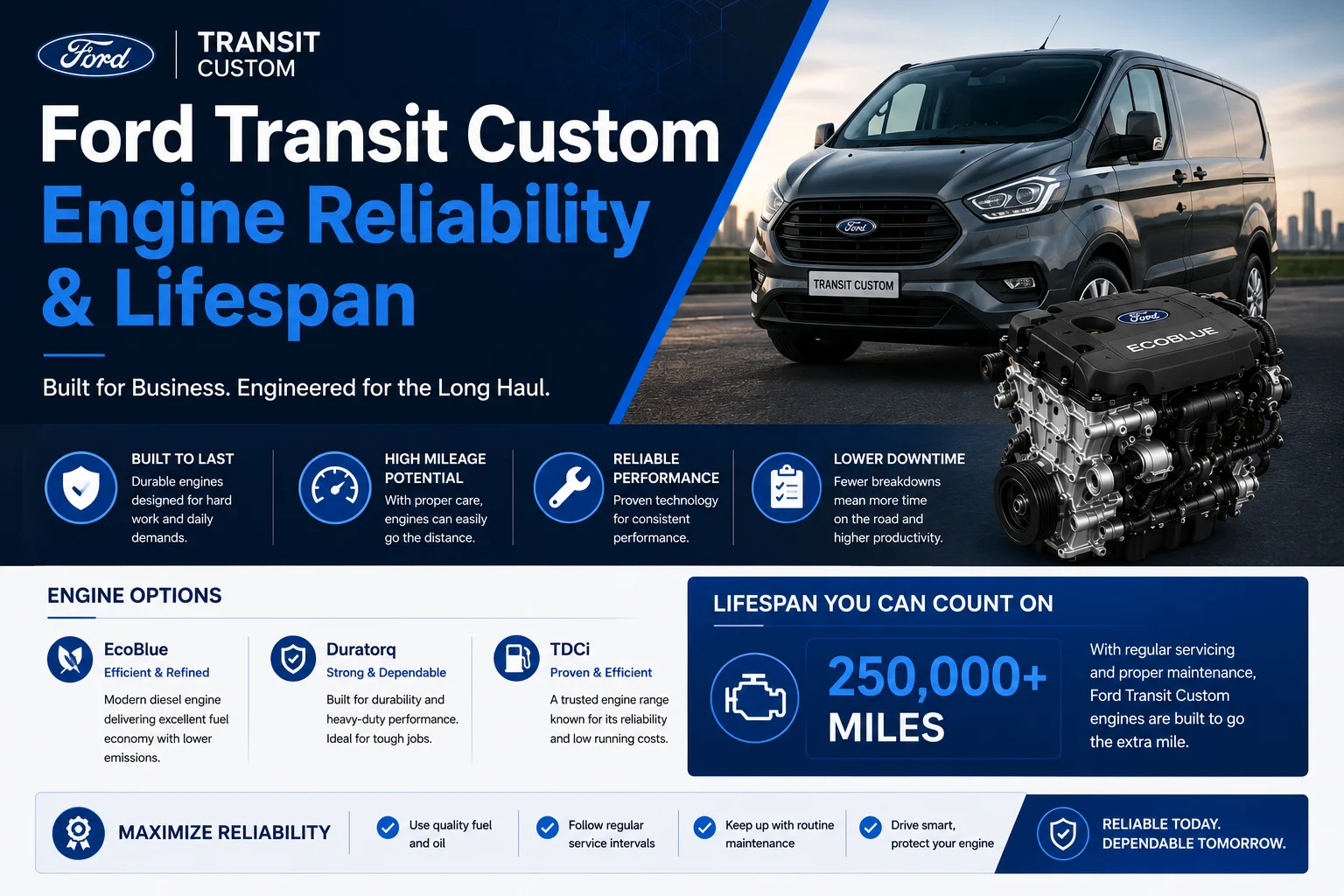
With reasonable care, most Transit Custom engines, across EcoBlue, TDCi, and Duratorq variants, are capable of 150,000 to 250,000+ miles before requiring major work. Fleet vehicles that are serviced strictly on schedule regularly exceed this range.
Engine Lifespan by Mileage and Servicing History
As a rough guide to what to expect at different mileage points:
- Under 60,000 miles – should run with minimal issues if serviced correctly; any problems at this stage are usually component-specific faults rather than general wear
- 60,000–120,000 miles – wear items start becoming relevant: injectors, turbo actuators, EGR valves, and on wet belt engines, belt condition
- 120,000–200,000 miles – timing components, oil pump, and cooling system parts are worth closer inspection; this is a common range for engine rebuild consideration
- 200,000+ miles – engines can and do continue running well past this point, but the case for a full rebuild or replacement engine becomes stronger as multiple wear items start to align
Wet Belt vs Timing Chain: Which Transit Custom Engines Are Affected?
This is one of the most important distinctions for Transit Custom owners to understand, and it's frequently glossed over in general buying guides.
Certain 2.0 EcoBlue variants use a wet belt, a timing belt that runs submerged in engine oil rather than a traditional dry timing belt or timing chain. The design has efficiency benefits, but it introduces a specific risk: if oil quality degrades or service intervals are missed, the belt material can break down faster than expected, sometimes with limited external warning.
This is different from the 2.2 TDCi and Duratorq engines, most of which use a conventional timing belt or chain, giving more predictable wear patterns and more visible warning signs before failure.
Wet Belt Failure Signs and Replacement Intervals
Watch for:
- Small rubber or belt material fragments in the oil during a service
- A rattling noise on cold start
- Engine management light with timing-related fault codes
- Any metallic debris found in the oil filter during routine servicing
Given the potential severity of wet belt failure, which can cause catastrophic internal damage on an interference engine, many independent specialists now recommend replacing the wet belt proactively, generally somewhere in the 60,000–90,000 mile range, rather than waiting for it to reach a manufacturer-quoted interval that may be optimistic for vans in hard commercial use.
Common Engine Problems at a Glance
Across all Transit Custom engine types, the most frequently reported issues include:
- Turbocharger and turbo actuator faults
- EGR valve clogging
- DPF regeneration failures, particularly on short-journey vans
- Fuel injector wear past higher mileages
- Wet belt degradation (EcoBlue-specific)
For Full Diagnosis and Warning Signs, See Our Complete Engine Problems Guide
If any of this sounds familiar, power loss, warning lights, unusual noises, our dedicated Ford Transit engine problems guide covers full diagnostic detail, symptom-by-symptom, including how to distinguish between similar-sounding faults before you spend money on the wrong repair.
Ford Transit Custom Engine Maintenance & Running Costs
Reliability isn't just about the engine design, it's heavily influenced by how consistently a van is maintained. This section covers what actually keeps a Transit Custom engine running well for the long haul.
Transit Custom Engine Oil: Capacity and Specification
Oil capacity and specification vary by engine type, so always check against your specific engine code rather than assuming a generic figure applies. As a general guide:
- 2.0 EcoBlue – typically requires a low-viscosity, fully synthetic oil meeting Ford's specific WSS-M2C948-B (or later) specification, reflecting the tighter tolerances of modern diesel engines
- 2.2 TDCi and Duratorq – generally use a more conventional fully synthetic diesel oil, though still to Ford-approved specification
Using the wrong oil specification on an EcoBlue engine, even if the viscosity looks similar, can accelerate wet belt wear, since the belt itself runs directly in the oil and is sensitive to its exact composition.
Recommended Maintenance Schedule and Servicing Intervals
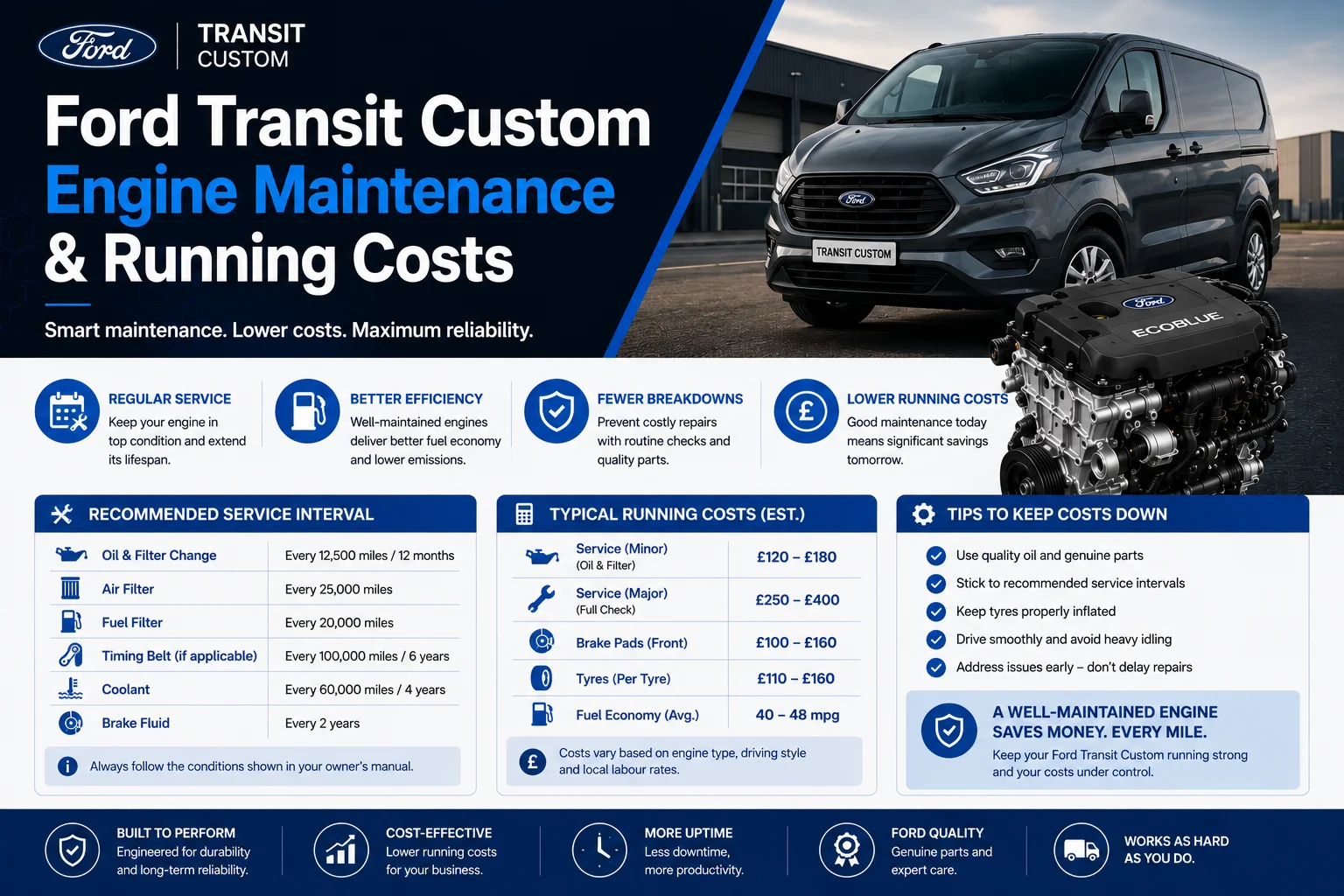
Ford's official servicing intervals for the Transit Custom typically fall around 18,000–24,000 miles or annually, whichever comes first, though vans in hard daily use often benefit from more frequent oil changes regardless of the mileage counter.
A sensible maintenance checklist includes:
- Oil and filter change at the recommended interval (or sooner for high-mileage or hard-use vans)
- Fuel filter replacement to protect injectors and the high-pressure fuel pump
- EGR valve inspection and cleaning where carbon buildup is evident
- DPF health check, particularly for vans doing mostly short journeys
- Coolant level and condition check, given the role it plays in preventing overheating and head gasket stress
- Wet belt inspection (EcoBlue only) at or before the recommended replacement interval
Timing Belt and Wet Belt Replacement Intervals
For the 2.2 TDCi and Duratorq engines using a conventional timing belt, manufacturer intervals typically sit around 100,000–120,000 miles, though many specialists recommend earlier replacement on high-use commercial vehicles. For the EcoBlue's wet belt, as covered above, proactive replacement in the 60,000–90,000 mile range is increasingly the recommended approach among independent specialists, regardless of the original manufacturer guidance.
What Affects Long-Term Ownership Costs?
Beyond routine servicing, several factors materially affect what a Transit Custom actually costs to own over time:
- Driving pattern – short, stop-start journeys accelerate DPF and EGR issues compared to consistent motorway use
- Servicing consistency – missed or delayed oil changes are one of the single biggest contributors to premature engine wear
- Load carrying – vans regularly run at or near maximum payload place more strain on turbo, injectors, and drivetrain components
- Fuel quality – consistently using quality diesel from reputable stations reduces injector fouling over time
A van serviced strictly to schedule and driven sensibly will, in almost every case, cost meaningfully less to run over its lifetime than one that's had patchy maintenance, even if the upfront purchase price was identical.
Replacing Your Ford Transit Custom Engine: Options, Costs & Getting a Quote
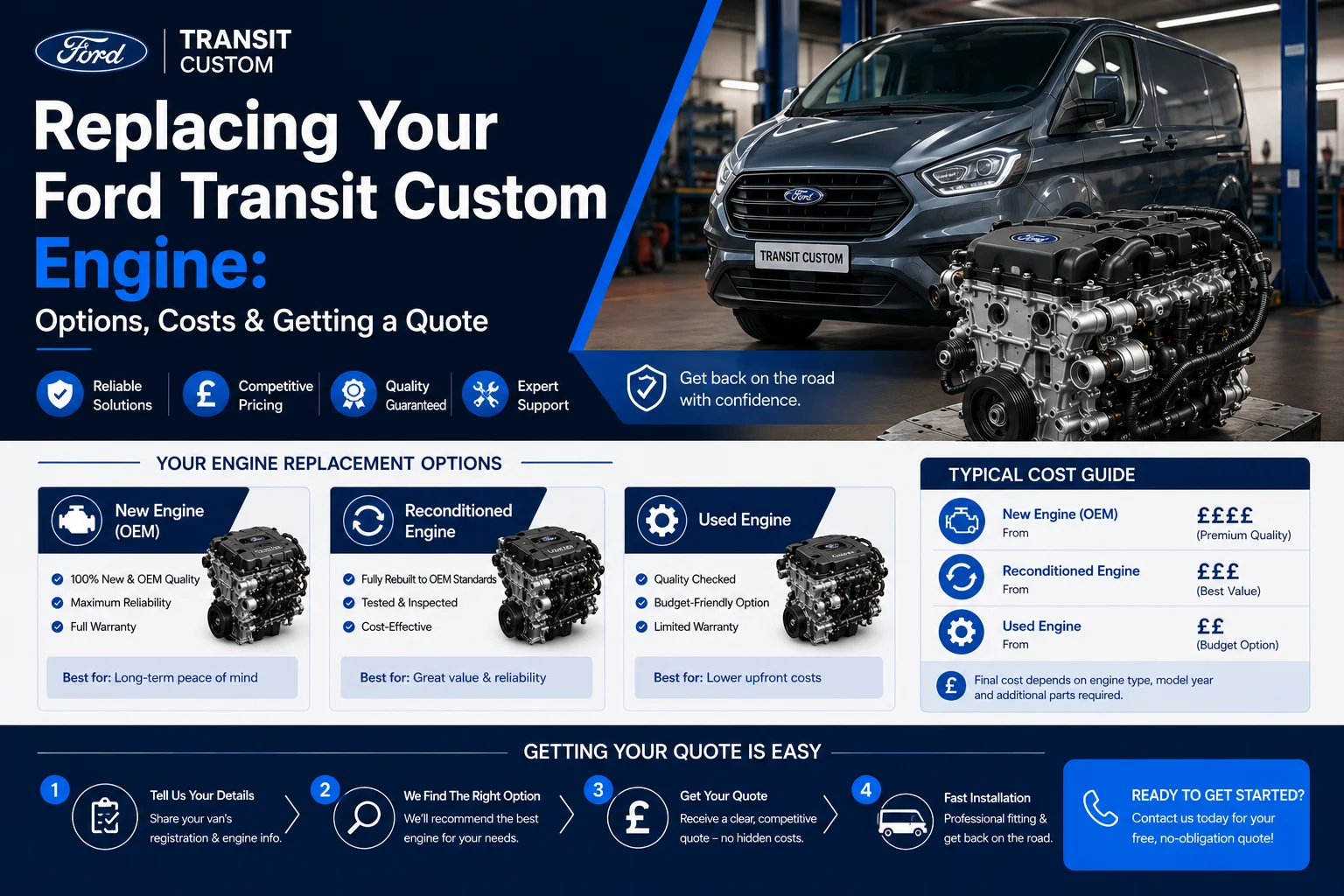
Eventually, some Transit Custom owners reach the point where repair no longer makes financial sense and a replacement engine becomes the more sensible route. Here's how to approach that decision properly.
Used vs Reconditioned vs Remanufactured Transit Custom Engines
These three terms get used loosely across the industry, but they represent genuinely different products, and understanding the difference protects you from a poor purchase.
Type | What It Means | Typical Cost | Typical Warranty |
| Used engine | Removed from a donor vehicle, tested but not rebuilt | Lowest | Shortest, often 30–90 days |
| Reconditioned engine | Worn components replaced, cleaned and reassembled | Mid-range | Moderate, often 6–12 months |
| Remanufactured engine | Fully stripped, every part inspected and replaced to OEM tolerance | Highest | Longest, often 12–24 months |
Which Option Offers the Best Value?
For most owners planning to keep the van for several more years, a reconditioned or remanufactured engine offers the better long-term value despite the higher upfront cost, you're paying for known condition and meaningful warranty cover rather than the uncertainty of an engine pulled from another vehicle with unknown service history.
A used engine can make sense as a lower-cost option if the van itself has limited remaining life or you're planning a shorter ownership period, but it comes with more risk attached.
Ford Transit Custom Engine Replacement Cost in the UK
Costs vary depending on engine type, specification, and whether you're sourcing supply-only or supplied-and-fitted. As a general guide:
- Used engine – typically £1,200–£2,200 supply-only
- Reconditioned engine – typically £2,000–£3,500 supply-only
- Remanufactured engine – typically £3,000–£4,800 supply-only
- Fitting labour – generally adds £600–£1,200 depending on engine type and van accessibility
These are guide ranges rather than fixed quotes, the exact figure depends on your specific engine code, current specification, and any additional work identified once the old engine is removed.
Engine Compatibility: What to Check Before You Buy
Getting compatibility wrong is one of the most common, and costly, mistakes in engine replacement. Before ordering:
- Confirm your exact engine code, not just the general "2.0 EcoBlue" or "2.2 TDCi" description
- Check ancillary compatibility, turbo type, injector specification, and sensor wiring can differ between seemingly similar engine codes
- Confirm gearbox compatibility, particularly if you're considering an engine from a different model year
- Verify emissions equipment compatibility, since Euro 5 and Euro 6 components are not always interchangeable
VIN and Engine Code Compatibility Explained
Your VIN links directly to the exact specification your van left the factory with, making it the most reliable starting point for confirming compatibility. Any reputable engine supplier should ask for your VIN or engine code before confirming a quote, treat it as a good sign if they do, and a warning sign if they don't.
Warranty and Installation: What's Included?
Before committing to any replacement engine, clarify exactly what's covered:
- Whether the warranty covers the full engine or only specific components
- Whether labour is included if a fault develops post-installation, or only parts
- Whether the warranty is affected by who performs the installation
- What servicing requirements apply to keep the warranty valid
A slightly higher-priced engine backed by a genuine, clearly defined warranty is almost always the better long-term decision compared to the cheapest option available with vague or minimal cover.
Get a Quote for Your Ford Transit Custom Engine
If you've read this far and you're weighing up a rebuild, reconditioned unit, or full replacement, the next practical step is getting an accurate quote based on your specific engine code and van condition. At Ford Engines, we specialise specifically in Ford Transit and Transit Custom engines — supplying used, reconditioned, and remanufactured units across the UK, with clear warranty terms and supply-and-fit options available. A quote costs nothing and gives you a real figure to compare against ongoing repair costs.
Frequently Asked Questions
Which engine is best in the Ford Transit Custom?
It depends on priorities. The 2.2 TDCi has the strongest reputation for straightforward long-term reliability, while the 2.0 EcoBlue offers better fuel economy and stronger torque in its higher-output variants, provided it's serviced consistently.
Is the 2.0 EcoBlue reliable?
Generally yes, particularly when serviced on schedule with the correct oil specification. Issues tend to arise from missed servicing, short-journey-only use affecting DPF regeneration, and wet belt neglect on affected variants.
What engine does the Transit Custom use?
Depending on age, either the Duratorq, 2.2 TDCi, or 2.0 EcoBlue diesel engine, each with several power output variants.
How long does a Transit Custom engine last?
Typically 150,000–250,000+ miles with proper servicing, though this varies by engine type and how consistently maintenance has been carried out.
Are EcoBlue engines reliable?
Yes, when maintained properly. The main risk factor specific to this engine is the wet belt design in certain variants, which is more sensitive to oil quality and service intervals than a traditional timing chain or belt.
What causes Transit Custom engine failure?
Most commonly turbo faults, EGR clogging, DPF regeneration failures, injector wear, and, on affected EcoBlue variants, wet belt degradation from missed servicing.
What is the cost of replacing a Transit Custom engine?
Costs generally range from around £1,200 for a used engine supply-only up to £4,800+ for a remanufactured unit, with fitting typically adding £600–£1,200.
Should I rebuild or replace my engine?
A rebuild tends to make sense when damage is limited to specific wear components. Replacement is usually the better option when damage is extensive or you want a known-condition engine with a clearer warranty.
Is a reconditioned engine worth buying?
In most cases, yes, reconditioned engines offer a strong balance between cost and reliability, provided you buy from a reputable supplier with clear warranty terms.
Which Transit Custom engine has a wet belt?
Certain 2.0 EcoBlue variants use a wet belt design. It's worth confirming your exact engine code, as not every EcoBlue variant uses this configuration.
What oil should I use?
This depends on your exact engine code, EcoBlue engines typically require a specific low-viscosity fully synthetic oil meeting Ford's current specification, while TDCi and Duratorq engines generally use a more conventional fully synthetic diesel oil.
When should the timing belt be replaced?
For conventional timing belt engines, typically 100,000–120,000 miles. For EcoBlue wet belt variants, many specialists recommend proactive replacement in the 60,000–90,000 mile range.
What is the most reliable Transit Custom engine?
The 2.2 TDCi holds the strongest reputation for long-term reliability, largely due to its simpler design and wide independent garage support, though the 2.0 EcoBlue performs well under consistent servicing.
The Bottom Line
Every Transit Custom engine, Duratorq, TDCi, or EcoBlue, is capable of a long, reliable working life, but that depends heavily on knowing exactly what you've got and maintaining it accordingly. Confirming your engine code, sticking to proper service intervals, and staying alert to early warning signs will do more for your van's longevity than almost anything else.
If you've reached the point where repair costs no longer stack up, or you're planning ahead for a replacement, getting the right engine, matched precisely to your van's specification, backed by a genuine warranty, makes all the difference. Ford Engines specialises specifically in Transit and Transit Custom engines, with used, reconditioned, and remanufactured options supplied and fitted across the UK.
Get in touch for a straightforward quote based on your exact engine code, and let's get your Transit Custom running the way it should.