
If your Ford Transit engine has failed, or you're sourcing a replacement, exchange, or reconditioned unit, one detail matters more than anything else: the engine code. Get it wrong, and you risk ordering an engine that won't bolt up, won't map to your ECU, or won't pass an MOT emissions check. Get it right, and the whole replacement process, from quote to fitting, becomes straightforward.
This guide walks you through exactly what Ford Transit engine codes are, where to find yours, how to read the full code list by generation and capacity, and what you need to check before buying a replacement. Whether you're a fleet manager, an independent mechanic, or a Transit owner trying to work out what's actually under the bonnet, this page is built to answer that question properly, not just list codes and leave you guessing.
What Are Ford Transit Engine Codes?
A Ford Transit engine code is a short alphanumeric identifier, usually four characters, such as DRFA, CVRA, or JXFA, stamped directly onto the engine block. It tells you exactly which engine variant you have, independent of the model year or trim level printed on your logbook.
This matters because two Transits from the same year, same 2.2 TDCi badge, and same dealership can carry different engine codes depending on power output, emissions standard, and market specification. The badge on the back of the van tells you the engine family. The engine code tells you the exact build.
How Ford Transit Engine Codes Are Structured
Ford's engine codes aren't random. They typically follow a pattern that reflects the engine family, generation, and sometimes the power output or fuel delivery system. For example, codes beginning with "CV" or "DR" generally sit within the Duratorq TDCi range, while EcoBlue-generation engines use a different alphanumeric structure entirely.
You don't need to memorise the logic, that's what the reference list further down this page is for, but understanding that the code is a deliberate classification system (not a serial number) helps explain why substituting one code for another isn't always safe, even within the same engine family.
Ford Transit Engine Code vs VIN, What's the Difference?
This is one of the most common points of confusion, so it's worth being direct about it: the engine code and the VIN are not the same thing, and one cannot always be used to reliably confirm the other.
- The VIN (Vehicle Identification Number) identifies the specific vehicle, its build date, factory, model variant, and originally fitted engine family.
- The engine code identifies the specific engine unit currently fitted to that vehicle, which, especially in vans with high mileage or a service history involving engine swaps, may not always match what the VIN suggests.
If your Transit has ever had engine work done, or you're buying it second-hand, checking the physical engine code stamp is more reliable than relying on VIN records alone.
Why Knowing Your Engine Code Matters Before You Buy a Replacement
Ordering the wrong engine because you assumed "2.2 TDCi" was specific enough is one of the most common, and most expensive, mistakes we see. The wrong code can mean:
- Mounting points or ancillaries that don't align
- ECU and injector mapping that doesn't match
- Emissions compliance issues (a Euro 4 engine fitted where Euro 5 or 6 is required)
- Turbo or timing system mismatches that cause premature failure
Getting the code right at the start avoids all of this. It's a five-minute check that saves weeks of delay and potentially thousands in wasted parts.
Where to Find Your Ford Transit Engine Code
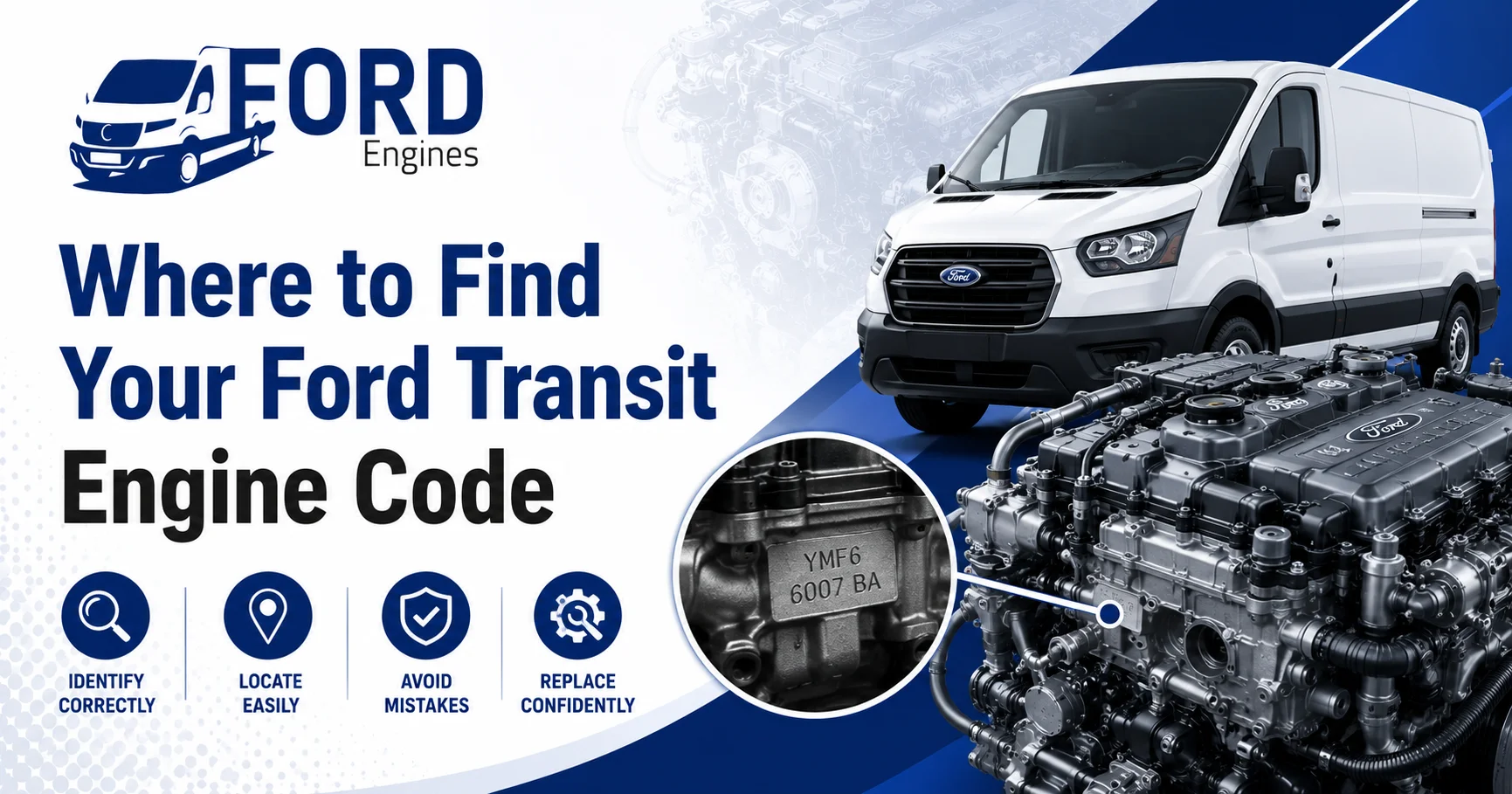
Locating your engine code takes a few minutes if you know where to look. There are three reliable methods, and we'd recommend cross-checking at least two of them if you're preparing to order a replacement engine.
Engine Code Location on the Engine Block
The most direct method is checking the engine itself. On most Ford Transit diesel engines, the code is stamped onto a flat machined surface on the engine block, commonly:
- Near the front of the block, close to where it meets the transmission bell housing
- On the side of the cylinder block, sometimes beneath the exhaust manifold
- Occasionally on a small metal plate riveted to the block rather than stamped directly
It's usually a short code (four to six characters) followed by a longer production number. The engine code is the shorter alphanumeric sequence, the longer string is typically the individual unit's serial number, not the code you need for compatibility purposes.
If access is difficult without raising the van or removing covers, this is a job worth doing carefully, or having a technician confirm during diagnosis.
Finding Your Engine Code Using the VIN
Your VIN can point you toward the correct engine family, even if it shouldn't be treated as a substitute for the physical stamp.
How to Decode a Ford Transit VIN Step-by-Step
- Locate your 17-character VIN, usually on the driver's side door pillar, the windscreen base, or your V5C logbook.
- Identify characters 4 to 8, which typically encode the model, body type, and engine family fitted at production.
- Cross-reference this against Ford's official model and engine documentation, or use a trusted VIN decoding service.
- Confirm the result against the physical engine code stamp where possible, particularly on vehicles with unknown service history.
This method is genuinely useful for narrowing down the engine family before you go hunting under the bonnet, but for final confirmation before ordering a replacement engine, the physical stamp remains the gold standard.
Finding Your Engine Code From Your V5C Logbook or Registration Number
Your V5C logbook lists engine capacity and, in some cases, fuel type, but it rarely lists the specific engine code. What it does give you is the registration number, which can be used with certain vehicle data-check services to pull manufacturer records, including original engine specification.
This is a useful starting point, especially if the vehicle isn't in front of you, but treat it as a lead rather than final confirmation.
Complete Ford Transit Engine Code List by Generation & Capacity
Ford has used several distinct engine families across the Transit range, spanning multiple emissions standards and decades of production. Below is a structured breakdown by family and capacity, designed to be far easier to navigate than a flat alphabetical list.
Duratorq TDCi Engine Codes (1.8, 2.0, 2.2 & 2.4 TDCi)
The Duratorq TDCi range formed the backbone of Transit diesel power for over a decade, spanning Euro 3 through Euro 5 emissions standards. Within this family, capacity alone doesn't tell you enough, the code determines power output, injection type, and emissions compliance.
Common 2.2 TDCi Engine Codes (DRFA, DRFB, CVRA, CVRB)
The 2.2 TDCi is one of the most widely fitted Transit engines, produced across multiple power outputs from roughly 100PS to 155PS. Codes like DRFA, DRFB, CVRA, and CVRB reflect these different states of tune, along with Euro 4 and Euro 5 variants. A DRFA and a CVRA may share the same displacement, but they are not automatically interchangeable, injector systems, turbo specification, and ECU calibration can differ significantly between them.
Common 2.4 TDCi Engine Codes (D2FA, D4FA, D4FB)
Predating the 2.2 TDCi in many Transit ranges, the 2.4 TDCi engines (including D2FA, D4FA, and D4FB codes) were common through the mid-2000s. These engines are generally recognised for their durability, though earlier variants sit at Euro 3 or Euro 4 emissions standards, which matters if you're sourcing a replacement for a vehicle that needs to remain compliant with current standards or low-emission zone requirements.
EcoBlue Engine Codes (2.0 EcoBlue Explained)
The EcoBlue engine range replaced Duratorq TDCi as Ford's primary Transit diesel, introduced to meet Euro 6 emissions standards. The 2.0 EcoBlue is available across multiple power outputs and, depending on specification, in both single-turbo and twin-turbo configurations.
EcoBlue engine codes follow a different structural pattern to the older Duratorq range, and, critically, EcoBlue and Duratorq engines are not cross-compatible without significant modification. If your Transit is EcoBlue-equipped, your replacement search needs to stay within that family.
Older TDDi & Petrol Transit Engine Codes
Earlier Transit generations, particularly pre-2006 models, used TDDi (mechanically injected diesel) engines and, in some markets and light commercial variants, petrol engines. These are less common on the road today but still turn up in older fleet vehicles, imports, and restoration projects. If you're working on an older Transit, engine code identification is even more important, since parts availability for these units is typically more limited.
Engine Code Compatibility & Replacement Guide
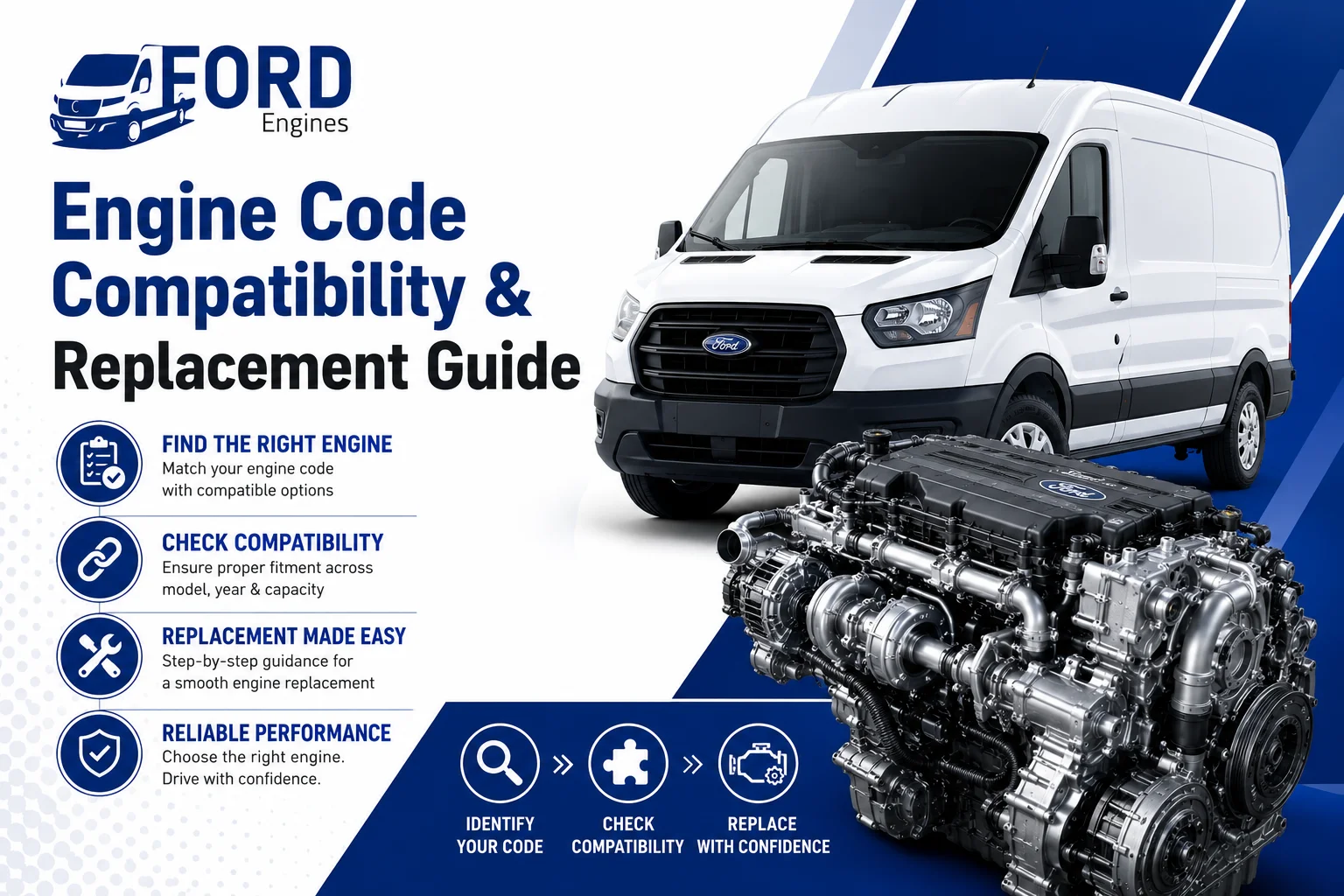
Once you know your engine code, the next question is almost always the same: what can I actually replace it with?
Can You Replace One Engine Code With Another?
Sometimes, but not automatically, and this is where a lot of costly mistakes happen. Compatibility between engine codes generally depends on:
- Whether the codes share the same engine family and generation
- Whether ECU and injector specifications match or can be recalibrated
- Whether emissions standards are compatible with your vehicle's current MOT and registration requirements
- Whether physical mounting points, ancillaries, and turbo systems align
Interchangeable Engine Codes Explained
As a general pattern, engine codes within the same close family and similar production years (for example, certain DRFA and DRFB variants) are more likely to be interchangeable with minor adjustment, while codes spanning different emissions standards or different engine families (Duratorq to EcoBlue, for instance) typically are not, without substantial modification work that often isn't cost-effective.
The safest approach is always to confirm compatibility against your specific code before purchase, not to assume it based on capacity or badge alone.
What to Check Before Buying a Replacement Engine
Before committing to a replacement, reconditioned, or exchange engine, it's worth working through a short checklist:
- Confirm your exact engine code from the physical stamp, not just the badge or logbook
- Check the emissions standard required for your vehicle's continued compliance
- Ask about warranty terms on any reconditioned or remanufactured unit
- Clarify what's included long block, short block, or complete unit with ancillaries
- Confirm fitting support is available if you're not doing the work yourself
A reputable supplier should be able to talk you through all of this before you commit, not just after you've paid.
Get a Quote for Your Ford Transit Replacement Engine
If you've identified your engine code and you're ready to move forward, the fastest way to avoid guesswork is to speak directly with a specialist who deals with Ford engines every day. At fordengines.co.uk, we work with Ford Transit owners, independent garages, and fleet operators across the UK to source the correct engine, whether that's a genuine OEM unit, a quality reconditioned engine, or an exchange unit backed by warranty.
Send us your engine code, or your VIN and registration if you haven't located the code yet, and we'll confirm compatibility before you order, not after.
Frequently Asked Questions
What is my Ford Transit engine code? Your engine code is a short alphanumeric identifier stamped on the engine block, typically near the transmission housing or on the side of the cylinder block. It's separate from your VIN and isn't usually listed on your V5C logbook.
Where is the engine code located? Most commonly, it's stamped on a flat machined section of the engine block itself. Exact location varies slightly by engine family, which is why physical inspection is the most reliable method.
How do I identify my Transit engine? Check the physical engine code stamp first. If access is limited, use your VIN to narrow down the likely engine family, then confirm with the physical code where possible.
Can VIN identify engine code? Your VIN can indicate the engine family originally fitted at production, but it isn't a guaranteed match if the vehicle has had engine work done. Always confirm against the physical stamp for certainty.
Which engine fits my Transit? This depends entirely on your confirmed engine code. Engines within the same family and generation are more likely to be compatible, but capacity and badge alone aren't reliable indicators.
Is engine code the same as VIN? No. The VIN identifies the vehicle; the engine code identifies the specific engine unit. They're related but not interchangeable pieces of information.
Which 2.2 TDCi engine do I have? There are several 2.2 TDCi variants (including DRFA, DRFB, CVRA, and CVRB), each with different power outputs and emissions standards. Check your physical engine code to confirm exactly which one you have.
Can engine codes interchange? Some can, particularly within the same close family and production era. Others, especially across different emissions standards or engine families, typically can't without significant modification.
Which engine code is Euro 6? Generally, Ford's EcoBlue range was introduced to meet Euro 6 standards, while most Duratorq TDCi codes correspond to Euro 3, 4, or 5, depending on production year and variant.
How do I decode Ford engine numbers? Cross-reference the code against a verified engine code list by family and capacity, ideally confirmed against the physical stamp and, where needed, your VIN.
Can I replace DRFA with DRFB? In some cases, yes, depending on year and specification, but this should always be confirmed against ECU compatibility and emissions requirements before purchase, don't assume based on the codes looking similar.
What engine is in my Transit? The only certain way to know is checking your engine code directly. Badge, capacity, and even VIN can narrow it down, but the physical code stamp gives you the definitive answer.
Final Thoughts
Ford Transit engine codes exist for a reason: to give you a precise, unambiguous way to identify exactly what's under the bonnet, regardless of what the badge or paperwork says. Skipping that step when sourcing a replacement engine is how straightforward jobs turn into expensive, drawn-out problems.
Take the time to locate and confirm your code properly, cross-check it against your VIN where you can, and don't assume compatibility just because two engines share a capacity or a similar-looking code.
If you've got your engine code and you're ready to source a replacement, get in touch with the team at fordengines.co.uk. We'll confirm compatibility, talk you through your options, genuine, reconditioned, or exchange, and get you a straight answer on availability and warranty, without the guesswork.