

Your Ford Transit just lost power on the motorway. Or maybe there's a ticking noise under the bonnet that wasn't there last week. Perhaps the engine management light flicked on this morning and now you're sitting wondering if it's a £50 sensor or a £3,000 rebuild.
If you're running a Transit for work, every hour it's off the road costs you money. That's exactly why this guide exists, to help you identify what's actually wrong, understand why it happened, and figure out whether you're looking at a quick repair, a rebuild, or a full engine replacement.
We've worked on enough Ford Transit engines across every generation, from the old 2.4 TDCi through to the current 2.0 EcoBlue, to know that most engine failures follow predictable patterns. Once you know what to look for, diagnosing a Transit engine problem stops being guesswork.
Let's get into it.
Most Common Ford Transit Engine Problems (Symptoms & Warning Signs)
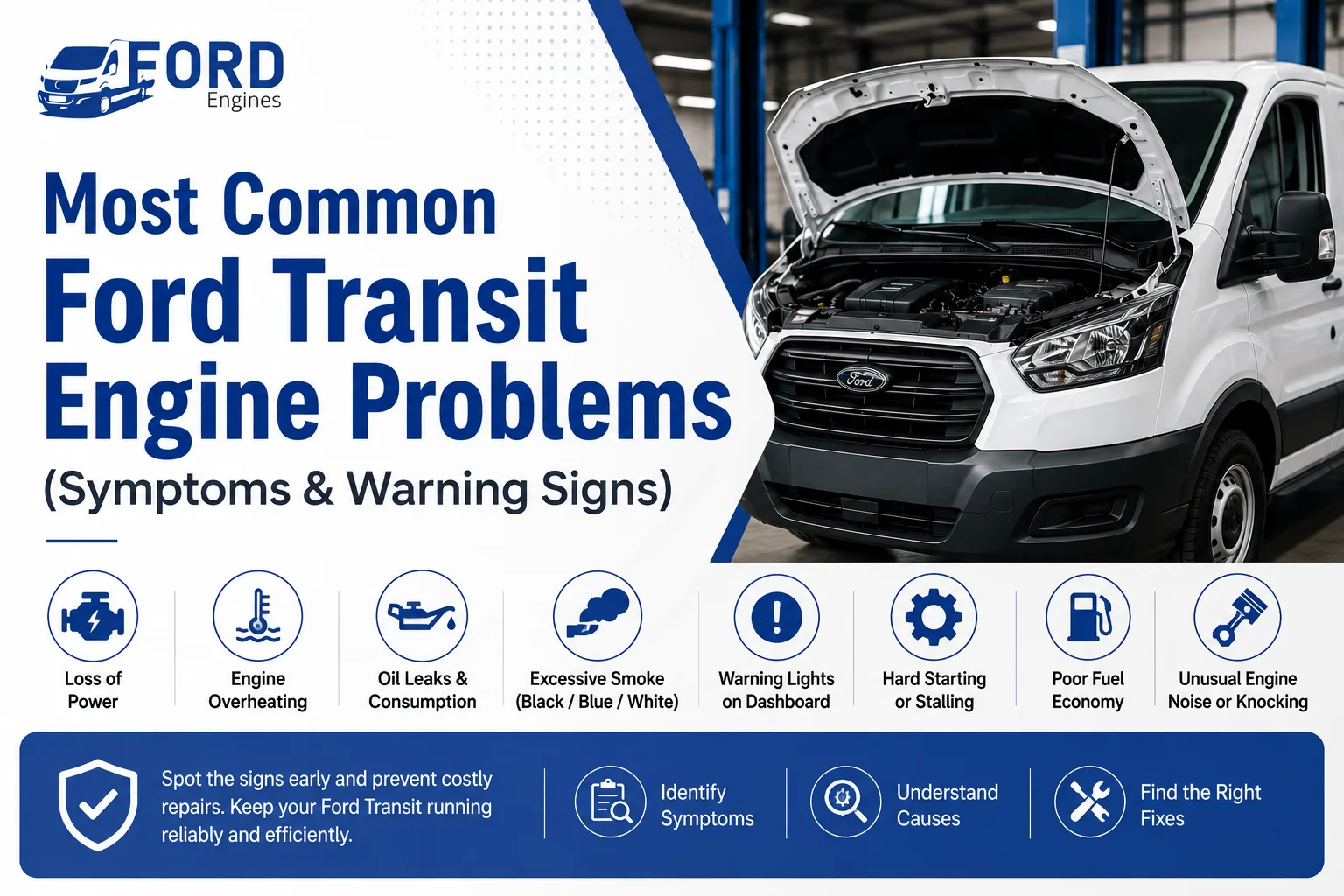
Before you can fix anything, you need to know what you're actually dealing with. Most Ford Transit engine problems announce themselves well before total failure, the trick is recognising the signs early enough to act on them.
Why Does My Ford Transit Lose Power While Driving?
Loss of power is one of the most common complaints across every Transit generation, and it rarely has a single cause. In our experience, it usually comes down to one of these:
- Blocked or failing turbocharger – reduced boost pressure means the engine simply can't produce the power it should
- Clogged DPF (diesel particulate filter) – forces the engine into a protective, low-power state
- Fuel injector problems – uneven or insufficient fuel delivery causes flat spots and hesitation
- EGR valve clogging – disrupts airflow and combustion efficiency
- Failing fuel pump – can't maintain the fuel pressure the engine needs under load
If the power loss happens gradually over weeks, it's often DPF or EGR related. If it happens suddenly and is paired with a warning light, it's more likely to be an injector fault or a sensor triggering limp mode.
What Causes Ford Transit Engine Knocking or Ticking Noises?
A ticking noise at idle is different from a deep knocking sound under load, and the distinction matters.
Ticking is often linked to:
- Low oil pressure or degraded oil not lubricating properly
- Worn timing chain tensioners
- Injector clicking (which is actually normal to some degree in diesel engines, but excessive ticking suggests injector wear)
Knocking, on the other hand, is more serious and can point to:
- Piston slap from worn cylinder walls
- Connecting rod bearing wear
- Crankshaft problems
A good rule of thumb: ticking is worth investigating soon. Knocking is worth stopping the vehicle for. Continuing to drive on a genuine engine knock can turn a repairable fault into a full engine rebuild situation within a matter of miles.
Why Is My Ford Transit Engine Overheating?
Overheating is rarely caused by the engine itself, it's almost always a cooling system component that's failed:
- Failed thermostat stuck closed, restricting coolant flow
- Water pump failure, especially common past 80,000–100,000 miles
- Coolant leaks from hoses, the radiator, or a degrading head gasket
- Blocked radiator reducing heat dissipation
If your Transit is overheating and you notice coolant loss with no visible external leak, that's a red flag for a head gasket problem, something we'll cover in more detail further down.
What Does Excessive Smoke From a Ford Transit Exhaust Mean?
Smoke colour is one of the most reliable diagnostic clues available, and it costs nothing to check.
Blue Smoke vs White Smoke vs Black Smoke, What's the Difference?
Smoke Colour | Likely Cause | Urgency |
| Blue smoke | Oil burning in the combustion chamber, worn piston rings or valve seals | Moderate to high |
| White smoke (persistent) | Coolant entering the combustion chamber, often head gasket failure | High |
| Black smoke | Excess fuel, poor combustion, injector or turbo boost issue | Moderate |
| White smoke (light, cold mornings) | Normal condensation, not a fault | Low |
The key distinction with white smoke is persistence. A puff on a cold morning that clears in seconds is completely normal. White smoke that continues once the engine's warm is a different story entirely.
Why Is My Ford Transit Idling Roughly or Misfiring?
Rough idle and misfires usually trace back to:
- Dirty or failing fuel injectors
- A vacuum leak in the intake system
- Faulty glow plugs (especially in cold weather starts)
- EGR valve stuck open, letting exhaust gas disrupt combustion
- Failing crankshaft or camshaft sensors sending incorrect timing data to the ECU
If the rough idle only happens when cold and smooths out once warm, glow plugs or thermostat issues are the most likely culprits. If it's rough all the time, look at the injectors and sensors first.
Ford Transit Engine Warning Lights Explained
The dashboard is trying to tell you something specific, you just need to know what each light means.
Check Engine Light vs Engine Management Light: What's the Difference?
They're often confused, but there's a practical difference:
- The check engine light typically relates to emissions and general engine fault codes stored by the ECU (Engine Control Unit)
- The engine management light is broader and can relate to the PCM (Powertrain Control Module) managing both engine and transmission behaviour
Either way, a solid light means get it scanned soon. A flashing light means stop driving and get it checked immediately, a flashing light usually indicates a misfire that could damage the catalytic converter if you keep driving.
Ford Transit Engine Problems by Engine Type & Generation
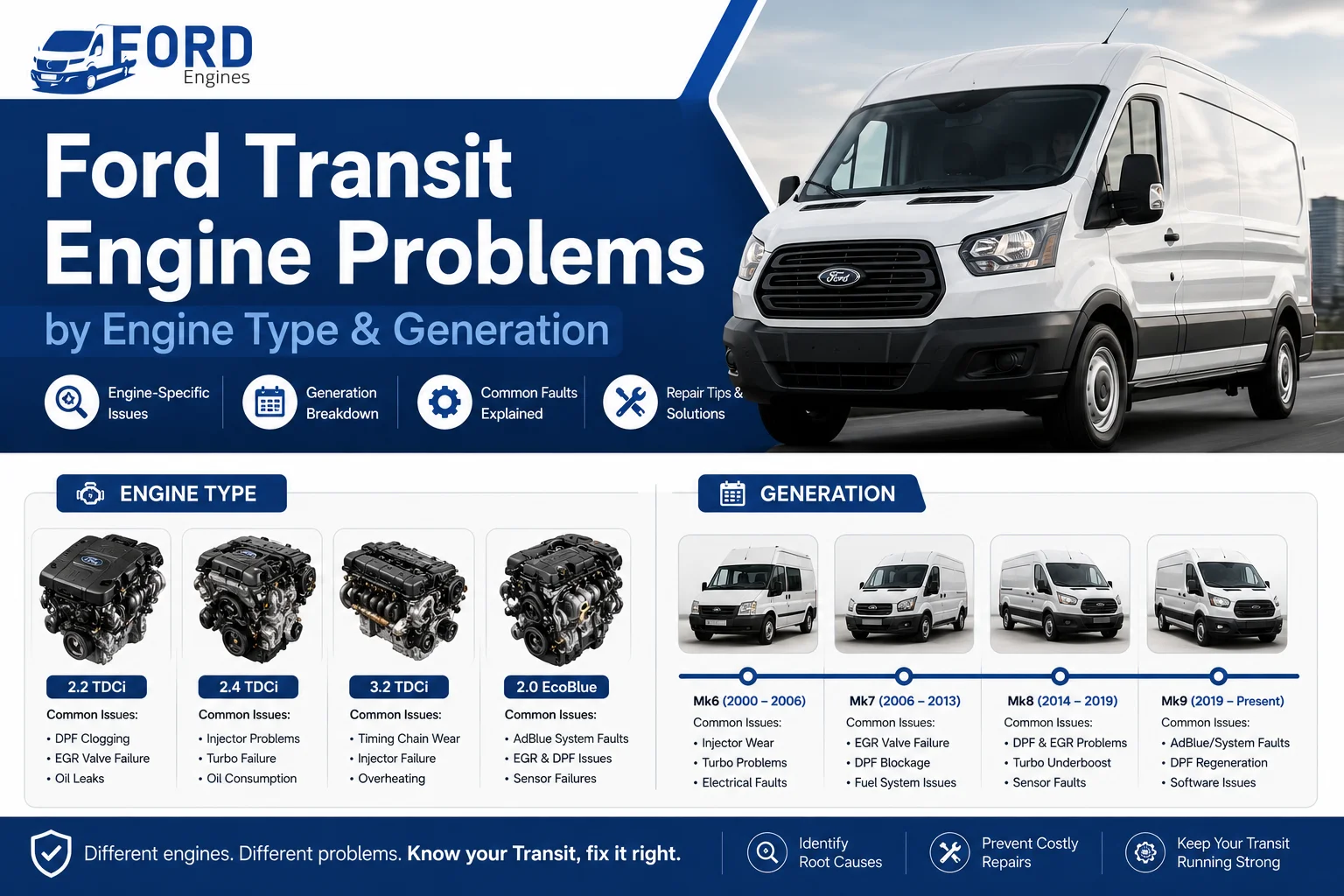
Not all Transit engines are built the same, and reliability varies significantly across generations. If you're buying, maintaining, or troubleshooting a Transit, knowing which engine you have changes everything.
2.0 EcoBlue Engine Problems (2016–Present)
The 2.0 EcoBlue replaced the older Duratorq/TDCi engines and brought genuine improvements in efficiency and emissions, but it introduced its own set of issues.
Common EcoBlue problems include:
- Wet timing belt degradation – unlike a timing chain, this engine uses a belt that runs in oil, and oil contamination can cause it to degrade faster than expected
- DPF regeneration failures, particularly in vans used mostly for short, stop-start journeys
- EGR valve clogging, especially on high-mileage examples
- Turbocharger actuator faults affecting boost control
Is the 2.0 EcoBlue Reliable?
Broadly, yes, when serviced on schedule. The engine is more efficient than its predecessors, but it's less forgiving of missed oil changes and short-journey-only use. Vans that mostly do motorway miles tend to fare much better than those doing constant urban stop-start driving, because DPF regeneration needs sustained higher revs to complete properly.
2.2 TDCi Engine Issues (2006–2014)
The 2.2 TDCi has a solid reputation overall, but known issues include:
- Turbo actuator problems, similar to the EcoBlue but generally easier and cheaper to resolve
- Fuel injector wear past 100,000 miles
- EGR valve clogging from carbon buildup
- Timing chain rattle on high-mileage units where tensioners have worn
2.4 TDCi and 3.2 Duratorq Common Faults (Pre-2006 Models)
These older engines are mechanically simpler, which owners often appreciate, but they carry their own age-related risks:
- Crankshaft pulley failure on the 2.4 TDCi, a well-documented issue
- Fuel pump wear due to age and mileage
- Head gasket failure becoming more common as these units pass 150,000+ miles
- General wear across seals, gaskets, and sensors simply due to vehicle age
Which Ford Transit Engine Is the Most Reliable?
There's no single "perfect" answer, but here's a practical comparison based on real-world patterns:
Engine | Reliability Reputation | Best Suited For |
| 2.2 TDCi | Strong, well-proven | High-mileage, motorway-heavy use |
| 2.0 EcoBlue | Good, if serviced strictly | Modern efficiency, regular servicing |
| 2.4 TDCi | Solid but ageing | Simpler diagnostics, older vans |
| 3.2 Duratorq | Robust but fuel-hungry | Heavy-duty, high-load work |
If you're buying a used Transit, the 2.2 TDCi remains a favourite among fleet operators specifically because of its balance of reliability and repair cost, though the 2.0 EcoBlue is closing that gap as more data comes in on long-term durability.
Diagnosing the Root Cause: Turbo, Injector, Timing Chain & DPF Failures
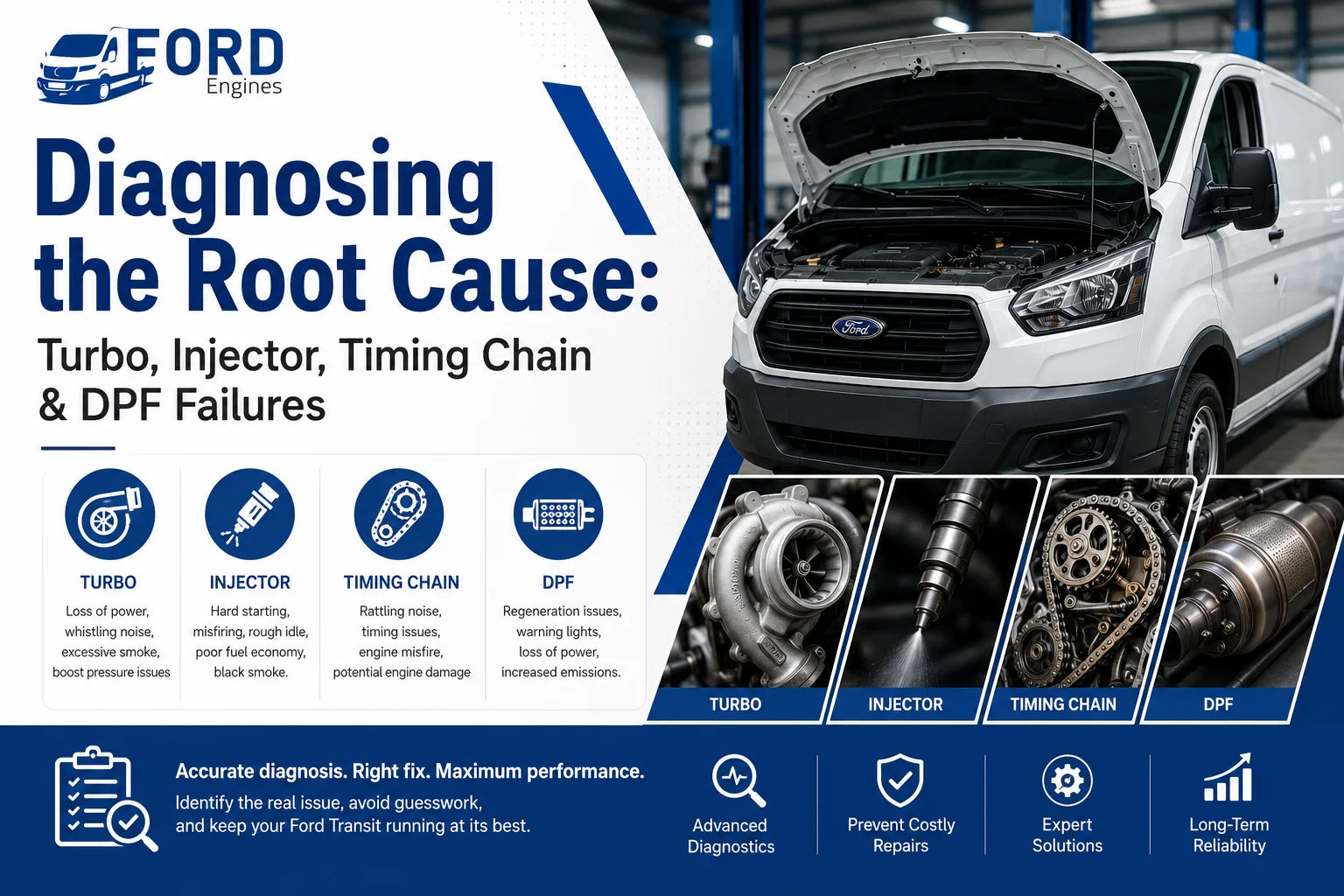
Symptoms point you in a direction. This section helps you confirm the actual component at fault before you spend money on the wrong repair.
Ford Transit Turbo Failure: Symptoms and Causes
Turbo failure rarely happens without warning. Watch for:
- A high-pitched whistling or whining noise under acceleration
- Visible blue-grey smoke from worn turbo seals letting oil into the exhaust
- Reduced boost pressure and sluggish acceleration
- Oil consumption increasing without an obvious external leak
Turbo actuator faults (common on both EcoBlue and TDCi engines) are often mistaken for full turbo failure, but they're a different, and usually cheaper, fix. An actuator controls the turbo's variable geometry vanes, and when it sticks or fails, boost pressure becomes inconsistent.
Can a Faulty Turbo Cause Limp Mode?
Yes. When the ECU detects boost pressure outside expected parameters, it triggers limp mode as a protective measure, cutting engine power to prevent further damage. If your Transit suddenly feels sluggish and a warning light appears at the same time, a turbo or boost pressure sensor issue should be one of the first things checked.
Ford Transit Injector Problems: Signs and Diagnosis
Fuel injector problems are among the most common Ford Transit engine issues, particularly past 100,000 miles. Signs include:
- Rough idle, especially noticeable when cold
- Excessive black smoke on acceleration
- Reduced fuel economy
- A distinct misfire on one or more cylinders
- Fault codes relating to injector circuit or fuel trim
Injector coding matters here too, on common-rail diesel systems like the EcoBlue and later TDCi units, replacement injectors often need to be coded to the ECU to match their specific calibration values. Skipping this step is a common reason injector replacements don't fully resolve rough running.
Ford Transit Timing Chain Problems: What to Look For
Timing chain issues are more common on some Transit engines than owners expect, particularly the 2.0 EcoBlue's wet timing belt (which behaves differently from a traditional chain but faces similar failure risks from oil degradation).
Watch for:
- A rattling noise on cold start that fades as the engine warms up
- Engine management light with timing-related fault codes
- Rough idle or hesitation caused by the ECU detecting incorrect valve timing
If timing chain or belt failure is left unaddressed, the consequences can be severe, on an interference engine, a snapped timing chain or belt can cause pistons to strike valves, turning a moderate repair into a full engine rebuild or replacement.
Ford Transit DPF Issues and Regeneration Failures
The diesel particulate filter traps soot from the exhaust and periodically burns it off through a process called regeneration. Problems arise when:
- Short journeys prevent the engine reaching the temperature needed for regeneration
- The DPF becomes physically blocked, triggering warning lights and power reduction
- Sensors monitoring exhaust pressure fail, giving the ECU incorrect data
A forced regeneration (sometimes done via diagnostic tool, sometimes by a sustained motorway drive) can resolve early-stage blockages. Once the DPF is severely blocked or damaged, cleaning or replacement becomes necessary.
Common Ford Transit Fault Codes and What They Mean
Fault codes stored by the ECU/PCM give you a starting point, not always the final answer. Some of the most frequently seen include:
- P0299 – Turbo/supercharger underboost condition
- P0401 – EGR flow insufficient
- P2002 – DPF efficiency below threshold
- P0087 – Fuel rail/system pressure too low
- P0335 – Crankshaft position sensor circuit malfunction
How to Read OBD-II Codes on a Ford Transit
Any standard OBD-II diagnostic scanner will pull these codes from the vehicle's ECU. The code itself tells you the system affected, but proper diagnosis requires checking live data, actual boost pressure, actual fuel pressure, sensor readings, rather than replacing parts based on the code alone. This is where a lot of unnecessary parts get swapped without fixing the underlying problem.
Ford Transit Coolant Loss and Oil Consumption: What's Normal vs What's Not
Some oil consumption is normal in any diesel engine, but there are limits.
- Oil consumption beyond roughly 1 litre per 1,000 miles is worth investigating, check for worn piston rings, valve seals, or turbo seal leaks
- Coolant loss with no visible external leak strongly suggests internal loss, most commonly through a failing head gasket or a cracked cylinder head
If you're topping up either fluid regularly and can't find where it's going, a compression test and cooling system pressure test will usually reveal the answer.
Repair, Rebuild, or Replace? Costs, Options & Getting a Quote
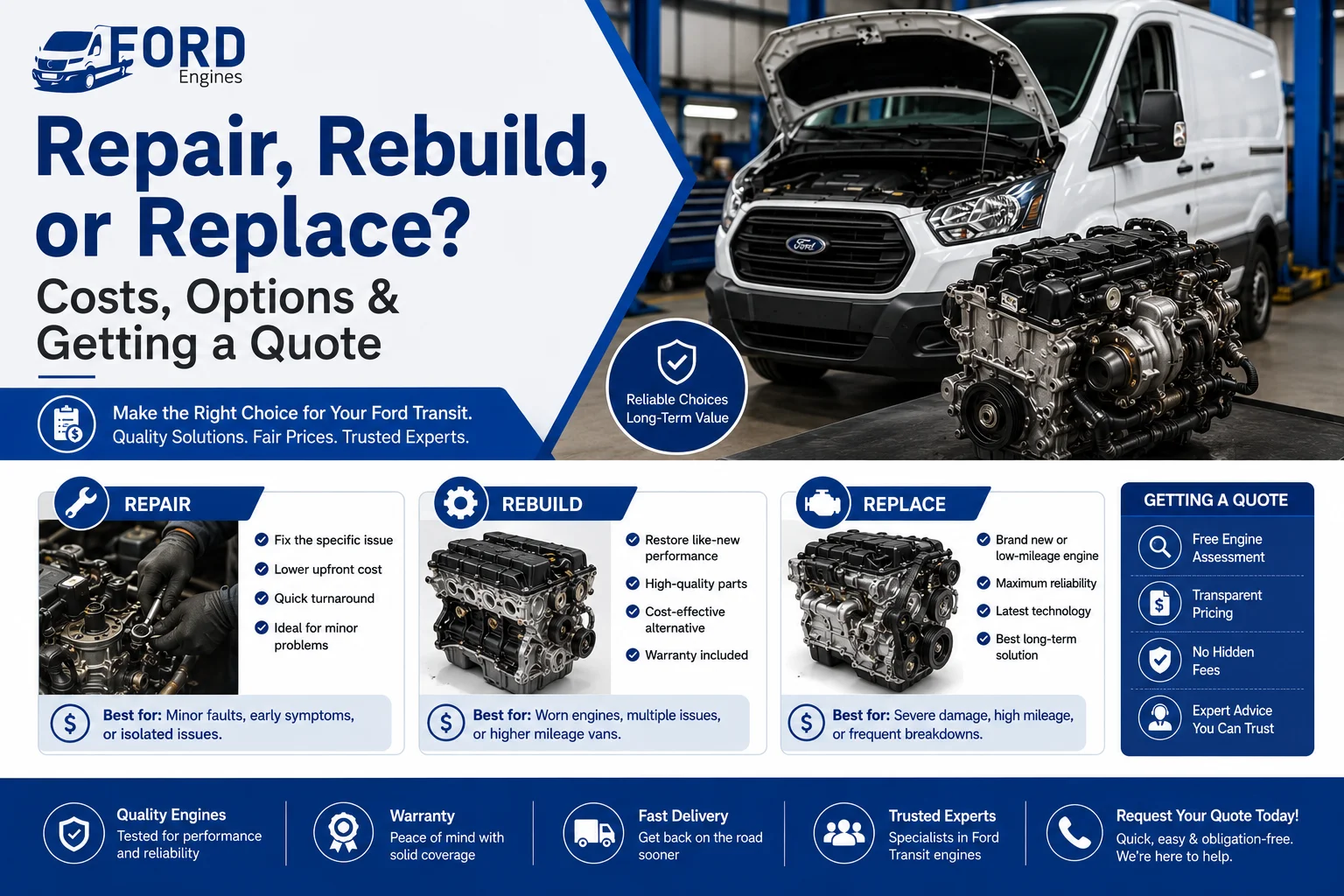
This is the question that actually matters once you know what's wrong: is it worth fixing, or are you better off with a rebuild or full replacement?
Ford Transit Engine Repair Costs (By Common Fault)
Costs vary by garage and region, but here's a realistic UK range for common repairs:
Repair | Typical Cost Range (Parts & Labour) |
| Turbo actuator replacement | £250 – £500 |
| Full turbocharger replacement | £600 – £1,200 |
| Single injector replacement (with coding) | £250 – £450 |
| Full injector set replacement | £900 – £1,800 |
| EGR valve replacement/clean | £150 – £400 |
| DPF clean | £200 – £400 |
| DPF replacement | £800 – £1,500 |
| Timing chain/belt replacement | £600 – £1,200 |
| Head gasket replacement | £800 – £1,600 |
| Water pump replacement | £250 – £450 |
These figures are a guide, not a quote, actual costs depend on your specific van, mileage, and the extent of damage found once the fault is properly diagnosed.
Ford Transit Engine Rebuild vs Replacement: Which Is Right for You?
This decision usually comes down to three factors: the extent of the damage, your van's overall condition, and how the numbers stack up against the vehicle's value.
A rebuild makes sense when:
- The damage is contained to specific components (pistons, rings, bearings) rather than the block or crankshaft
- The rest of the van is in good condition and worth keeping on the road
- You want to retain the original engine for warranty or provenance reasons
A full replacement makes sense when:
- The damage is extensive, cracked block, damaged crankshaft, or catastrophic timing failure
- You want a guaranteed, known-condition engine with minimal downtime
- The cost difference between rebuild and replacement is marginal once labour is factored in
When Does It Make Sense to Rebuild Instead of Replace?
As a rough guide: if the core damage is limited to wear parts and the block/crankshaft are sound, a rebuild is often 20–40% cheaper than a full replacement engine. But if you're already deep into a rebuild and further damage is found once it's stripped down, the labour cost of a rebuild can quickly approach, or exceed, the cost of simply fitting a replacement unit.
How Much Does a Ford Transit Engine Replacement Cost in the UK?
Full engine replacement costs vary significantly by engine type and whether you're fitting a reconditioned, remanufactured, or used engine. As a general range, expect anywhere from £2,500 to £5,500 including fitting, depending on the engine variant and specification.
Reconditioned vs Remanufactured Ford Transit Engines: What's the Difference?
These terms get used interchangeably, but they're not the same thing.
Reconditioned Engine | Remanufactured Engine | |
| Process | Worn parts replaced, engine cleaned and reassembled | Fully stripped, every component inspected/replaced to OEM spec |
| Consistency | Varies by supplier and what's replaced | Standardised process, more consistent results |
| Typical Cost | Lower | Higher |
| Typical Warranty | Shorter | Longer |
If you're comparing quotes, always ask exactly what's included, "reconditioned" without detail can mean anything from a full rebuild to a basic clean and reseal.
Ford Transit Engine Warranty: What to Look For Before You Buy
Before committing to any replacement or rebuilt engine, check:
- What's actually covered (full engine, or just specific components?)
- The warranty length, anywhere from 3 months to 2 years depending on supplier
- Whether labour is covered if the engine fails again, or just parts
- Whether the warranty is voided by missed servicing
A cheap engine with no meaningful warranty can end up costing more than a slightly pricier one backed by proper cover.
Get a Quote for Your Ford Transit Engine Rebuild or Replacement
If you've worked through this guide and landed on "I think I need a rebuild or replacement," the next step is getting a proper assessment rather than guessing. At Ford Engines, we specialise specifically in Ford Transit engines, reconditioned, remanufactured, and supply-only options, with clear warranty terms and UK-wide support. Getting a quote costs nothing and gives you a real number to weigh against ongoing repair costs.
Frequently Asked Questions
Why does my Ford Transit lose power?
Most commonly due to a failing turbo, a blocked DPF, worn fuel injectors, or a clogged EGR valve. The pattern of the power loss (gradual vs sudden) helps narrow down the cause.
Why is my Ford Transit overheating?
Usually a cooling system fault, a failed thermostat, worn water pump, or coolant leak, rather than the engine itself. Persistent overheating with no visible leak can point to head gasket failure.
What is the most reliable Transit engine?
The 2.2 TDCi has the strongest long-term reputation, though the 2.0 EcoBlue performs well when serviced strictly to schedule.
Is the 2.0 EcoBlue reliable?
Yes, generally, but it's less tolerant of missed servicing and short-journey-only use than older TDCi engines, particularly around DPF regeneration and wet timing belt condition.
What causes Ford Transit injector failure?
Age, mileage, poor fuel quality, and normal wear on the injector's internal components. Past 100,000 miles, injector wear becomes increasingly common.
Can a turbo cause limp mode?
Yes. When the ECU detects boost pressure outside its expected range, it triggers limp mode to protect the engine, cutting power until the fault is addressed.
How much does a Transit engine rebuild cost?
It depends on what's damaged, but rebuilds are typically 20–40% cheaper than full replacement, provided the block and crankshaft are undamaged.
Should I replace or rebuild my engine?
Rebuild if damage is limited to wear components and the van's otherwise in good shape. Replace if damage is extensive or you want a known-condition engine with minimal downtime.
What causes excessive smoke?
Blue smoke points to oil burning (worn rings/seals), white smoke (persistent) points to coolant entering the engine, and black smoke usually means excess fuel from injector or turbo issues.
Why won't my Transit start?
Common causes include a failing fuel pump, dead glow plugs (in cold weather), a faulty crankshaft sensor, or battery/starter motor issues unrelated to the engine itself.
Can timing chain failure destroy the engine?
Yes, particularly on interference engines where a snapped chain or belt allows pistons to strike valves, causing extensive internal damage.
What causes coolant loss?
External leaks from hoses or the radiator, or internal loss through a failing head gasket or cracked cylinder head if there's no visible external leak.
How long do Transit engines last?
With proper servicing, 150,000–250,000 miles is realistic for most Transit diesel engines, though this varies by generation and usage pattern.
What are common EcoBlue problems?
Wet timing belt degradation, DPF regeneration failures on short journeys, EGR clogging, and turbo actuator faults.
How do I diagnose engine failure?
Start with an OBD-II fault code scan, then check live data (boost pressure, fuel pressure, sensor readings) rather than relying on the code alone. A compression test can confirm internal mechanical issues.
The Bottom Line
Most Ford Transit engine problems give you warning before they become expensive. A ticking noise, a smoke colour that's not quite right, a warning light that stays on, these are all your van telling you something specific, and catching it early is almost always cheaper than waiting.
If you've been through this guide and you're now fairly confident about what's wrong, or you've reached the point where repair costs no longer make sense against rebuilding or replacement, that's exactly where we can help. Ford Engines works specifically with Transit engines across every generation, from diagnosis through to supply and fitting of reconditioned and remanufactured units, backed by clear warranty terms.
Get in touch for a straightforward quote, and let's get your Transit back on the road with an engine you can actually rely on.