
If you've ever popped the bonnet on a Ford Transit and wondered exactly what you're looking at, you're not alone. Ask ten van owners what engine sits under their Transit and you'll likely get ten different answers, "it's a 2.0 diesel," "mine's the EcoBlue," "I think it's a 2.2 TDCi." The truth is, Ford has fitted more than half a dozen distinct engine sizes into the Transit range since it first rolled onto UK roads, and knowing exactly which one you've got matters more than most owners realise.
Whether you're trying to work out what's covered by a warranty, sourcing the right replacement parts, deciding between a rebuild or a full engine swap, or simply buying a used Transit and want to know what you're getting into, this guide gives you the complete picture. No guesswork, no vague manufacturer jargon. Just a clear breakdown of every Ford Transit engine size, how they compare, which ones hold up best over time, and what to do when yours needs attention.
Let's get into it.
Ford Transit Engine Sizes Explained (By Generation & Type)
The Ford Transit has gone through several major engine generations, and the size, meaning the displacement, or how much volume the cylinders take up, has a direct impact on power, torque, fuel economy, and how the van handles heavier loads. Larger displacement generally means more low-end torque (useful for towing and heavy payloads), while smaller, turbocharged engines tend to be more fuel-efficient and better suited to everyday city or motorway driving.
Here's where it gets useful: not every Transit engine is a diesel, and not every diesel Transit shares the same block. Let's break each one down.
Ford Transit Diesel Engine Sizes
Diesel has always been the backbone of the Transit range, and for good reason, vans do heavy lifting, quite literally, and diesel's torque characteristics suit stop-start commercial driving far better than petrol in most cases.
2.0 EcoBlue Engine Specifications
The 2.0 EcoBlue is the engine you'll find in the current-generation Transit, and it's arguably the most significant step forward Ford has made in van engine design. It's a turbocharged, common rail diesel available in single-turbo and twin-turbo configurations, with outputs ranging from around 105 PS up to 185 PS depending on the exact tune. The EcoBlue name reflects its efficiency focus, it uses a lighter aluminium block, wall-flow diesel particulate filter, and SCR (Selective Catalytic Reduction) with AdBlue injection to meet Euro 6 emissions standards.
If your Transit was registered from around 2016 onwards, there's a strong chance you're running an EcoBlue.
2.2 TDCi Engine Overview
Before EcoBlue, there was the 2.2 TDCi, a Duratorq-family engine that powered Transits from roughly 2006 through to 2016. It's a genuinely well-regarded unit among fleet operators and independent garages alike, largely because of its simplicity. Earlier variants used a timing belt rather than a chain, which means service intervals for belt replacement are critical (more on that shortly). Power outputs typically ranged from 100 PS to 155 PS.
2.4 TDCi Engine Overview
Slightly older still, the 2.4 TDCi served the Transit range through the mid-2000s. It's a slightly larger-displacement Duratorq unit, known for being a genuine workhorse, less refined than later engines, but mechanically straightforward and durable when maintained properly. You'll mostly find this in pre-2006 Transit vans still soldiering on in trade use.
2.5 DI Engine (Older Generation)
Going back further, the 2.5 DI represents the older-generation Transit diesel, predating common rail injection technology entirely. It's a direct injection engine without the sophistication of modern turbo diesels, but it's mechanically simple, which some owners of classic Transits actually prefer for long-term reliability and ease of repair.
3.2 Duratorq Five-Cylinder Engine
Here's where the Transit range gets genuinely interesting. The 3.2 Duratorq is a five-cylinder inline diesel, an unusual configuration that gives it a distinctive engine note and strong low-down torque, making it a favourite for heavier Transit variants used for towing or maximum payload work. It was largely reserved for the heavier-duty Transit models and produced around 200 PS with substantial torque figures well suited to commercial hauling.
Ford Transit Petrol Engine Sizes
Petrol Transits are far less common in the UK market, but they do exist, and it's worth knowing what's out there, particularly if you're looking at grey imports or specific fleet variants.
3.5 EcoBoost V6 Specifications
The 3.5 EcoBoost is a twin-turbo V6 petrol engine, primarily fitted to North American-spec Transits. It delivers strong horsepower and torque figures that rival diesel counterparts, but with the smoother power delivery petrol engines are known for. It's rare in the UK but worth knowing if you're importing or comparing global Transit specifications.
3.7 Ti-VCT V6 (Legacy US-Spec)
The 3.7 Ti-VCT is another V6 petrol option, again largely a US-market engine, using twin independent variable camshaft timing for improved efficiency and smoother power delivery across the rev range.
Ford E-Transit Electric Drive (No Engine Displacement)
The Ford E-Transit doesn't have an "engine size" in the traditional sense, there's no displacement, no cylinders, no litres. Instead, it runs on a single electric motor producing the equivalent of around 269 PS, paired with a battery pack rather than a fuel tank. If you're comparing running costs or performance against a diesel Transit, the comparison shifts from displacement and torque curves to battery range, charging times, and payload capacity affected by battery weight.
Engine Size Comparison Table (Capacity, Power, Torque & Fuel Economy)
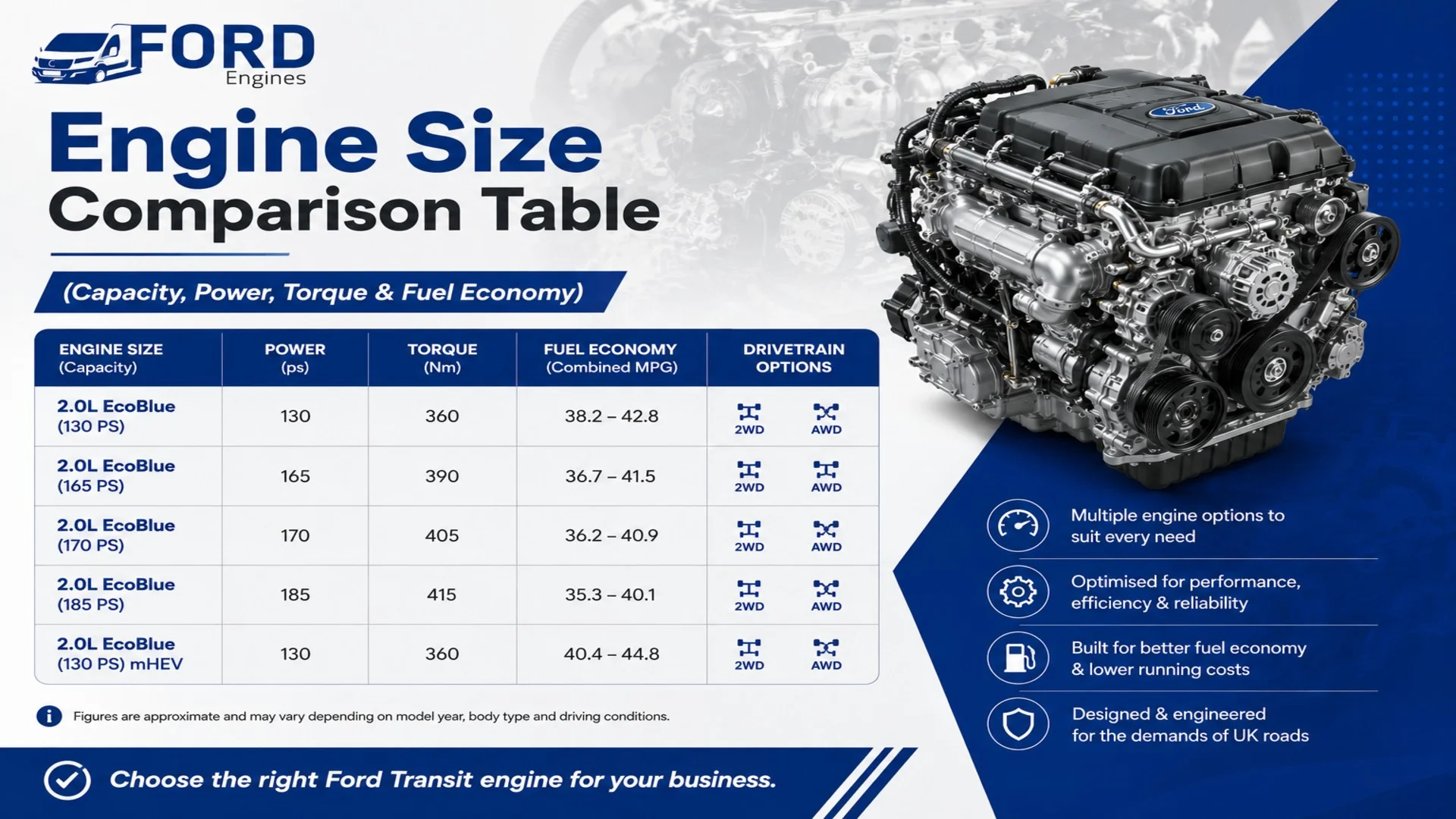
Numbers tell the story better than descriptions alone. Here's how the main Ford Transit engines stack up against each other across the metrics that actually matter day to day.
Engine | Displacement | Cylinders | Power Output | Fuel Type | Approx. Fuel Economy |
| 2.0 EcoBlue | 1,996cc (2.0L) | Inline 4 | 105–185 PS | Diesel | 30–38 mpg |
| 2.2 TDCi | 2,198cc (2.2L) | Inline 4 | 100–155 PS | Diesel | 28–34 mpg |
| 2.4 TDCi | 2,402cc (2.4L) | Inline 4 | 90–140 PS | Diesel | 26–30 mpg |
| 2.5 DI | 2,496cc (2.5L) | Inline 4 | 75–90 PS | Diesel | 24–28 mpg |
| 3.2 Duratorq | 3,198cc (3.2L) | Inline 5 | ~200 PS | Diesel | 22–26 mpg |
| 3.5 EcoBoost | 3,496cc (3.5L) | V6 | 275–310 PS | Petrol | 16–20 mpg |
| E-Transit Motor | N/A | Electric | ~269 PS equivalent | Electric | ~2.0 mi/kWh |
Fuel economy figures are approximate and vary based on load, driving conditions, and specific van configuration.
Displacement & Cubic Capacity Chart (Litres & CC)
If you're trying to work out engine size purely in litres versus cubic centimetres, here's the quick reference:
- 1.996cc = 2.0 litres (EcoBlue)
- 2,198cc = 2.2 litres (TDCi)
- 2,402cc = 2.4 litres (TDCi)
- 2,496cc = 2.5 litres (DI)
- 3,198cc = 3.2 litres (Duratorq)
- 3,496cc = 3.5 litres (EcoBoost V6)
These figures matter beyond curiosity, many replacement part suppliers and engine specification lookups require the exact cc figure, not just the "2.0" or "2.2" shorthand, especially when cross-referencing with your V5C logbook or engine code.
Horsepower (PS) and Torque Comparison by Engine
Power alone doesn't tell you how a van will actually perform under load. Torque, the twisting force that gets a loaded van moving from a standstill, often matters more for commercial use than outright horsepower.
- The 2.0 EcoBlue in twin-turbo form produces up to 415Nm of torque, making it genuinely competitive with older, larger-displacement engines despite its smaller size.
- The 2.2 TDCi typically delivers around 385Nm, solid for most day-to-day van work.
- The 3.2 Duratorq produces some of the highest torque figures in the range, often exceeding 470Nm, which explains why it was reserved for the heaviest-duty Transit variants.
Fuel Economy Comparison Across Engine Sizes
Smaller displacement doesn't always mean better economy once you factor in real-world load carrying, but generally, the EcoBlue range delivers the best balance of economy and capability in the current lineup. The larger 3.2 Duratorq and V6 petrol engines trade fuel efficiency for raw pulling power, a trade-off worth considering carefully based on how the van is actually used.
Best Engine for Towing & Payload
Which Transit Engine Handles Heaviest Loads?
For maximum payload and towing capacity, the 3.2 Duratorq and the higher-output 2.0 EcoBlue twin-turbo (185 PS) are the strongest performers in the range. If your Transit regularly tows a trailer, carries heavy trade equipment, or operates at or near its GVWR (Gross Vehicle Weight Rating), these engines provide the torque delivery needed without excessive strain.
Which Ford Transit Engine Is Most Reliable?
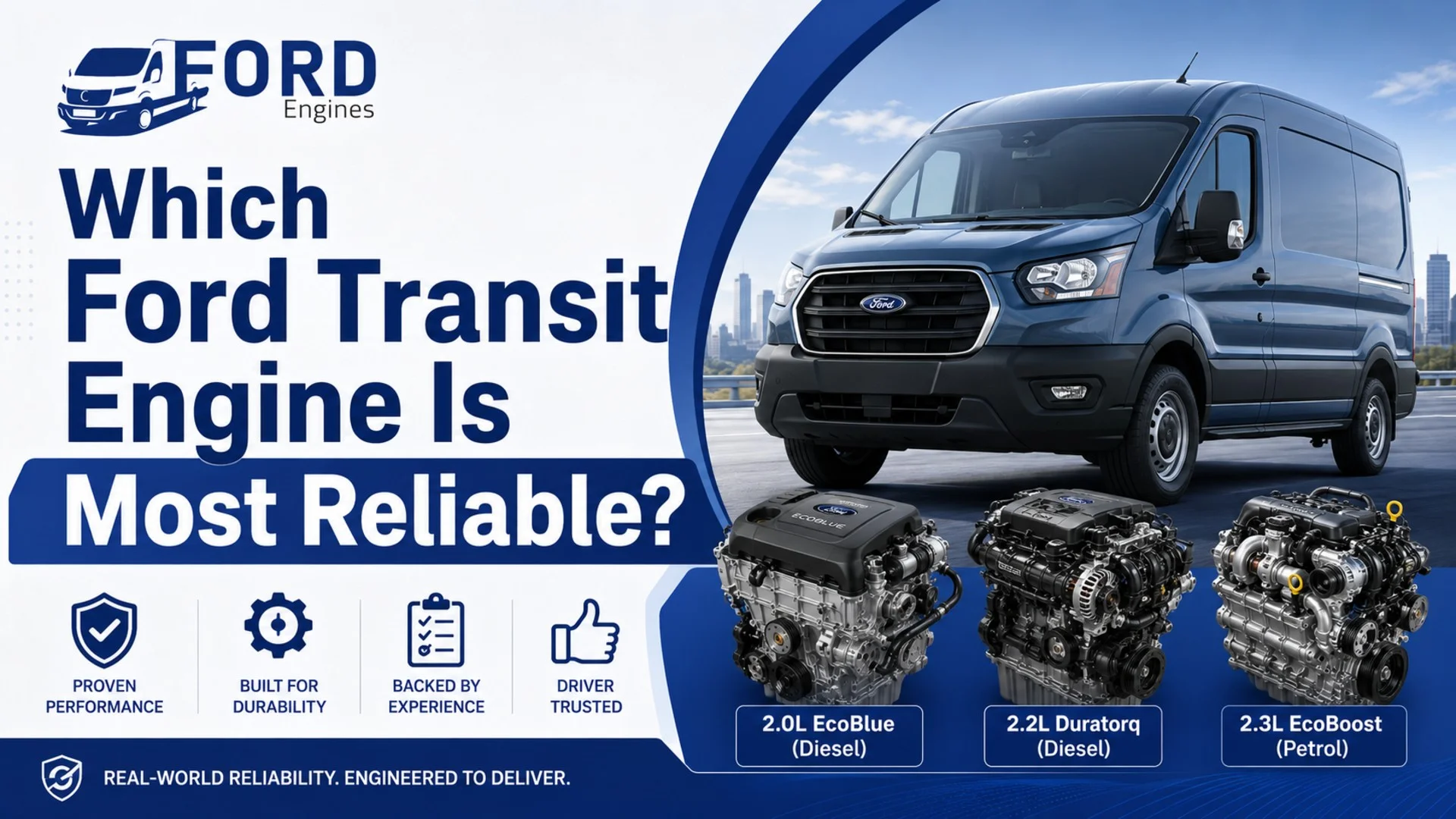
This is easily one of the most searched questions among Transit owners, and understandably so, an unreliable engine in a commercial vehicle doesn't just cost money, it costs working days.
2.0 EcoBlue Reliability & Common Faults
The EcoBlue has proven largely dependable, but it's not without known issues. Some owners report:
- DPF blocking on vans used mostly for short, low-speed journeys (a common issue across most modern diesels, not unique to Ford)
- Turbo actuator faults in early production years
- EGR valve carbon build-up over high mileage
With regular servicing and occasional motorway runs to help clear the DPF naturally, the EcoBlue tends to run well past 150,000 miles without major issues.
2.2 TDCi Reliability & Common Faults
The 2.2 TDCi has built a strong reputation among tradespeople and fleet operators over the years. Its main weak points tend to be:
- Timing belt failure if service intervals are missed (this is a belt engine, not a chain, critical distinction, covered below)
- Injector wear on very high-mileage examples
- DPF issues on vans not driven regularly at sustained speeds
When properly maintained, the 2.2 TDCi is widely regarded as one of the most dependable Transit engines ever fitted.
3.2 Duratorq Reliability & Longevity
The five-cylinder 3.2 Duratorq has a reputation for being mechanically tough, largely because it was engineered for heavy-duty use from the outset. Reported issues are relatively rare and tend to relate to age and mileage rather than design flaws, timing chain tensioners on very high-mileage units being the most commonly flagged concern.
Timing Chain vs Timing Belt: Which Engines Have Which
This single detail causes more expensive surprises than almost anything else on this list, so it deserves its own section.
- Timing belt engines (including early 2.2 TDCi variants) require belt replacement at manufacturer-specified intervals, typically every 100,000 miles or 10 years, whichever comes first. Missing this can result in catastrophic engine damage if the belt fails.
- Timing chain engines (including the EcoBlue and 3.2 Duratorq) are designed to last the life of the engine under normal conditions, though chain tensioners and guides can wear over very high mileages.
If you're unsure which your van has, checking your engine code (covered below) or consulting your handbook will confirm it, and it's worth doing before you hit a major service interval, not after.
Average Ford Transit Engine Lifespan (Miles/Years)
With consistent servicing, most Ford Transit diesel engines, EcoBlue, TDCi, and Duratorq alike, are capable of reaching 200,000 to 250,000 miles, and well-maintained examples in fleet use have exceeded 300,000 miles. Lifespan depends far more on maintenance history than on which specific engine size you have.
Identifying, Maintaining & Replacing Your Transit Engine
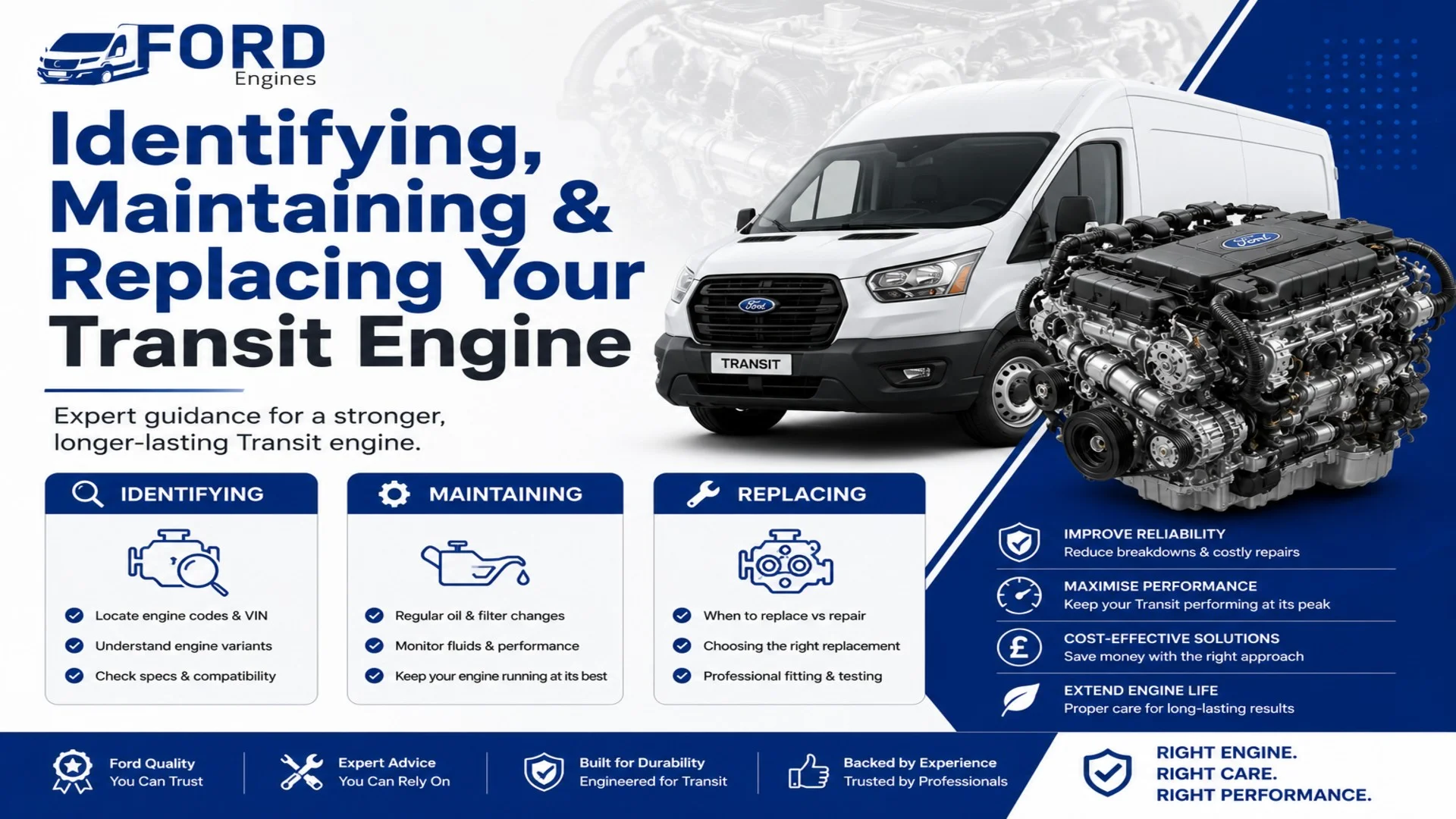
Once you know what engine you've got and how it stacks up, the next step is practical: keeping it running, and knowing your options if it doesn't.
How to Identify Your Ford Transit Engine Code
Engine Code Location Guide
The engine code is typically stamped directly onto the engine block itself, often near the front of the engine or on a machined flat surface. It's also listed on the VIN plate, usually located in the engine bay or driver's door pillar.
VIN Decoding for Engine Type
Your Transit's VIN (Vehicle Identification Number) encodes the engine type within its character sequence. Cross-referencing your VIN through a dealer, parts supplier, or reputable VIN lookup service will confirm the exact engine fitted, particularly useful if you're buying used and want certainty beyond what the seller tells you.
Ford Transit Engine Maintenance Essentials
Recommended Oil Type & Capacity
Most modern Transit diesel engines (EcoBlue in particular) require a low-viscosity, fully synthetic oil meeting Ford's WSS-M2C913-D or similar specification, typically in 5W-30 grade. Oil capacity varies by engine but generally sits between 6 and 8.5 litres including the filter. Using the wrong oil specification can affect DPF performance and long-term engine health, so it's worth confirming the exact spec for your engine code rather than assuming.
Common Warning Signs (Engine Light, Noise, Vibration)
Pay attention to:
- A persistent engine management light, often linked to EGR, turbo, or emissions system faults
- Unusual knocking or ticking noises, which can indicate injector or timing component wear
- Excessive vibration at idle, sometimes pointing to worn engine mounts rather than the engine itself
Catching these early typically means a smaller repair bill rather than a full engine rebuild.
Replacement & Reconditioned Engine Options
Reconditioned vs Used vs New Engine, Which Is Right for You?
When a Transit engine reaches the end of its economical repair life, you generally have three routes:
- Reconditioned engines — rebuilt to factory tolerances with new wear components, offering a strong balance of reliability and cost, usually backed by a warranty
- Used engines — the most budget-friendly option, though reliability and remaining lifespan vary significantly depending on the donor vehicle's history
- New replacement engines — the most expensive route, but with the longest expected lifespan and full manufacturer backing
For most commercial operators, a reconditioned engine offers the most sensible balance between upfront cost, dependability, and minimal downtime, particularly when the van itself is otherwise in good condition.
Get a Ford Transit Engine Quote
If your Transit's engine has failed, is due for major work, or you're simply weighing up your options before committing to a repair, it's worth getting a proper quote before deciding. At fordengines.co.uk, you can compare reconditioned and replacement engine options specific to your exact engine code and get a straightforward quote, helping you make the decision with clear numbers in front of you rather than guesswork.
Frequently Asked Questions
What engine size is in a Ford Transit?
It depends on the generation and model year. Current Transits typically run a 2.0 EcoBlue diesel, while older models used the 2.2 TDCi, 2.4 TDCi, 2.5 DI, or 3.2 Duratorq, with rarer petrol variants including the 3.5 EcoBoost V6.
Which Ford Transit engine is best?
For most buyers, the 2.0 EcoBlue offers the best overall balance of power, efficiency, and modern emissions compliance. For heavy towing or payload work, the 3.2 Duratorq remains a strong choice where available.
Which Transit engine is most reliable?
The 2.2 TDCi and 3.2 Duratorq both have strong long-term reliability track records, provided timing belt intervals (where applicable) are respected and servicing is kept up to date.
What is the biggest Transit engine?
The 3.5 EcoBoost V6 petrol is the largest by displacement, though the 3.2 Duratorq is the largest diesel option fitted to the Transit range.
What is the smallest Transit engine?
The 2.0 EcoBlue is the smallest displacement engine currently fitted, though earlier smaller-output diesel variants have existed across the range's history.
Is the 2.0 EcoBlue reliable?
Yes, generally. Common issues relate to DPF blocking on short journeys and occasional turbo actuator faults, both manageable with regular servicing and appropriate driving patterns.
Is the 3.2 Duratorq reliable?
Yes, it's widely regarded as one of the toughest engines in the Transit lineup, built specifically for heavy-duty commercial use.
Which Transit has a V6?
V6 petrol engines (3.5 EcoBoost and 3.7 Ti-VCT) were primarily fitted to North American-spec Transits and are uncommon in UK models.
How long does a Transit engine last?
With proper maintenance, most Transit diesel engines comfortably reach 200,000–250,000 miles, with many fleet examples exceeding 300,000 miles.
Which engine has a timing chain?
The 2.0 EcoBlue and 3.2 Duratorq both use timing chains. Earlier 2.2 TDCi variants use a timing belt requiring scheduled replacement.
Which Transit engine is best for towing?
The 3.2 Duratorq and higher-output 2.0 EcoBlue (185 PS twin-turbo) both deliver the torque needed for heavier towing work.
How do I identify my Transit engine?
Check the engine code stamped on the block or cross-reference your VIN number through your dealer or a parts specialist.
Final Thoughts
Knowing your Ford Transit's engine size isn't just a technical curiosity, it directly affects everything from servicing costs and reliability expectations to towing capability and resale value. Whether you're running a 2.0 EcoBlue on daily local routes or relying on a 3.2 Duratorq for heavy-duty towing, understanding what's under the bonnet puts you in a far stronger position, whether you're maintaining it, upgrading it, or planning ahead for an eventual replacement.
If your Transit's engine is showing its age or has reached the point where repair no longer makes financial sense, fordengines.co.uk can help you find the right reconditioned or replacement engine for your exact model and engine code, with straightforward quotes and no guesswork involved. Get in touch to discuss your options and keep your Transit working exactly as it should.