

Your Ford Transit's engine has just failed, and you're staring down a repair bill that could run into thousands of pounds. Before you panic or hand over your card, there's one question that matters more than any other: what does your warranty actually cover?
Most van owners don't find out the answer until it's too late, until they're mid-claim, reading fine print they never noticed, discovering an exclusion that leaves them footing the bill. That's not how this should work.
This guide breaks down exactly what a Ford Transit engine warranty covers, how it differs from a manufacturer warranty, what voids it, and how to make sure a claim actually gets approved. Whether you're weighing up a reconditioned engine, comparing extended warranty options, or trying to understand why your last claim got rejected, you'll find the answer here.
What Does a Ford Transit Engine Warranty Actually Cover?
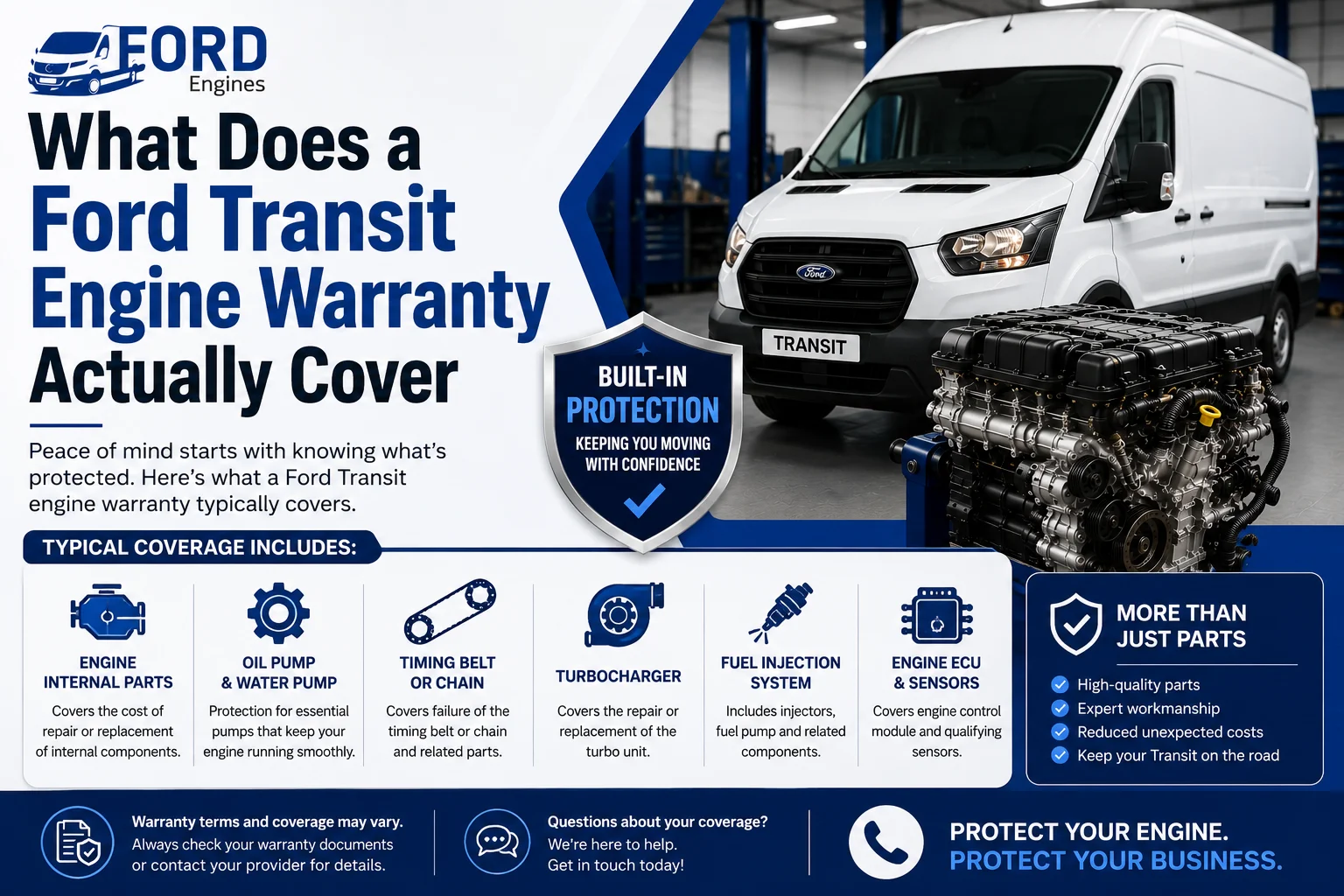
A Ford Transit engine warranty is essentially a promise: if a covered component fails within the warranty period through no fault of your own, the cost of repair or replacement is taken care of. But "covered" is doing a lot of work in that sentence, and it means something slightly different depending on who's providing the warranty.
Most engine warranties on replacement, reconditioned, or remanufactured Transit engines are built around three core promises, the parts are sound, the labour to fit them is included, and the whole job is backed by a guarantee if something goes wrong early.
Parts Covered Under Our Replacement Engine Warranty
A solid engine warranty should cover the major internal components that actually cause catastrophic failure when they go wrong, not just the easy, cheap-to-replace bits. That typically includes:
- Cylinder head and engine block, the two components most likely to cause a total write-off if they crack or warp
- Crankshaft and connecting rods, critical to the engine's rotating assembly
- Pistons and rings, covered against premature wear or failure
- Camshaft and timing components, including chains, and in some cases, belts
- Oil pump and water pump, both essential to keeping the engine lubricated and cool
- Bearings, a common failure point in high-mileage commercial engines
The strength of a warranty isn't just whether these parts are listed, it's whether the provider actually tests and inspects the engine before it leaves the workshop, so you're not relying on the warranty to catch a fault that should never have been fitted in the first place.
Is Labour Included in the Warranty?
This is where a lot of van owners get caught out. Some warranties cover parts only, meaning if your engine fails, you get a replacement component, but you're paying a garage's labour rate to have it fitted. On a Transit engine, that labour alone can run to several hundred pounds.
A genuine supply and fit warranty covers both. If a covered part fails, the cost of the part and the cost of having it professionally fitted are included. Before you commit to any warranty, whether it's a manufacturer warranty, an aftermarket warranty, or an extended plan, check this specific detail. It's usually written clearly, but it's often the difference between a warranty that actually protects you and one that just softens the blow.
Genuine OEM Parts vs Aftermarket Components
Not all replacement parts are equal, and this affects your warranty in ways that aren't always obvious.
OEM (Original Equipment Manufacturer) parts are made to the exact specification Ford originally used. They're built to fit and perform identically to the part they're replacing. Warranties built around OEM components tend to be more reliable simply because the parts have a known, consistent failure rate.
Aftermarket parts are made by third-party manufacturers. Some are excellent and virtually indistinguishable in quality. Others are budget alternatives that cut corners on tolerances or materials, and this is often where warranty disputes start, because a provider may argue a non-OEM part contributed to the failure.
If you're comparing quotes for a reconditioned or remanufactured Transit engine, always ask directly: are the internal components OEM, and is that documented anywhere? A reputable specialist will have no problem confirming this in writing.
What's Not Covered? Common Warranty Exclusions Explained
Every warranty has exclusions, and understanding them upfront saves a lot of frustration later. Typical exclusions across most Ford Transit engine warranties include:
- Wear and tear items,such as drive belts, hoses, and gaskets that degrade naturally over time and aren't considered a "failure"
- Damage from neglect, running the engine low on oil, ignoring warning lights, or continuing to drive after overheating
- Pre-existing faults, issues present before the engine was fitted, if they weren't disclosed
- Modifications, remapping, aftermarket turbo upgrades, or ECU tuning that alters the engine's original specification
- Accident damage, mechanical failure caused by a collision isn't an engine warranty issue, it's an insurance one
- Consequential damage in some cases, for example, if a warranty is parts-only and a failure damages a non-covered component
Read exclusions before you need them, not after. A five-minute check when you take out the warranty can save you a very expensive argument later.
Reconditioned vs Remanufactured vs Replacement Engine Warranties, What's the Difference?
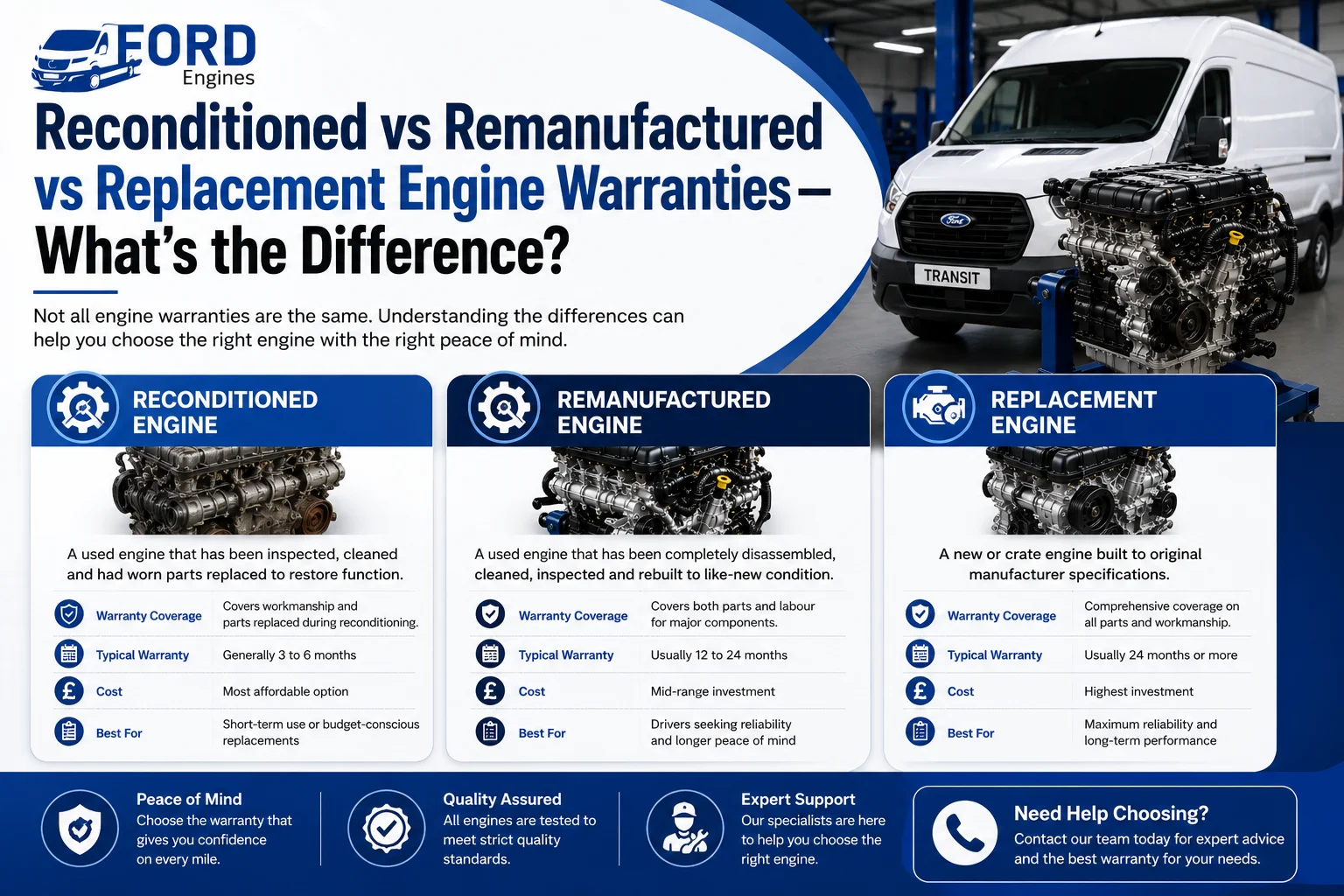
These three terms get used almost interchangeably in casual conversation, but they mean different things — and the differences directly affect how strong the warranty behind each one tends to be.
Engine Type | What It Means | Typical Warranty Strength |
| Replacement (used) | A tested, low-mileage engine taken from another vehicle | Moderate, depends heavily on mileage and provider testing |
| Reconditioned | An engine that's been stripped, inspected, and had worn components repaired or replaced | Good, most reputable reconditioners offer 6, 12 months as standard |
| Remanufactured | Fully rebuilt to original factory specification, often with all wear parts replaced regardless of condition | Strongest, commonly backed by 12, 24 month warranties due to consistent quality control |
Reconditioned Ford Transit Engine Warranty Explained
A reconditioned engine has typically been dismantled, cleaned, inspected component by component, and had any worn or damaged parts replaced. It's not a brand-new build, it's a targeted repair of an existing unit to bring it back to a reliable working standard.
Because the quality can vary depending on how thorough the reconditioning process was, the warranty attached to it matters more here than almost anywhere else in this guide. A reconditioned engine with a genuine 6 to 12 month warranty backed by proper testing documentation is a very different proposition to one sold with a vague, unverifiable guarantee.
Remanufactured vs Rebuilt Engine Warranty: Which Is Stronger?
"Remanufactured" generally implies a more rigorous process than "rebuilt." A remanufactured engine is typically restored to the original manufacturer's tolerances and specifications, often with every wear-prone component replaced as standard, not just the parts that failed.
This consistency is exactly why remanufactured engines tend to carry longer, more confident warranties. There's less variability in the outcome, so there's less risk for the provider to price into the warranty, and that usually translates into better cover for you.
If you're comparing two quotes and one is noticeably cheaper, it's worth asking directly whether the engine is reconditioned or remanufactured. The terminology isn't just semantics, it reflects a real difference in process and, ultimately, in how much you can trust the warranty behind it.
Ford Transit Custom & EcoBlue Engine Warranty Cover
The Ford Transit Custom, particularly models fitted with the EcoBlue diesel engine, has some specific warranty considerations worth knowing about. The EcoBlue range replaced the older Duratorq engines and introduced some design changes, most notably around the timing drive, that directly affect what a warranty needs to cover.
A warranty on an EcoBlue-equipped Transit Custom should clearly state whether it includes the timing drive system, the turbocharger, and the fuel injection components, since these are among the higher-risk areas on this engine family.
Does the Warranty Cover Wet Belt & Turbo Failures?
This is one of the most searched, and most misunderstood, questions relating to newer Ford Transit and Transit Custom engines.
Certain EcoBlue engines use a wet belt, a timing belt that runs in oil rather than dry, as older timing belts did. It's a design choice Ford made for efficiency reasons, but wet belts have developed a reputation for premature failure if servicing intervals aren't followed precisely, and a failure here can cause catastrophic engine damage.
Whether wet belt failure is covered depends entirely on the specific warranty terms, and this is genuinely one of the most important questions to ask before you buy. Some warranties exclude wet belt failure outright, treating it as a maintenance item. Others cover it fully, provided the belt was replaced at the correct interval and you can show the paperwork.
Turbocharger failure is a similar story. Turbos work under extreme heat and pressure, so they're a known wear point, but a genuine failure caused by a manufacturing or fitting fault should be covered under any proper engine warranty. Always confirm this specifically rather than assuming it's included.
How Long Does a Ford Transit Engine Warranty Last?
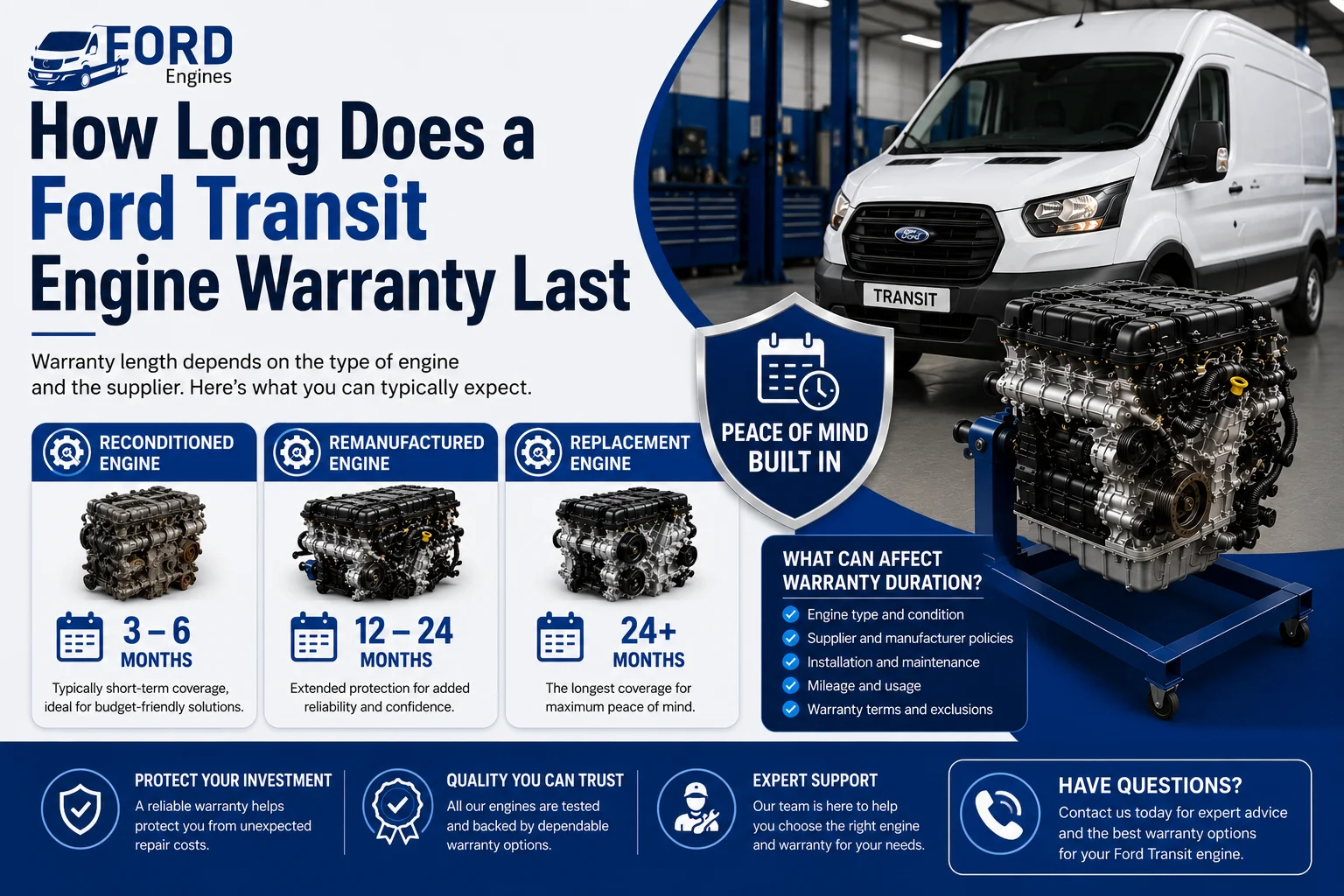
Warranty length is one of the biggest factors in deciding whether a deal is genuinely good value or just looks that way on paper. A shorter warranty on a cheaper engine isn't automatically worse, but you need to understand what you're trading off.
6, 12 & 24-Month Engine Warranty Options Compared
Here's how the most common Ford Transit engine warranty durations typically compare:
Warranty Length | Best Suited For | What to Watch For |
| 6 months | Budget-conscious repairs, older vans nearing end of commercial life | Shorter window to catch early failures, get it inspected soon after fitting |
| 12 months | Most reconditioned engines, standard commercial use | The most common "sweet spot", long enough to catch most early faults |
| 24 months | Remanufactured engines, vans expected to stay in service long-term | Usually reflects higher confidence in build quality, but check mileage caps |
A shorter warranty isn't necessarily a red flag, it might reflect an older or higher-mileage engine being sold honestly at a lower price point. What matters is that the length matches your expectations and the vehicle's realistic lifespan.
Supply and Fit Warranty vs Standalone Engine Warranty
A supply and fit warranty covers the engine and the labour to install it as one package, usually from a single provider who both sources the engine and carries out the fitting. This tends to be the most straightforward option because there's one point of contact if something goes wrong.
A standalone engine warranty, by contrast, covers only the engine itself. If you're sourcing the engine separately and having an independent garage fit it, you'll want to check whether the warranty remains valid regardless of who does the fitting, some providers require approved installers, and using an unapproved garage can void the cover entirely.
Ford Manufacturer Warranty vs Our Extended Engine Warranty
It's worth being clear about the difference between Ford's manufacturer warranty and a specialist extended engine warranty, because they serve different purposes.
Ford's manufacturer warranty on a new Transit typically covers manufacturing defects for a set period from the vehicle's original registration date. Once that period ends, or once you've had an engine replaced with a reconditioned or remanufactured unit, the manufacturer warranty either no longer applies to that component or was never designed to cover it in the first place.
An extended engine warranty, whether purchased alongside a replacement engine or as separate cover for an ageing vehicle, is built specifically to bridge that gap. It's not a substitute for the manufacturer warranty on a new vehicle; it's protection for vehicles and components that have moved beyond that original cover.
Can You Extend Your Ford Transit Engine Warranty?
In many cases, yes. Some providers offer the option to extend cover at or before the point the original warranty expires, provided the engine has been maintained according to the required service schedule and there's no unresolved fault at the time of renewal. If long-term cover matters to you, particularly for a van that's central to your business, it's worth asking about extension options before you commit to the initial warranty term, rather than waiting until it's about to lapse.
How to Claim Your Warranty (and Keep It Valid)
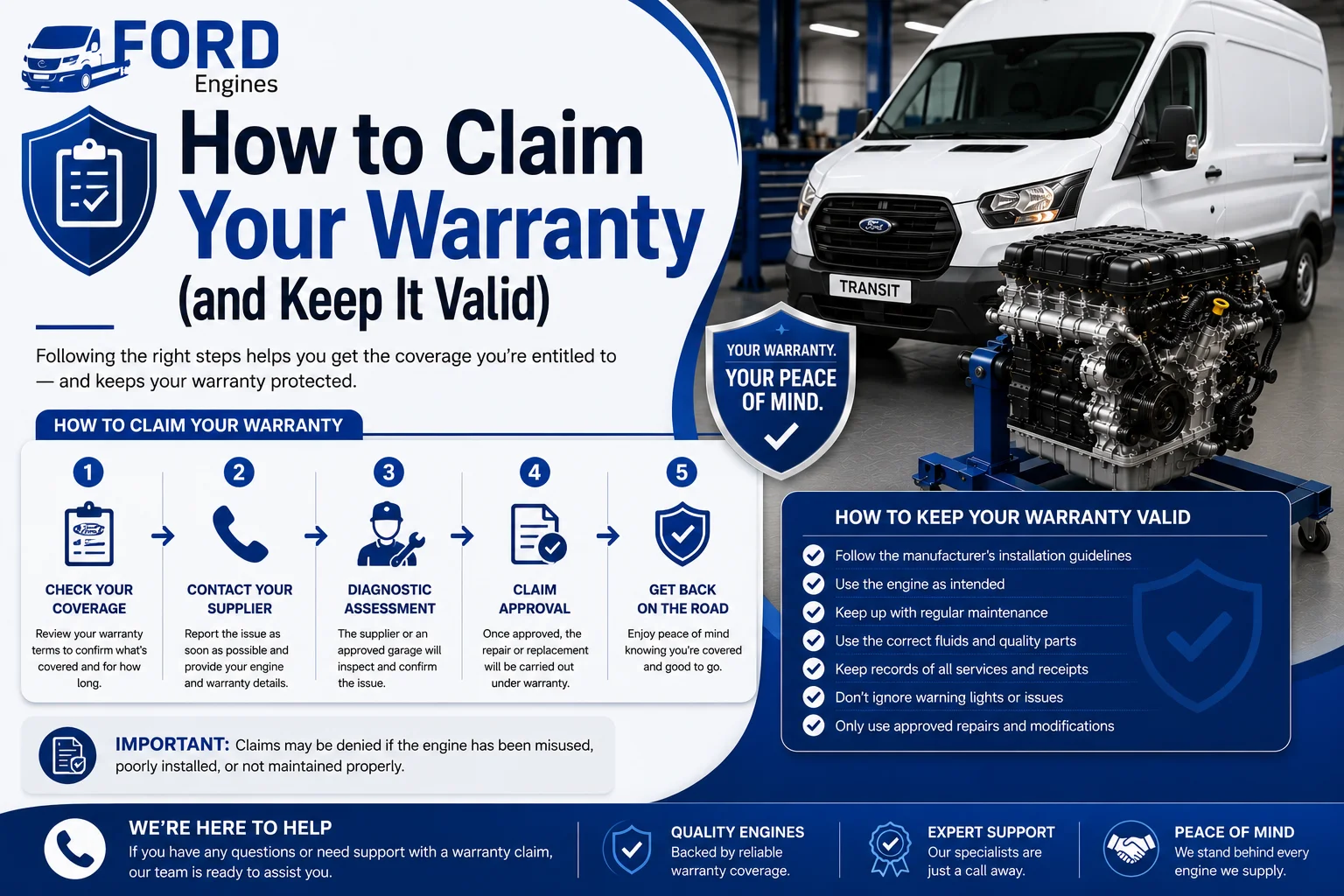
A warranty is only as good as your ability to actually use it. This section covers exactly what happens during a claim, and, just as importantly, what can stop a valid claim from being approved.
Step-by-Step: How to Make a Warranty Claim
Step 1: Stop driving and report the fault. The moment you notice a serious warning sign, knocking, loss of power, warning lights, unusual smoke, stop driving and report it. Continuing to drive on a developing fault is one of the most common reasons claims get partially or fully rejected.
Step 2: Get the fault diagnosed. The provider will usually need a proper diagnostic assessment to confirm the cause of the failure and whether it falls under covered components. This is normally done by the original fitter or an approved garage.
Step 3: Submit your claim with supporting documentation. This includes your warranty document, proof of the fault, and your maintenance records (more on this below).
Step 4: Approval and repair. Once approved, the repair is carried out, either by the original provider or an approved garage, depending on your warranty type.
Step 5: Back on the road. You collect the van, ideally with documentation confirming the work carried out and any updated warranty terms going forward.
Documentation & Service History You'll Need
Warranty providers aren't being difficult when they ask for paperwork, they're confirming the failure wasn't caused by neglect. Keep these on hand:
- Service records showing the van has been maintained at the recommended intervals
- Oil change history, since low or degraded oil is one of the leading causes of claim rejection
- The original warranty document or booklet, with registration details completed
- Any previous repair invoices relevant to the engine or related systems
- MOT history, which can support the timeline of the vehicle's condition
A missing service stamp doesn't automatically void a claim, but it does make the process slower and gives the provider grounds to question it. Keeping digital copies of everything, not just the physical booklet, is a simple habit that pays off if you ever need to claim.
How Long Does a Warranty Claim Take to Process?
Most straightforward claims, where the fault is clearly covered and documentation is in order, are assessed within a few working days. More complex cases, where the cause of failure needs closer investigation, can take longer. If your van is off the road, ask upfront about any provisions for onward travel or a replacement vehicle while the claim is processed, as some warranty packages include this and others don't.
What Voids Your Ford Transit Engine Warranty?
Knowing what invalidates a warranty is arguably more useful than knowing what it covers, because these are the mistakes that are entirely avoidable:
- Missed servicing, running past the recommended service interval, even by a small margin, is one of the most common reasons claims are refused
- Continuing to drive after a warning sign, this is treated as contributing to the damage, not just failing to prevent it
- Using an unapproved garage for fitting or repairs, where the warranty specifies approved installers
- Unauthorised modifications, remapping or performance modifications almost always void cover
- Using the wrong oil or fluid specification, Ford Transit engines, particularly EcoBlue variants, have specific oil requirements
- Failure to register the warranty where registration within a set period is a condition of the cover
None of these are unreasonable requirements, they exist because warranty providers need some assurance the failure wasn't preventable. The good news is every one of them is within your control.
Get a Free Ford Transit Engine Warranty Quote Today
If your Transit's engine has failed, or you're planning ahead before it does, the smartest move is understanding your options before you're under pressure to decide quickly. A properly sourced replacement, reconditioned, or remanufactured engine, backed by a warranty that actually covers parts, labour, and the components most likely to cause you problems, is worth far more than the cheapest quote on paper.
Get in touch for a free, no, obligation quote tailored to your Transit's engine and mileage, and we'll walk you through exactly what's covered before you commit to anything.
Frequently Asked Questions
What does a Ford Transit engine warranty cover?
Most engine warranties cover the major internal components, cylinder head, block, crankshaft, pistons, camshaft, and pumps, along with the labour to fit a replacement if a covered part fails. Always confirm whether labour is included, as some warranties are parts-only.
How long does an engine warranty last?
Typically between 6 and 24 months, depending on whether the engine is reconditioned or remanufactured, and depending on the provider. Longer warranties are more common on remanufactured engines due to their more consistent build quality.
Is labour included in a Ford Transit engine warranty?
Not always. A supply and fit warranty includes labour; a standalone parts warranty usually doesn't. Check this specifically before purchasing.
Does servicing affect my warranty?
Yes. Missing a scheduled service, or using the wrong oil specification, is one of the most common reasons a claim is rejected. Keep full service records for the life of the warranty.
Is a wet belt failure covered under warranty?
It depends on the provider and the specific terms. Some warranties exclude wet belt failure as a maintenance item; others cover it if the belt was replaced at the correct interval with documented proof.
Can a Ford Transit engine warranty be transferred if I sell the van?
Some warranties are transferable to a new owner, which can be a useful selling point; others are tied to the original purchaser. Check the specific terms of your warranty document.
Is a remanufactured engine better than a used replacement engine?
Generally, yes, in terms of consistency and warranty strength. A remanufactured engine is rebuilt to original specification with wear parts replaced as standard, whereas a used replacement engine's condition depends entirely on its prior history and mileage.
What's the difference between a manufacturer warranty and an aftermarket warranty?
A manufacturer warranty covers original components for a set period from the vehicle's registration date. An aftermarket or extended warranty is separate cover, typically purchased for a replacement engine or a vehicle that has moved beyond its original manufacturer cover.
Final Thoughts
A Ford Transit engine warranty isn't just paperwork you file away and forget, it's the thing standing between you and a repair bill that could take your van off the road for weeks. The stronger and more transparent the warranty, the less that failure actually costs you, in money and in downtime.
If you're weighing up a reconditioned, remanufactured, or replacement engine for your Transit, get a straight answer on what's covered before you commit. Get your free Ford Transit engine warranty quote today and drive away knowing exactly where you stand.