
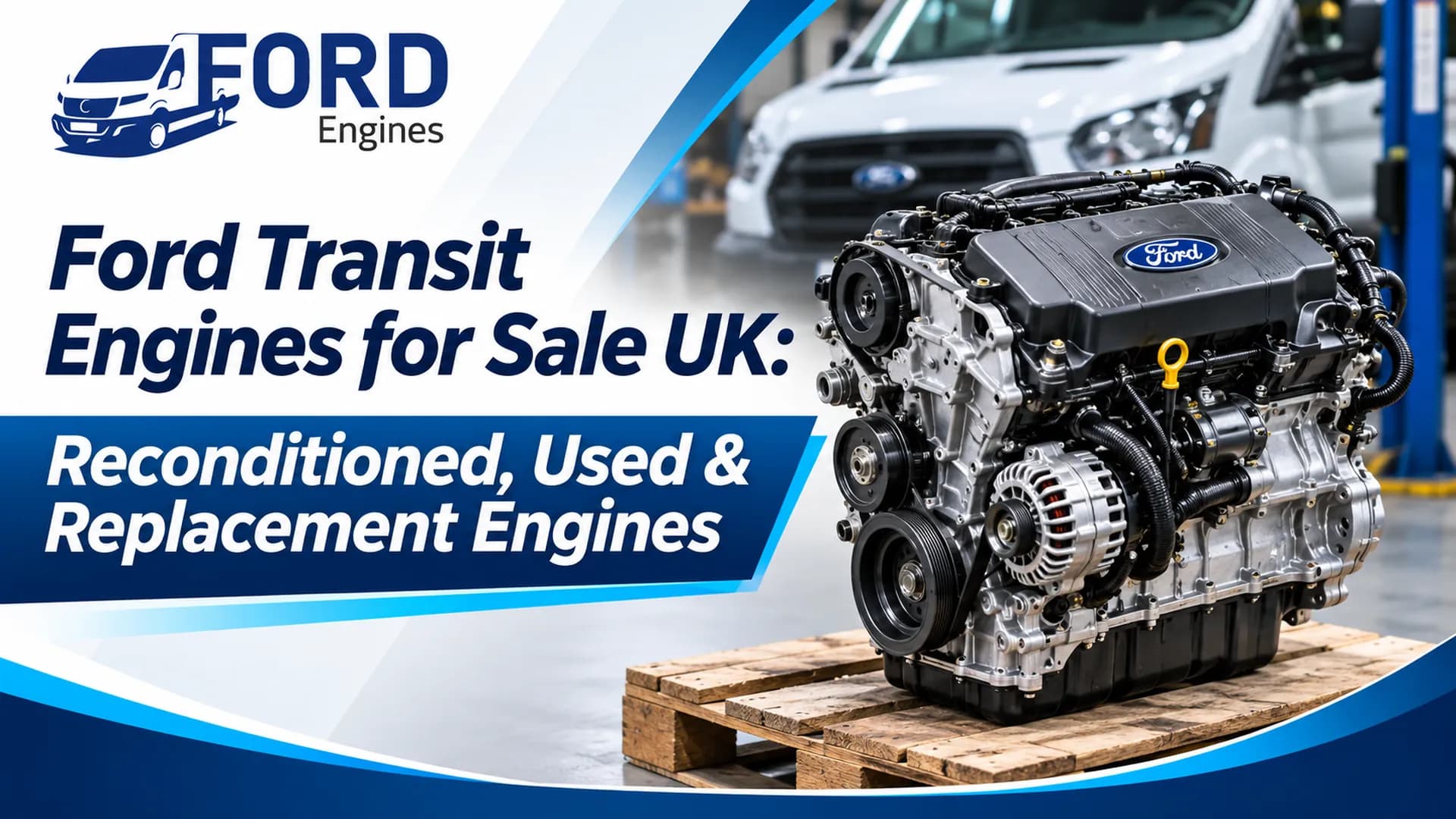
Your Transit is not a hobby. It is a workshop on wheels, a delivery round, or the thing that gets the crew to site by seven. When the engine fails, the van stops earning, and every day on the driveway costs you more than the repair itself.
A Ford Transit replacement engine is often the fastest way to get that income back. At Ford Engines, we supply reconditioned Ford Transit engines, tested used units and rebuilt options across the UK. You can choose supply-only, or a Ford Transit engine supply and fit service that puts the work under one roof. Every enquiry starts with a compatibility check on your exact van, because the right engine is the one that matches your specification, not just your capacity.
If you are searching for a Ford Transit engine specialist UK buyers can trust, this page walks you through matching the right engine to your van, choosing between used and reconditioned, and how our supply and fitting service works from first call to the road.
Which Ford Transit Engine Does Your Van Need?
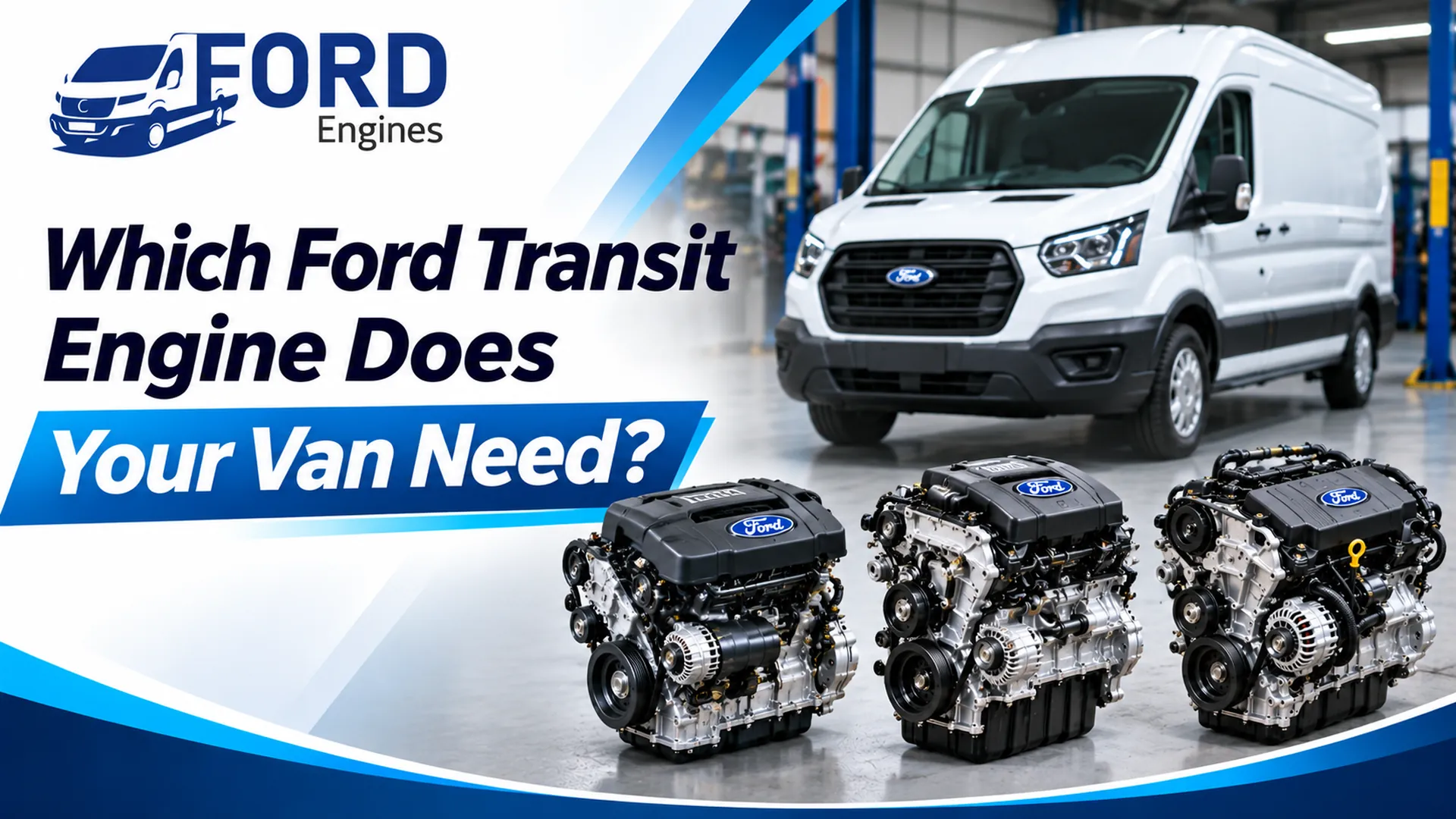
Most modern Transits run on diesel, and they fall into two main families. The Duratorq TDCi engines, including the 2.2, 2.4 and 3.2, power the Mk6 and Mk7 era vans. The 2.0 EcoBlue took over on the Mk8 and the Transit Custom, with newer emissions technology. Each family has its own components, so each needs its own replacement approach.
The short answer is that your Ford Transit engine is defined by its code, drivetrain and emissions specification, not by size alone. Two engines with the same capacity can differ in power output, ancillaries and ECU requirements. That is why we never quote on capacity alone.
How Do You Find Your Ford Transit Engine Code and Check Compatibility?
Finding the code takes a few minutes. Work through these steps:
- Check the engine itself. The identification number is stamped or labelled on the engine. Your garage can read it quickly if you cannot reach it.
- Check your paperwork. The V5C lists your engine capacity and fuel type, which narrows the options.
- Send us your registration or VIN. We match your van's build details against our stock.
- Note the supporting details. Model year, power output, front or rear-wheel drive, and Euro 4, Euro 5 or Euro 6 emissions standard all affect compatibility.
Once you have those details, send us your registration and we will run a Ford Transit engine compatibility check before you commit to anything. It is the single best way to avoid ordering the wrong unit.
What Engines Were Fitted to the Transit Mk6, Mk7, Mk8 and Custom?
This table shows the broad picture by generation. We confirm the exact engine and code against your van before supplying anything.
Generation | Typical engines | Engine family | Drive layout | Emissions context |
| Mk6 | 2.0 and 2.4 diesel | Duratorq TDCi and TDDi | FWD and RWD | Euro 3 and Euro 4 |
| Mk7 | 2.2 and 2.4 TDCi, plus 3.2 TDCi | Duratorq TDCi | FWD and RWD | Euro 4 and Euro 5 |
| Mk8 | 2.0 EcoBlue | EcoBlue | FWD, RWD and AWD | Euro 6 |
| Transit Custom | 2.0 EcoBlue | EcoBlue | FWD, with AWD on some versions | Euro 6 |
Our dedicated pages for the Ford Transit 2.0 EcoBlue engine, the Ford Transit 2.2 TDCi engine and the Ford Transit 2.4 TDCi engine list the units we currently hold, and they are the quickest route to available stock. We list engine codes on those pages only where we have confirmed them against our own records.
Can a Different Engine Code Fit Your Transit, and What About FWD vs RWD?
Sometimes, yes. But a matching capacity is never enough on its own.
A different code can be a workable replacement when the power output, drivetrain, ancillaries, ECU and emissions specification all line up with your van. It can also be an expensive mistake when they do not. The front-wheel drive and rear-wheel drive versions of the same capacity are a classic trap. They look similar on a listing, but the mounting points, flywheel and ancillaries can differ.
Before accepting any alternative, we check:
- Drivetrain match, because FWD and RWD units are not interchangeable by default
- Power output, since the same capacity is sold in several outputs
- Emissions specification, especially where a DPF, EGR system or Euro 6 hardware is involved
- ECU and immobiliser compatibility, because the control unit often has to match the engine
- Ancillary fitment, including the turbocharger, injectors, sensors and mounts
If an alternative is genuinely compatible, we explain why. If it is not, we say so and find the right engine instead.
Should You Buy a Used, Reconditioned or Rebuilt Ford Transit Engine?
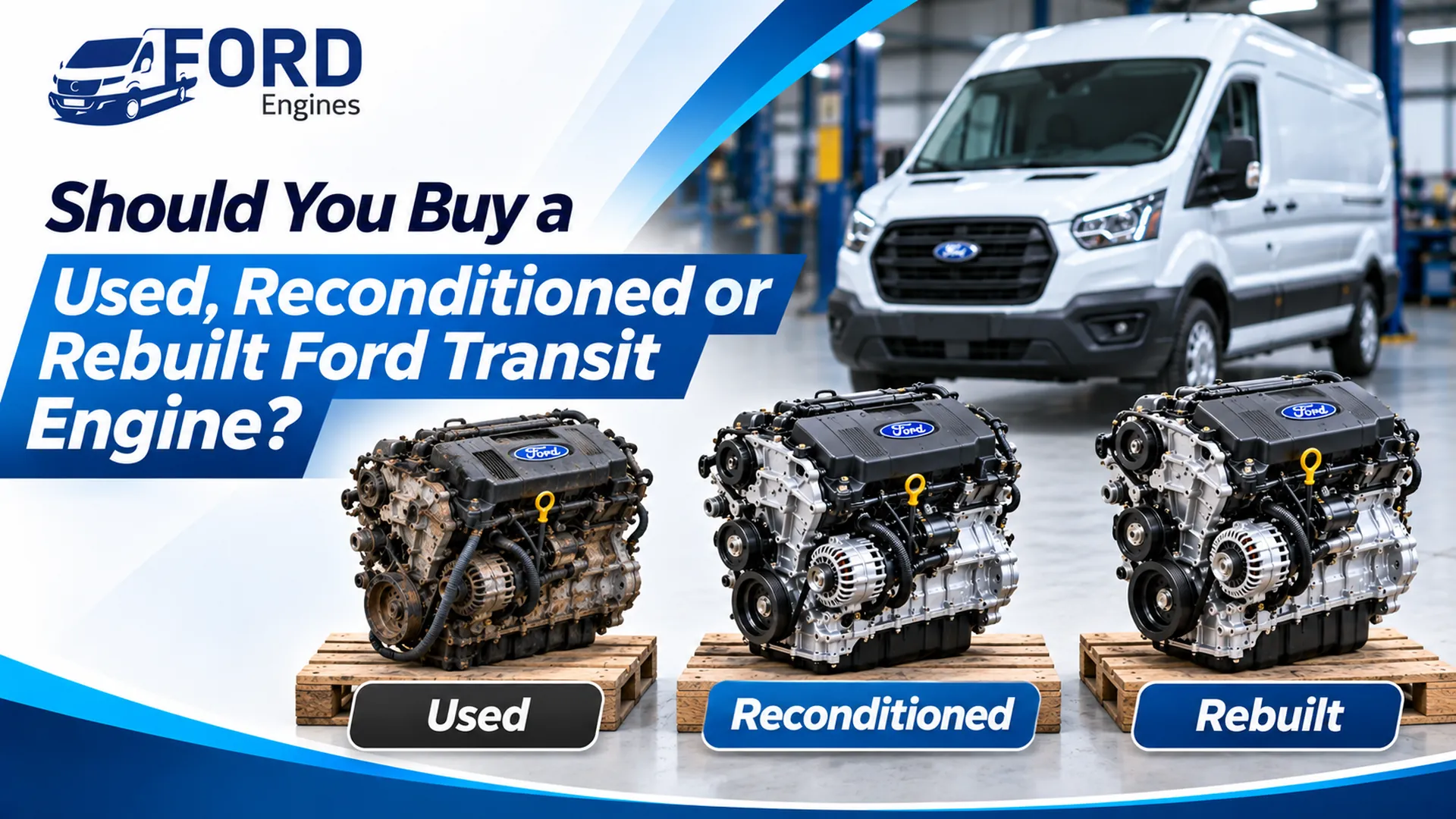
All three routes put a working engine back in your van. The right one depends on your budget, how hard the van works, and how long you plan to keep it.
A used Ford Transit engine is a complete unit from a donor vehicle that has been inspected and tested. A reconditioned Ford Transit engine, sometimes called a rebuilt engine, has been stripped, checked, machined where needed and reassembled with worn parts renewed. A remanufactured engine follows a similar process, usually to a more formal repeatable standard. Here is how they compare.
Used engine | Reconditioned or rebuilt engine | |
| What it is | Complete engine from a donor van, tested | Engine stripped, inspected, machined and rebuilt with worn parts renewed |
| Best for | An older van where you need a sensible fix | A working van you plan to keep and rely on |
| Condition | Depends on the donor and its mileage | Brought back to a rebuilt standard |
| Testing | Compression and condition checks | Inspection at every stage, then final testing |
| Warranty | Options available | Options available |
| Our verdict | Good value for a few more years of service | The stronger choice for long-term, high-use vans |
What Happens During Reconditioning?
Knowing what a reconditioned engine actually involves helps you judge any supplier. The process follows these stages:
- Stripping and inspection. The engine is taken apart and every component is checked for wear and damage.
- Cylinder head pressure testing. The head is tested for cracks and leaks before it is reused.
- Block cleaning and machining. The cylinder block is cleaned, checked and machined, including honing or reboring where the bores need it.
- Crankshaft inspection. The crankshaft is checked, ground or polished as needed, and bearings are renewed.
- Piston and ring replacement. Pistons and rings are renewed or replaced where wear is found.
- Oil pump and timing components. These are renewed so the lubrication and timing systems start fresh.
- Assembly and testing. The engine is reassembled to specification and tested before it leaves the workshop.
Each step exists for a reason. Skipping any of them is how engines come back with problems.
Our straightforward advice: if your Transit works hard every day and you plan to keep it, a reconditioned engine is usually the safer long-term choice. If the van is older and you need a dependable fix, a tested used engine can make good sense.
What Causes Ford Transit Engine Failure, and Is Replacement Worth It?
Most engines do not fail without warning. The signs are usually there for a while: knocking on start-up, loss of power, a warning light, smoke from the exhaust, overheating or a falling oil pressure reading. Catching these early gives you more options.
The most common causes of failure we see include:
- EcoBlue wet belt failure. The 2.0 EcoBlue uses a timing belt that runs in oil. If that belt degrades, fragments can reach the oil pump and strainer, which can starve the engine of lubrication.
- Turbocharger failure. A failing turbo can contaminate oil and cause secondary engine damage.
- Fuel injector faults. These upset combustion and, left alone, can damage cylinders.
- Overheating. Coolant loss can damage the cylinder head and head gasket.
- Oil starvation. Low oil level or pressure can damage crankshaft bearings and other internal parts.
- EGR and DPF problems. Emissions hardware can cause power loss and, in some cases, contribute to wider engine trouble.
Here is a practical way to think about the decision. If the damage is limited, a repair may be enough. If the bottom end is damaged, as it often is after oil starvation or a wet belt failure, replacement is usually the more sensible route. A good installer will also investigate why the original engine failed, so the new one does not meet the same fate.
The total cost of replacement depends on several factors:
- The engine itself. Used, reconditioned and rebuilt units differ, as do EcoBlue and TDCi engines.
- Supply-only or supply and fit. Fitting adds labour but places the whole job under one warranty.
- Fluids and service parts. A fresh engine deserves new oil, coolant, filters and the correct timing components.
- Ancillary components. Turbochargers, injectors, water pumps and mounts may need replacing alongside the engine.
- VAT and delivery. These are itemised so nothing surprises you.
- Warranty level. Broader or longer cover is an extra worth considering for a van that earns its keep.
We put all of this into a clear Ford Transit engine replacement quote, itemised line by line. Send us your registration and we will tell you exactly what is included before you say yes. Our guide to Ford Transit engine replacement cost in the UK explains each factor in more depth.
How Does Our Ford Transit Engine Supply and Fit Service Work?
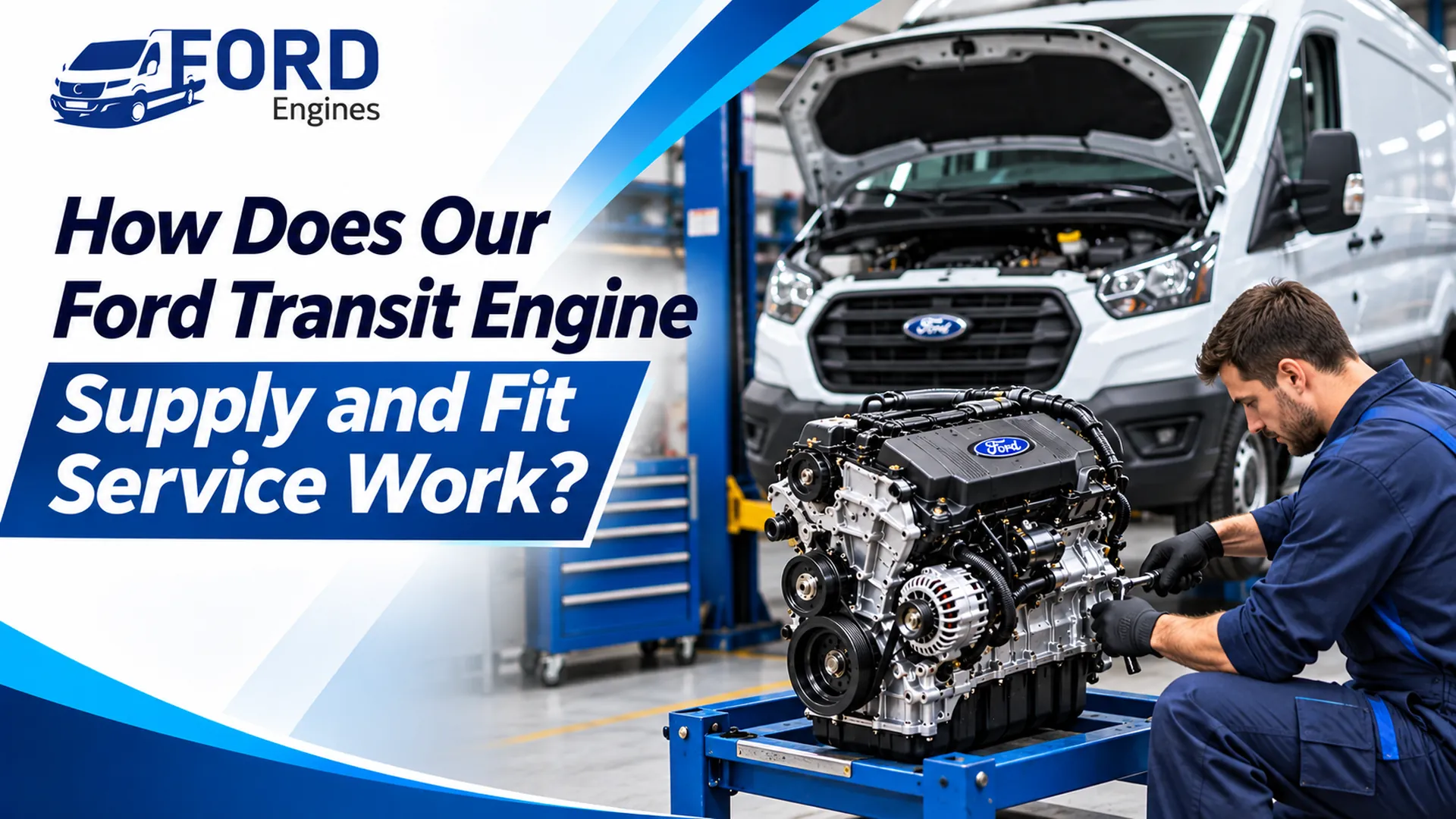
Replacing an engine should not feel like a gamble. Our process is built to remove guesswork at every stage.
- Enquiry. You send us your registration, or call us with your engine details.
- Compatibility check. We match your van against our stock and confirm the right engine code.
- Quote. You receive a clear quote for supply-only or supply and fit.
- Engine preparation. The chosen unit is inspected and tested before it leaves us.
- Delivery or fitting. We deliver across the UK to your garage or business address, or arrange fitting where you choose our service.
- Post-installation checks. The engine is checked after installation, including fluid levels, running condition and warning lights.
Fitting is worth serious thought. A perfectly good engine can still be let down by a poor installation, and seals, ancillaries and ECU matching all affect how the new unit performs.
Planning around downtime. For a working van, speed matters. Tell us at the enquiry stage that the van is off the road, and we will give you a realistic timescale rather than a promise we cannot keep. If you run a fleet and need several Transit engines replaced, we can plan the work in stages so you are never without every vehicle at once.
A typical scenario. A tradesman's Mk8 Transit stops on the way to a job with the oil pressure light on. A garage finds a wet belt failure has damaged the engine. He sends us his registration, we confirm the correct 2.0 EcoBlue unit, quote supply and fit, and the van returns to work with the new engine installed and checked.
What Testing, Warranty and Delivery Come with Every Engine?
You should never have to take an engine on trust. Before one of our units is supplied, it goes through checks that include:
- Compression testing, to confirm the cylinders are sealing properly
- Cylinder head pressure testing, to catch cracks and leaks
- Oil pressure checks, to confirm the lubrication system is healthy
- Coolant and head gasket checks, to rule out hidden leaks
- Inspection for knocking, smoke and unusual noises, the signs that an engine is not worth supplying
Warranty cover, exclusions and delivery arrangements depend on the engine and the service you choose, and we set them out in writing with your quote. You see the terms before you commit, not after. We deliver across the UK, and where you choose fitting, we handle that too.
Frequently Asked Questions About Ford Transit Engines
How long does a Ford Transit engine last?
A well-maintained Transit diesel can run well beyond 150,000 miles. Regular oil changes, the right oil specification and timely attention to timing components make the biggest difference.
What is the difference between EcoBlue and TDCi?
TDCi engines belong to the Duratorq family used in earlier Transits. The EcoBlue is the newer 2.0 diesel with updated emissions technology and a wet timing belt, fitted to the Mk8 and Transit Custom.
Does the engine code need to match exactly?
In most cases, yes. A different code can work only where power output, drivetrain, ECU, emissions specification and ancillaries all align. We confirm this before supplying anything.
Does a replacement engine come with a warranty?
Warranty options are available on our used, reconditioned and rebuilt engines. We confirm the exact terms and exclusions in writing with your quote.
Can you supply and fit, or supply only?
Both. You can have the engine delivered to your own garage, or choose our supply and fit service for a single point of contact.
How long does a Transit engine replacement take?
It depends on the engine, the van and the work involved. We give you a realistic timescale when we confirm your quote.
Is a used or reconditioned Transit engine better?
For a hard-working van you plan to keep, reconditioned is usually the stronger choice. For an older van, a tested used engine can offer sensible value.
Can a damaged Transit engine be rebuilt instead of replaced?
Sometimes. If the damage is contained, rebuilding can work. Where the block, crankshaft or several internal parts are affected, replacement is often more practical.
Get Your Transit Back to Work
A failed engine does not have to mean a failed van. With the right Ford Transit engine, matched to your exact specification, properly tested and backed by clear written warranty terms, your Transit can get back to earning.
Get a Ford Transit engine quote today. Send us your registration, tell us whether you want supply-only or supply and fit, and our team will come back with a compatible engine and an itemised quote. Prefer to talk it through? Call us and speak to someone who handles Ford engines every day.